
The multi store model of memory explains memory as three distinct stores: sensory memory, short-term memory and long-term memory. Atkinson and Shiffrin proposed that attention moves information into short-term memory, rehearsal helps retain and transfer it, and retrieval brings stored information back into conscious awareness.
It sounds simple. That simplicity is its strength, but also the source of its limitations. For IB Psychology, you need to do more than reproduce three boxes and a few arrows. You must explain the processes, connect research to the model and evaluate what the evidence can genuinely establish.
The model at a glance
Your minimum revision checklist is:
- Sensory register: briefly receives information through different senses.
- Attention: selects information for short-term memory.
- Short-term memory: has limited duration and capacity.
- Rehearsal: maintains information and can support transfer to long-term memory.
- Long-term memory: provides relatively durable, extensive storage.
- Retrieval: returns information from long-term storage to short-term memory.
- Supporting evidence: Glanzer and Cunitz's serial-position research.
- Evaluation: the model is clear and testable, but may oversimplify memory stores and transfer.
RevisionDojo's IB Psychology models of memory notes provide a useful companion when turning this checklist into complete explanations.
How the multi store model of memory works
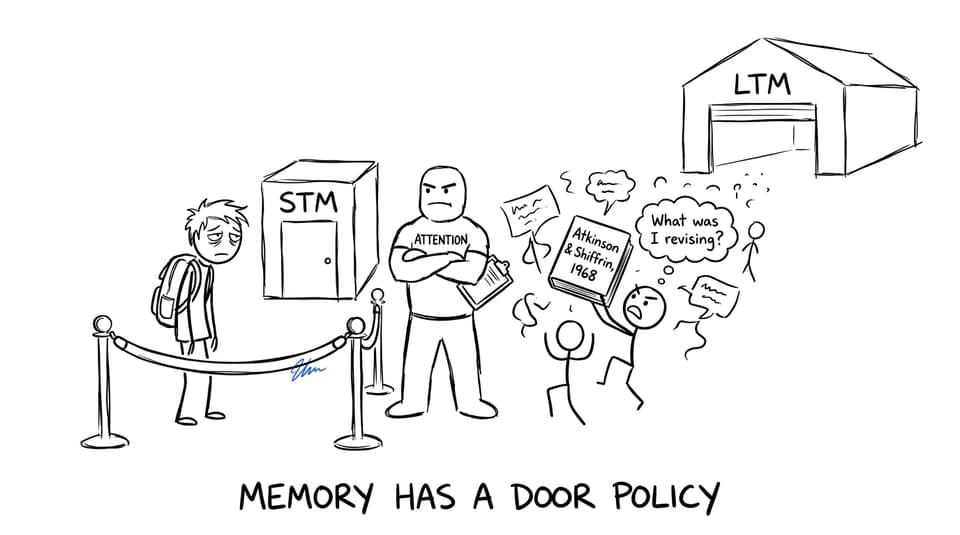
Atkinson and Shiffrin's 1968 framework distinguishes between structural stores and the control processes used to manage information. That distinction matters. The stores are the places represented in the model; attention, rehearsal and retrieval describe what happens between or within them.
Sensory register
Environmental stimulation first reaches modality-specific sensory registers. Visual information can be held as iconic memory, while auditory information can be held as echoic memory. Sensory information is fleeting: unless selected through attention, it rapidly becomes unavailable.
Imagine hearing your teacher announce an essay deadline while you are reading a notification. The sound reaches sensory memory, but if you do not attend to it, the date may never enter short-term memory. The model therefore treats attention as a filter rather than a guarantee of lasting learning.
Short-term memory
Short-term memory temporarily holds the information currently being processed. The original model describes it as limited in capacity and duration, with unrehearsed information becoming vulnerable to loss after a short period.
Miller's familiar estimate of seven, plus or minus two, is often taught alongside the model. Treat it as a historically influential estimate, not an unquestionable biological limit. Later research has produced lower estimates under some conditions because capacity depends on factors such as chunking and the type of material.
Rehearsal can maintain material in this store. Repeating “Atkinson and Shiffrin, 1968” may keep it active, but repetition alone does not prove that you understand why the model matters.
Long-term memory and retrieval
Long-term memory is presented as a relatively permanent store with very large capacity. Information is recovered through retrieval and returned to short-term memory, where it becomes available for active use.
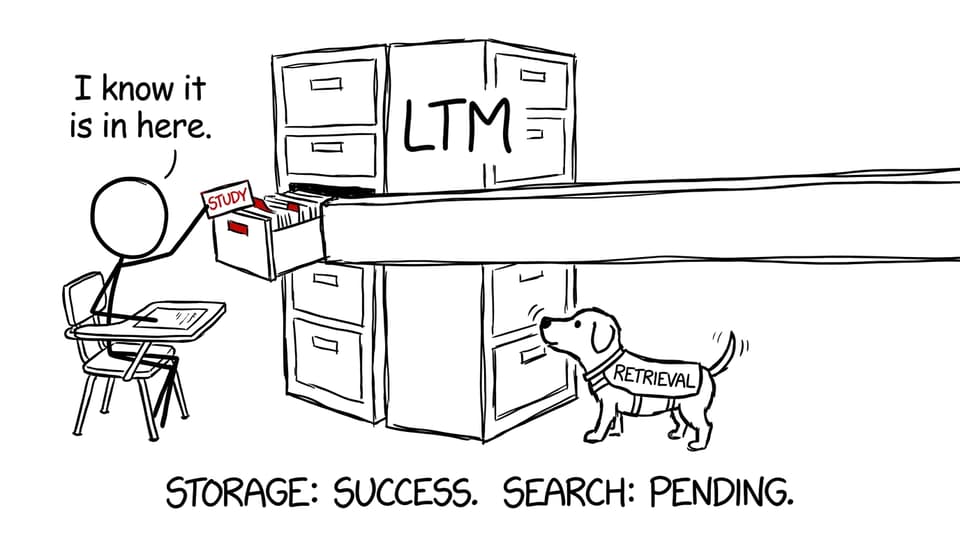
Consider an exam question about models of memory. You read the command term through sensory systems, attend to it and hold the wording in short-term memory. Relevant concepts and studies are then retrieved from long-term memory. Failure to answer does not necessarily mean the knowledge was never stored; the immediate problem may be finding the appropriate retrieval route.
Use RevisionDojo's models of memory flashcards to practise retrieval rather than simply rereading definitions.
Research evidence you can use
Glanzer and Cunitz's 1966 experiments investigated the serial-position effect, in which people tend to recall items near the beginning and end of a list better than items in the middle.
The model explains the primacy effect by proposing that early items receive more rehearsal and are more likely to enter long-term memory. The recency effect occurs because the final items may remain in short-term memory when recall begins. When recall was delayed using a distracting activity, the recency effect was reduced while the primacy effect remained. This pattern is consistent with separate short-term and long-term stores.
That final phrase is important: consistent with is more defensible than proves. A controlled laboratory task can isolate variables, but recalling word lists is narrower than remembering lessons, relationships or autobiographical events. Alternative explanations and later memory models also remain possible.
RevisionDojo's recency-effect Psychology IA exemplar can help you see how this theory becomes an operationalized investigation. Use exemplars to understand decisions and criteria, never as material to reproduce.
Strengths and limitations worth evaluating
The model gave cognitive psychologists a clear, testable account of memory. Its separation of short-term and long-term storage is supported by serial-position findings, especially when a delay selectively disrupts recency. It also recognizes active control processes rather than portraying a person as a completely passive container.
However, the model risks making each store look unitary. Short-term processing can involve different forms of information and different tasks, while long-term memory includes more than one kind of knowledge. Treating rehearsal as the principal path to durable storage is also too simple: meaning, organization and prior knowledge can influence retention, while repeated material can still be forgotten.
A strong evaluation therefore avoids declaring the whole model either correct or obsolete. A better judgment is that it provided a productive structural foundation, but later accounts offer more detailed explanations of working memory and long-term systems.
How to answer an IB Psychology exam question
IB Psychology has a syllabus transition: the previous course has its final assessment in 2026, while the revised course begins assessment in 2027. Exact paper structures and command-term expectations therefore depend on your exam session. Confirm your route with your teacher, then use the relevant IB Psychology resources.
Suppose the question asks: “Explain one model of memory, using one relevant study.”
A focused response could follow this plan:
- Define the model: identify Atkinson and Shiffrin and the three stores.
- Explain the mechanism: trace information through attention, rehearsal and retrieval.
- Introduce research: state the aim and procedure of Glanzer and Cunitz.
- Report the relevant finding: delayed recall weakened recency more than primacy.
- Make the link explicit: explain why this is consistent with separate short-term and long-term stores.
- Return to the question: conclude what the model helps explain.
A useful worked link might read:
The delayed distraction task reduced the recency effect because the final words were no longer available in short-term memory. The continued primacy effect suggests that earlier words had entered longer-term storage. The different effects of delay are therefore consistent with the model's distinction between short-term and long-term stores.
Notice what this does not do: it does not merely describe the procedure and hope the examiner finds the connection. The final sentence converts research knowledge into an answer.
Practise this structure in the IB Psychology cognitive-processing Questionbank, then compare your organization with RevisionDojo's Psychology exam strategy guide. For extended evaluation, the IB Psychology ERQ rubric guide helps distinguish description from genuine critical thinking.
Common exam mistakes
- Listing without explaining: naming three stores is not an account of information flow.
- Confusing stores and processes: attention and rehearsal are control processes, not additional stores.
- Overstating evidence: one laboratory finding supports an interpretation; it does not conclusively prove the complete model.
- Using numbers as absolute facts: capacity and duration estimates vary with task conditions.
- Describing a study without linking it: every finding should answer “How does this support or challenge the model?”
- Giving one-sided evaluation: clarity and testability can coexist with oversimplification.
- Ignoring the command term: “explain,” “discuss” and “evaluate” require different levels of argument.
Quick-reference summary
| Element | Exam-ready point |
|---|---|
| Sensory register | Holds incoming sensory information extremely briefly. |
| Attention | Selects information for entry into short-term memory. |
| Short-term memory | Temporary store with limited capacity and duration. |
| Rehearsal | Maintains information and may support transfer to long-term storage. |
| Long-term memory | Relatively durable store with very large capacity. |
| Retrieval | Brings stored information into current conscious processing. |
| Key evidence | Serial-position research supports a distinction between short-term and long-term storage. |
| Main limitation | The stores and transfer processes may be more complex than the model suggests. |
The difference between recognizing this model and being able to use it is retrieval under pressure. Build that skill deliberately: review the complete models of memory topic, close your notes, draw the model, explain Glanzer and Cunitz, and write one linked paragraph.
RevisionDojo brings that cycle together through Study Notes, Flashcards, the Questionbank, AI Chat, Grading tools, Predicted Papers, Mock Exams, the Coursework Library and Tutors. The goal is not to keep information looking familiar. It is to make the right idea available when the question arrives.