


Mass defect is one of those IB Chemistry ideas that feels like a magic trick the first time you meet it. You add up the masses of protons and neutrons, expect the nucleus to weigh exactly that much, and then the numbers quietly disagree. At first it’s unsettling, likelike the universe misplaced a few decimals.
But mass defect isn’t about missing matter. It’s about a receipt you can’t see: energy. And once you understand that trade, nuclear chemistry stops being mysterious and starts being predictable, whichwhich is exactly what exam questions reward.
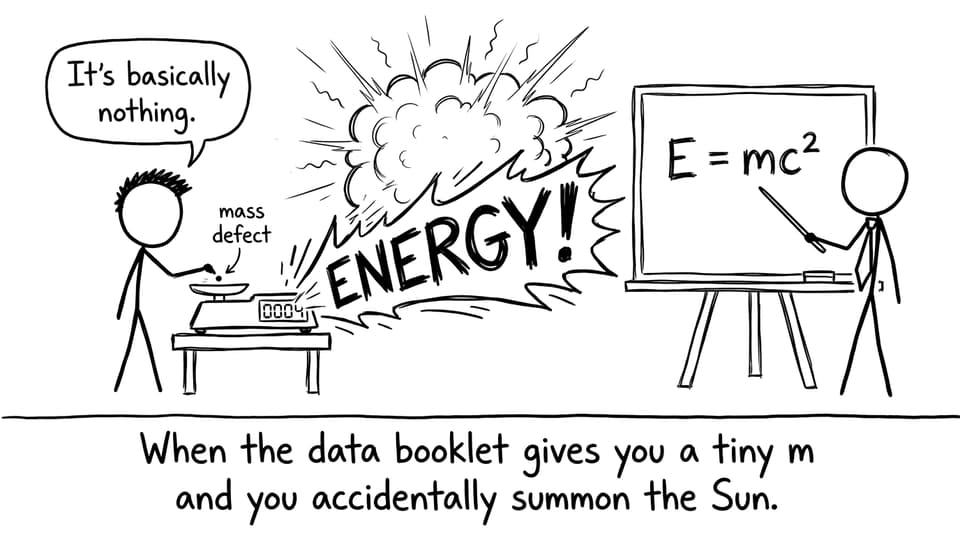
Mass defect (in one clean IB Chemistry definition)
In IB Chemistry, mass defect is the difference between:
-
the sum of the masses of the separate nucleons (protons + neutrons), and
-
the actual measured mass of the nucleus.
So the nucleus is slightly lighter than you’d expect if you built it by simply stacking individual particles.
That “missing mass” hasn’t vanished. In IB Chemistry, you say it precisely: mass has been converted into binding energy.
Quick checklist: what you need for exam marks
Use this when mass defect shows up in a data-based question:
-
State what mass defect is (expected nucleon mass minus nuclear mass).
-
Mention binding energy and the strong nuclear force.
-
Use E = mc² to convert mass defect into energy.
-
Keep units consistent (u to J, or convert to MeV if required).
-
Finish with an interpretation: bigger binding energy per nucleon usually means greater stability.
If you want extra practice in the exact style of exam questions, build a short timed set using RevisionDojo’s IB Chemistry Questionbank.
Why mass defect happens (the story behind the numbers)
Imagine nucleons as people trying to form a tight team. When they’re separate, there’s potential energy in the system. When they bind together in the nucleus, the strong nuclear force pulls them into a lower-energy, more stable arrangement. That drop in energy doesn’t just disappear, so it’sit’s released.
And in IB Chemistry, once energy leaves a system, the mass must reflect that. The nucleus ends up with less mass because it’s now a “cheaper” energy configuration than the separated nucleons.
This is why mass defect is not an exception to conservation laws; it’sit’s conservation written in a deeper language.
For the companion concept that examiners love to pair with mass defect, read IB Chemistry: Binding Energy Explained Simply.
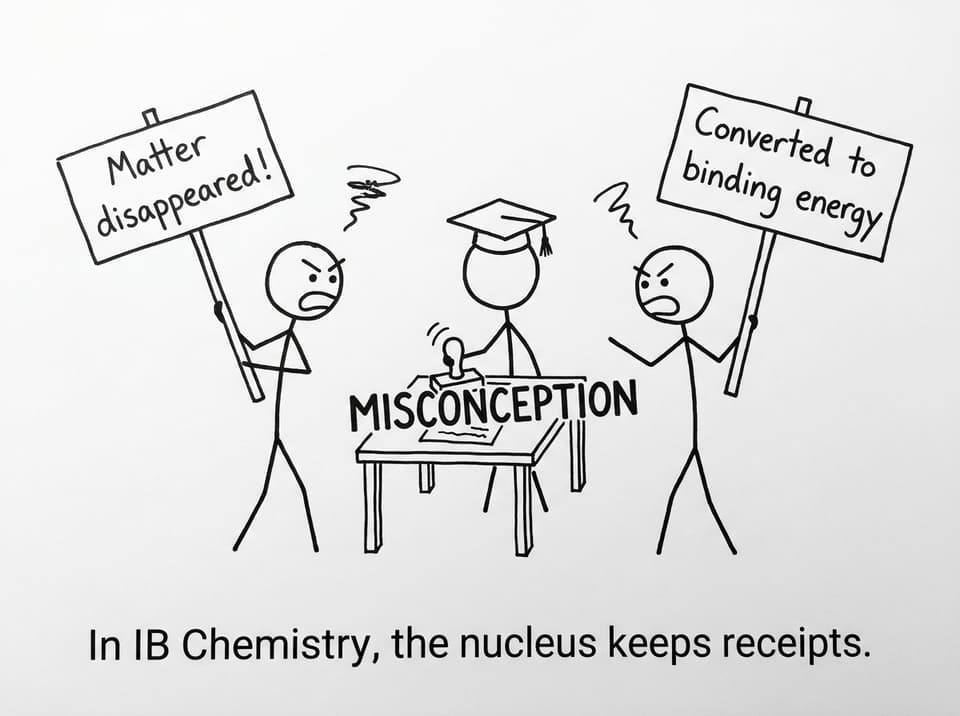
E = mc² (why a tiny mass defect becomes huge energy)
In IB Chemistry, you don’t need to re-derive Einstein. You just need to use the idea with discipline:
E = mc²
-
m is the mass defect (the missing mass)
-
c is the speed of light (so c² is enormous)
That enormous multiplier is the entire reason nuclear reactions release far more energy than chemical reactions. Chemical reactions rearrange electrons. Nuclear reactions reshape the nucleus itself, where binding energies are on a different scale.
How to calculate mass defect (IB Chemistry method)
Most mass defect questions follow the same pattern. You’ll be given (or can find from the data booklet):
-
mass of a proton
-
mass of a neutron
-
mass of the nucleus (or isotopic mass)
Then you compute:
mass defect = (Z × mₚ) + (N × mₙ) − (mass of nucleus)
Where:
-
Z = number of protons
-
N = number of neutrons
After that, convert mass defect to binding energy using E = mc².
If nuclear ideas in general feel fuzzy, it helps to widen the frame: Radioactivity Explained Simply connects stability, decay, and energy changes in the same exam-friendly language.
Where mass defect shows up: fusion and fission
Mass defect is not a “single-topic fact.” In IB Chemistry, it’s the glue that explains why both fusion and fission can release energy.
Mass defect in fusion (light nuclei joining)
In fusion, small nuclei combine to form a heavier nucleus with higher binding energy per nucleon. The final nucleus has lower mass than the starting total. The difference is released as energy.
RevisionDojo’s Nuclear Fusion Explained Simply is a quick follow-up if you want to connect mass defect to what powers stars.
Mass defect in fission (heavy nuclei splitting)
In fission, a large nucleus splits into two smaller nuclei that are generally closer to the “stable middle zone” in binding energy per nucleon. Again, the products have a slightly lower total mass. Again, the difference becomes energy.
For students who want everything organized in one hub (notes, questions, flashcards, and more), IB Chemistry Resources is the cleanest starting point.
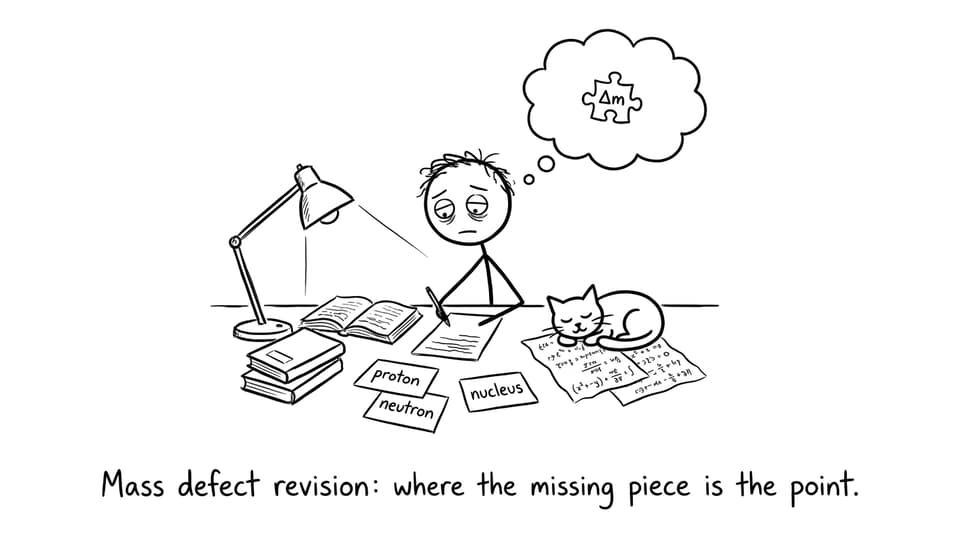
Common IB Chemistry misunderstandings (and how to fix them)
-
“Mass defect means matter disappears.” In IB Chemistry, the correct phrasing is: mass is converted into energy (binding energy). Conservation is still satisfied.
-
“Binding energy adds mass.” The opposite. When the nucleus forms and releases energy, the system’s mass decreases.
-
“Mass defect only matters in fusion.” Every nucleus has binding energy, so mass defect is always relevant.
A good way to eliminate these errors is to practice correction cycles: attempt a question, check the markscheme logic, then re-answer from memory. RevisionDojo’s AI Chat and Grading tools make that loop faster because you can test your phrasing, not just your final number.
Bringing it home: why this matters for IB Chemistry exams
Mass defect is the quiet engine behind nuclear chemistry. In IB Chemistry, it explains why nuclei weigh less than expected, why binding energy exists, and why fusion and fission can produce extreme energy from tiny mass changes.
If you want this to feel automatic by exam day, treat it like a skill, not a fact. Read the concept once, then drill it: a few targeted questions from the S1.2 The nuclear atom topic page, a quick review in Flashcards, then one timed set in the Questionbank with AI Chat feedback on your explanation style. That’s how IB Chemistry concepts stop being scary and start becoming points.


