


Radioactivity is one of those IB Chemistry topics that feels calm on the page and chaotic in your head. You read “unstable nucleus” and nod, but then a question asks for a decay equation, a half-life step, and a short explanation of why it’s random, and suddenly it’s 2 a.m. and you’re bargaining with physics.
The good news: radioactivity has a small set of rules, and IB Chemistry rewards students who can say them clearly. Once you can picture what changes (mass number and atomic number) and what never changes (the randomness for a single nucleus, the predictable pattern for a big sample), the topic becomes surprisingly manageable.
Start by anchoring yourself to the main hub: IB Chemistry Resources. It’s the easiest place to move between Study Notes, Flashcards, the Questionbank, and AI Chat when you want one clean explanation followed by exam-style practice.
Radioactivity in IB Chemistry: the 20-second checklist
If you can tick these boxes, most IB Chemistry exam questions on radioactivity become pattern recognition:
-
Define radioactivity as spontaneous emission from an unstable nucleus
-
Explain instability using proton-neutron ratio, nuclear size, and binding energy per nucleon
-
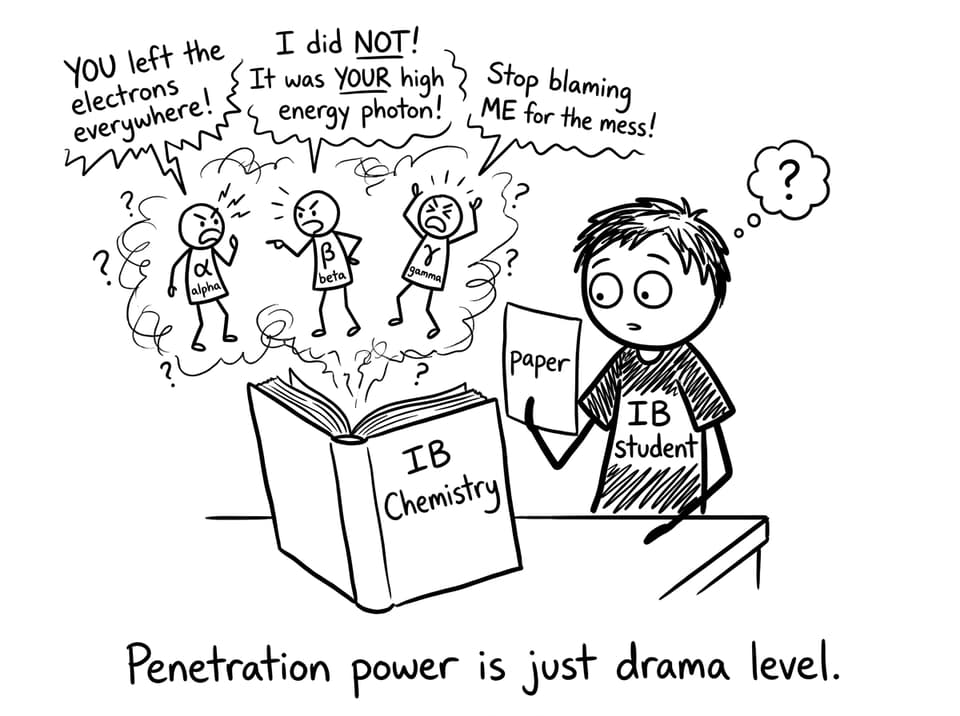
Distinguish alpha, beta (minus/plus), gamma by mass, charge, and penetration
-
Write and balance decay equations (A and Z conservation)
-
Use half-life logic (halve what remains) and state it’s unaffected by conditions
-
Name at least one detector (Geiger-Muller tube, cloud chamber, scintillation counter)
-
Connect to real uses: medical imaging/therapy, dating, industry, energy
For nucleus fundamentals that make this topic feel less abstract, pair this with S1.2 The Nuclear Atom.
What radioactivity actually is (and what it isn’t)
In IB Chemistry, radioactivity means the nucleus is unstable and releases particles and/or energy to become more stable. It’s spontaneous: no outside trigger is needed. It’s also random: you cannot predict when one specific nucleus will decay.
But “random” doesn’t mean “unpatterned.” In a large sample, decay becomes predictable because each nucleus has a constant probability of decaying in a given time. That’s why half-life works so reliably.
If you want to strengthen exam phrasing (the kind that earns marks without extra words), the Isotopes Explained Clearly for IB Chemistry article helps you lock in the language of Z, A, and isotopic identity.
Why nuclei become unstable in IB Chemistry
A nucleus is a tug-of-war: the strong nuclear force pulls nucleons together at very short range, while electrostatic repulsion pushes protons apart.
Nuclei tend to be unstable when:
-
The proton-to-neutron ratio is “off” for that size of nucleus
-
The nucleus is too large, so proton repulsion matters more across the distance
-
The binding energy per nucleon is relatively low, so the nucleus “benefits” energetically from changing
In other words, radioactive decay is the nucleus choosing a path toward stability, even if that path takes many steps.
Alpha, beta, gamma: what changes and what stays the same
Alpha decay (α)
Alpha particles are helium nuclei: (^{4}_{2}\text{He}). In IB Chemistry, alpha decay is your heavy-nucleus move.
-
Mass: large (compared to beta)
-
Charge: +2
-
Penetration: low (paper/skin can stop it)
-
Effect on nucleus: A decreases by 4, Z decreases by 2
Beta decay (β⁻ and β⁺)
Beta decay is about fixing the proton-neutron ratio.
Beta-minus (β⁻): a neutron becomes a proton and an electron is emitted.
-
A stays the same
-
Z increases by 1
Beta-plus (β⁺): a proton becomes a neutron and a positron is emitted.
-
A stays the same
-
Z decreases by 1
Beta has medium penetration compared to alpha.
Gamma emission (γ)
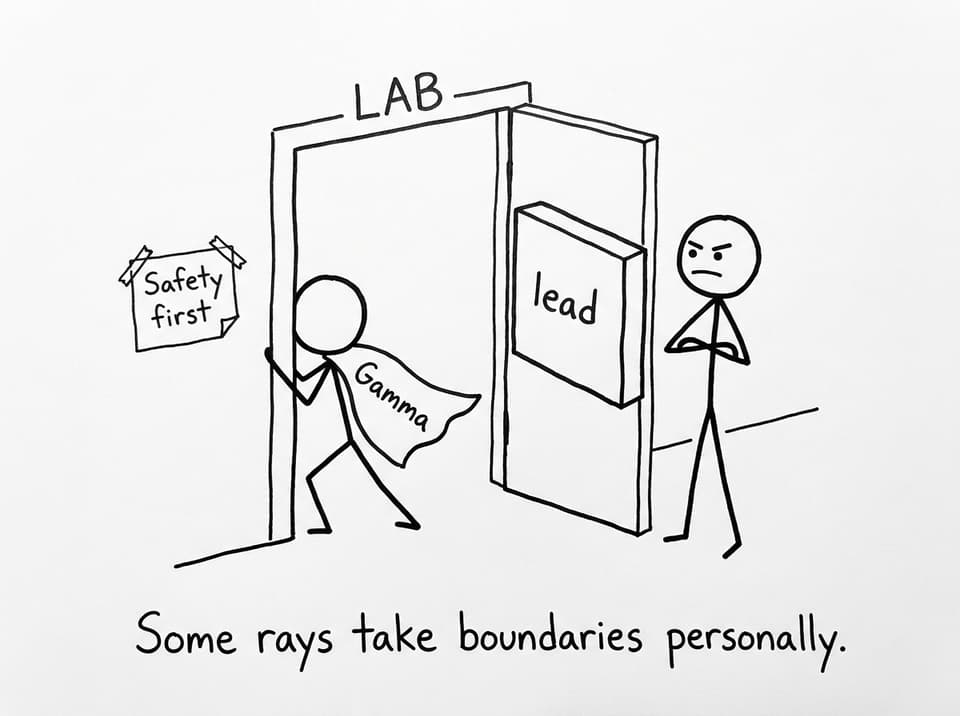
Gamma is high-energy electromagnetic radiation released when the nucleus drops from an excited state to a lower-energy state.
-
No mass, no charge
-
Very penetrating
-
A and Z do not change
A useful mental model for IB Chemistry: alpha and beta change identity; gamma changes “mood” (energy level).
Radioactive decay equations: the exam-friendly method
Decay equations are conservation statements. In IB Chemistry, you win by tracking two numbers:
-
Mass number (A): total nucleons
-
Atomic number (Z): protons
Examples you should be comfortable with:
Alpha decay:
(^{238}{92}\text{U} \rightarrow ^{234}{90}\text{Th} + ^{4}_{2}\text{He})
Beta-minus decay:
(^{14}{6}\text{C} \rightarrow ^{14}{7}\text{N} + \beta^-)
Beta-plus decay:
(^{11}{6}\text{C} \rightarrow ^{11}{5}\text{B} + \beta^+)
Gamma emission:
(^{60}{27}\text{Co}^* \rightarrow ^{60}{27}\text{Co} + \gamma)
To pressure-test this skill quickly, build a mini set in the RevisionDojo Questionbank and use the AI Chat for instant feedback on your balancing logic.
Half-life: the calm math inside the chaos
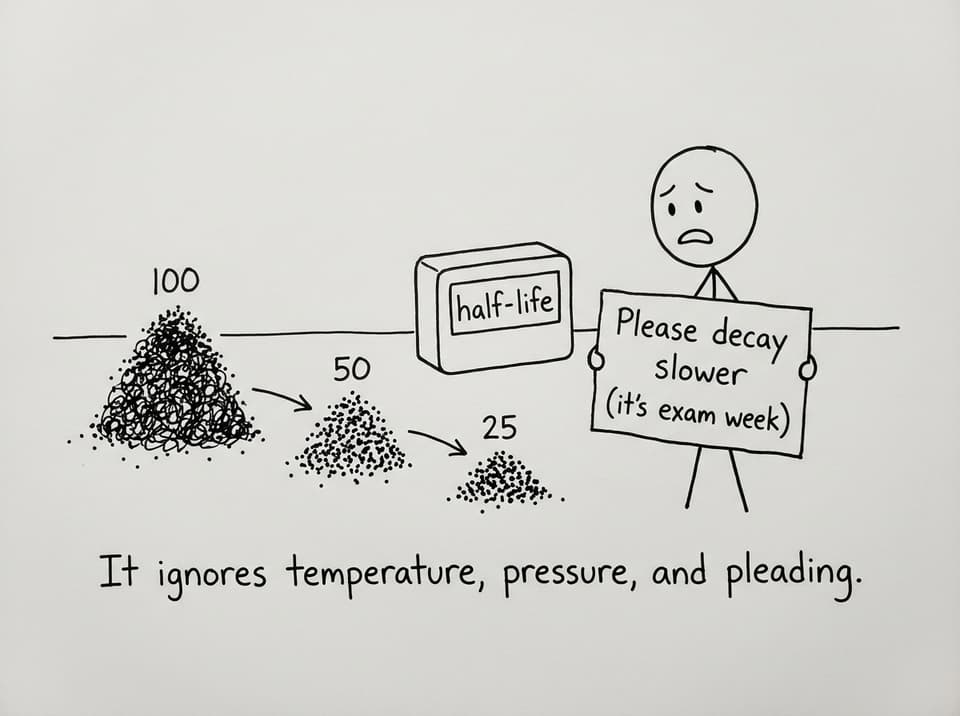
Half-life is the time taken for half of the radioactive nuclei in a sample to decay. The key phrase for IB Chemistry is: you halve what remains, not what you started with.
-
1 half-life: 50% remains
-
2 half-lives: 25% remains
-
3 half-lives: 12.5% remains
Half-life does not change with temperature, pressure, or chemical form. That’s a common trap statement.
For a deeper, exam-structured walkthrough, keep Half-Life Explained for IB Chemistry open while you practise.
Detection, uses, and safety (what IB Chemistry expects)
Radioactivity isn’t only definitions. IB Chemistry questions often ask you to connect radiation type to detection, shielding, and application.
Detection tools you should recognise:
-
Geiger-Muller tube: counts ionising events
-
Cloud chamber: shows tracks of charged particles
-
Scintillation counter: useful for gamma detection
Major applications:
-
Medicine: tracers for imaging, radiotherapy for cancer
-
Dating: carbon-14 for organic material
-
Industry: thickness monitoring, leak detection, sterilisation
-
Energy: nuclear fission releases huge amounts of energy from mass-to-energy conversion
If your understanding of fission feels fuzzy, Nuclear Fission Explained Simply connects the story from nucleus stability to energy production.
Safety essentials:
-
Radiation causes ionisation and can damage DNA
-
Risk depends on dose, exposure time, and radiation type
-
Shielding varies (paper vs aluminium vs lead/concrete)
Common IB Chemistry misconceptions (and the one-line fix)
-
“You can speed up decay.” No, decay rate is intrinsic and unaffected by typical external conditions.
-
“Gamma has mass.” Gamma is electromagnetic energy; no mass or charge.
-
“All radioactive sources are equally dangerous.” Danger depends on penetration, dose, and exposure pathway.
Closing: turn radioactivity into easy marks with RevisionDojo
Radioactivity in IB Chemistry isn’t meant to feel mystical. It’s a short list of emissions, a conservation game with A and Z, and an exponential pattern you can rehearse until it’s automatic. When you study it this way, exam questions stop feeling like surprises and start feeling like familiar templates.
If you want a single place to revise, practise, and get unstuck quickly, use IB Chemistry Revision Notes alongside the Questionbank, Flashcards, AI Chat, Grading tools, Predicted Papers, Mock Exams, and the Tutors and Coursework Library when you need extra structure. That’s how IB Chemistry becomes simpler: one clear explanation, then enough practice to make it yours.