

Binding energy in IB Chemistry feels like one of those topics that should be small. It’s just a little difference in mass, right?
And then you learn that the “missing” mass can power stars, reactors, and half of the questions that appear when nuclear chemistry shows up on an exam. In IB Chemistry, binding energy is where the syllabus quietly reminds you that nature keeps receipts: if mass goes down, energy shows up somewhere else.
This guide explains binding energy simply, connects it to mass defect, and shows you exactly what examiners want you to say (and calculate) when fusion, fission, or nuclear stability graphs appear.
Binding energy in IB Chemistry: the one-sentence definition
In IB Chemistry, binding energy is the energy needed to separate a nucleus into its individual protons and neutrons.
You can also flip the wording (and keep it correct): it’s the energy released when separate nucleons form a nucleus.
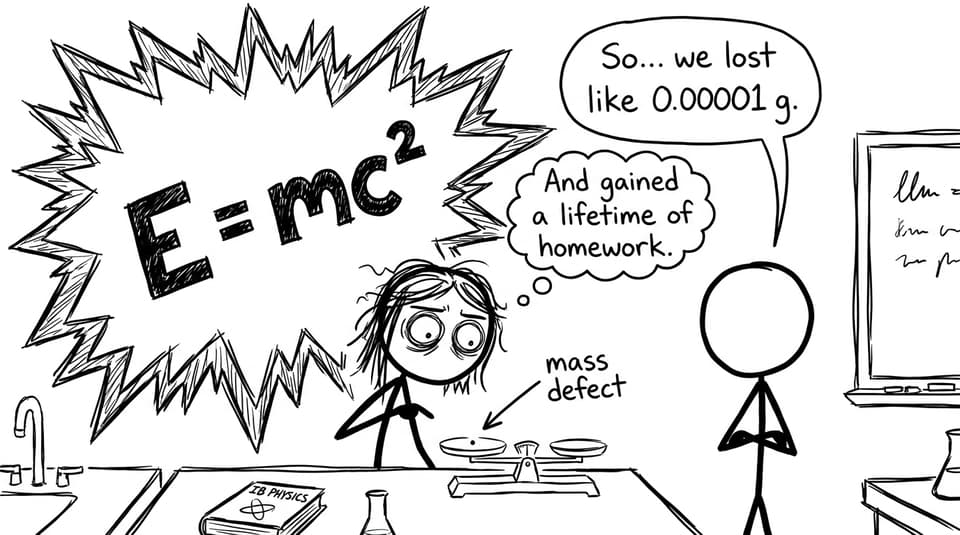
That second phrasing matters, because it explains why nuclei have less mass than you expect. When nucleons bind, energy is released, and that released energy corresponds to a loss of mass. The nucleus ends up lighter than the sum of its parts.
If you want a strong foundation before binding energy, start with Mass Defect Explained Simply.
Quick checklist: what you must know for IB Chemistry exams
Use this as a fast IB Chemistry binding-energy checklist:
-
Define binding energy correctly (separation energy of the nucleus).
-
Explain mass defect as “expected mass minus actual nuclear mass.”
-
Use E = mc² to convert mass defect into energy.
-
Distinguish total binding energy vs binding energy per nucleon.
-
Interpret the binding energy per nucleon curve (why fusion and fission release energy).
For nuclear structure context, see S1.2 The Nuclear Atom and the companion S1.2 The Nuclear Atom Notes.
Mass defect and E = mc²: where the energy hides
Here’s the core logic that IB Chemistry repeatedly tests:
-
Add up the masses of the separate nucleons (protons + neutrons).
-
Compare that with the measured mass of the nucleus.
-
The nucleus is slightly lighter.
-
That “missing” mass is the mass defect, and it becomes energy.
Einstein’s relationship links them:
E = mc²
-
m is the mass defect
-
c is the speed of light (3.00 × 10⁸ m s⁻¹)
Because c² is enormous, even a tiny mass defect creates a huge energy change. That’s why nuclear reactions dwarf chemical energetics in IB Chemistry.
If you want an analogy refresher from regular energetics (and a nice contrast), Bond Enthalpy Explained for IB Chemistry is a helpful comparison point.
Total binding energy vs binding energy per nucleon (the common trap)
Students often say “high binding energy means stable” and lose precision.
In IB Chemistry, the stability argument is usually about:
Binding energy
The total energy holding the nucleus together.
A bigger nucleus often has a larger total binding energy simply because it has more nucleons.
Binding energy per nucleon
Total binding energy ÷ number of nucleons.
This is the value that best tracks nuclear stability in IB Chemistry questions. Higher binding energy per nucleon generally means nucleons are held more tightly, and the nucleus is less likely to change.
The binding energy per nucleon curve: the story of iron
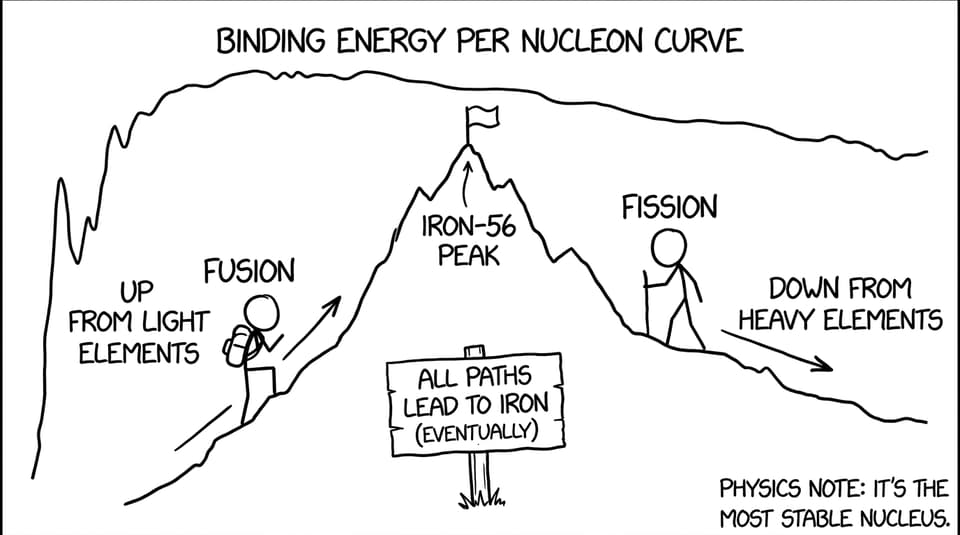
The binding energy per nucleon graph is basically a map of “which nuclear rearrangements pay you energy.” In IB Chemistry, you don’t need to draw it perfectly, but you do need to interpret it confidently.
Key features you should describe:
-
The curve rises quickly from hydrogen to mid-mass nuclei.
-
It peaks around iron-56 (often treated as the most stable).
-
It slowly declines for heavier nuclei.
So what does the curve mean?
-
Fusion of light nuclei releases energy because you move up the curve toward higher binding energy per nucleon.
-
Fission of heavy nuclei releases energy because you move down (toward iron) into products with higher binding energy per nucleon.
If you want direct practice on the narrative of splitting heavy nuclei, Why Does Splitting a Heavy Nucleus Release So Much Energy? is a great drill.
Binding energy in fusion (how stars “afford” to shine)
Fusion in IB Chemistry is usually explained with hydrogen isotopes combining into a heavier nucleus.
A common example:
²H + ³H → ⁴He + n + energy
The key exam wording:
-
The products have higher binding energy per nucleon.
-
The products have lower mass than the reactants.
-
The mass difference becomes energy (E = mc²).
For a full fusion walk-through, see Nuclear Fusion Explained Simply.
Binding energy in fission (why heavy nuclei can “cash out” energy)
In fission, a heavy nucleus splits into smaller nuclei. In IB Chemistry, you’ll often discuss uranium qualitatively.
What you must communicate:
-
Large nuclei are less tightly bound per nucleon than medium-mass nuclei.
-
Splitting creates fragments with higher binding energy per nucleon.
-
Total mass decreases slightly.
-
That decrease becomes released energy.
For a simple fission overview, use Nuclear Fission Explained Simply.
How to calculate binding energy (IB Chemistry method)
When a calculation shows up in IB Chemistry, keep your steps mechanical:
-
Find the mass defect:
Δm = (mass of separated protons + mass of separated neutrons) − (mass of nucleus) -
Convert to kg if needed.
-
Apply E = mc².
-
If asked for binding energy per nucleon, divide by the number of nucleons.
The data booklet gives the particle masses you need, so your job is mostly structure and units.
Bringing it home: use IB Chemistry practice that feels like the exam
Binding energy is simple once you see the pattern: nuclei “pay out” energy when they rearrange into more tightly bound states. In IB Chemistry, that idea powers definitions, graphs, fusion and fission explanations, and calculations with E = mc².
If you want to turn this into easy marks, RevisionDojo is built for it: use the Study Notes for quick clarity, the Flashcards for definitions, the Questionbank for exam-style repetition, and AI Chat when one step in your calculation keeps going wrong. When you’re ready to simulate real pressure, build Mock Exams, try Predicted Papers, and use the Grading tools to spot the exact phrasing examiners reward. And if you want human guidance, the Tutors and Coursework Library help you stay consistent when motivation dips.
For more IB Chemistry support across the syllabus, explore IB Chemistry Resources and the broader IB Chemistry Notes 2025 guide.