

Nuclear fusion has a strange talent: it looks like a tiny change on paper, then casually powers an entire star.
If you have ever stared at a nuclear equation in IB Chemistry and wondered how two symbols and a neutron can turn into sunlight, you are not alone. Fusion is one of those topics where the story matters as much as the definition. Once the story clicks, the marks usually follow.
Nuclear fusion in IB Chemistry (in one sentence)
Nuclear fusion is when two light nuclei combine to form a heavier nucleus, and energy is released because the final nucleus is more stable (higher binding energy per nucleon) and has a slightly smaller mass than you started with.
In IB Chemistry, fusion is really a test of whether you can connect four ideas:
-
what nuclei are (and how we write them)
-
electrostatic repulsion vs strong nuclear force
-
binding energy and mass defect
-
converting mass to energy using (E = \Delta mc^2)
For syllabus-aligned support, start with IB Chemistry Revision Notes (SL/HL) and the focused Notes for C.3 Nuclear fusion and fission.
Quick checklist for exam answers
When a fusion question appears, a high-scoring IB Chemistry answer usually includes:
-
A clear definition of nuclear fusion (joining light nuclei).
-
A correct example equation (often deuterium + tritium).
-
A statement that high temperature/pressure is needed to overcome electrostatic repulsion.
-
A link to mass defect and (E = mc^2).
-
A link to binding energy per nucleon (stability).
If binding energy still feels slippery, keep IB Chemistry: Binding Energy Explained Simply open while you revise fusion.
What is nuclear fusion (explained simply)
In nuclear fusion, you push two positively charged nuclei close enough that the strong nuclear force can “take over” and bind them. The problem is that, at longer distances, the nuclei repel each other due to electrostatic repulsion (both are positive).
That’s why fusion needs extreme conditions. It is not about being dramatic. It is about getting nuclei close enough for the strong force to matter.
In IB Chemistry, hydrogen isotopes show up often because they are light and realistic fusion fuel candidates:
-
protium (^{1}_{1}H)
-
deuterium (^{2}_{1}H)
-
tritium (^{3}_{1}H)
If nuclear symbols feel like a weak link, revisit IB Chemistry 2.1 The Nuclear Atom Notes.
The classic fusion reaction you should know
The most common example is deuterium-tritium fusion:
Products:
-
helium-4 (an alpha particle)
-
a neutron
-
lots of energy
This is the reaction that shows up in discussions of experimental fusion reactors, and it is a reliable “go-to” example for IB Chemistry exam responses.
Why fusion releases energy (the part examiners actually want)
The key idea is stability.
When the new nucleus forms, it has higher binding energy per nucleon than the starting nuclei. More binding energy means the nucleons are held together more tightly, so the final arrangement is more stable.
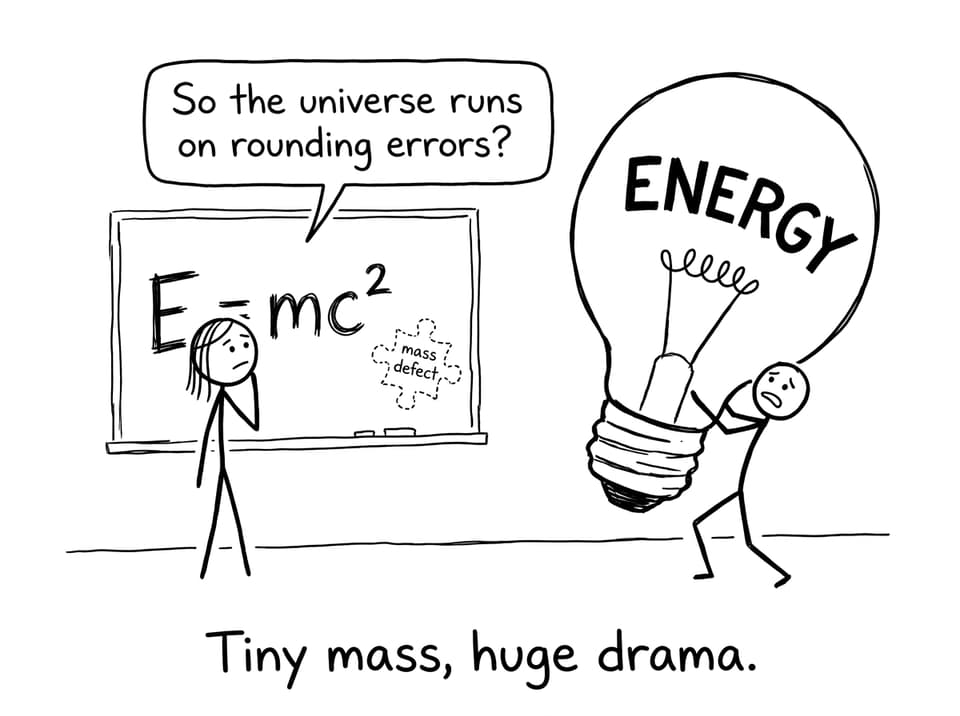
Here’s the twist that makes fusion feel like magic: the final nucleus has slightly less mass than the total mass of the original nuclei. That missing mass is the mass defect, and it becomes energy:
Because (c^2) is enormous, even a tiny (\Delta m) becomes a huge (E).
To practise saying this in markscheme language, use IB Chemistry Questionbank and write your own 2-3 sentence “why energy is released” template, then refine it with feedback.
Fusion in stars: why the Sun keeps paying its energy bills
Fusion is not a lab curiosity. It is the reason stars shine.
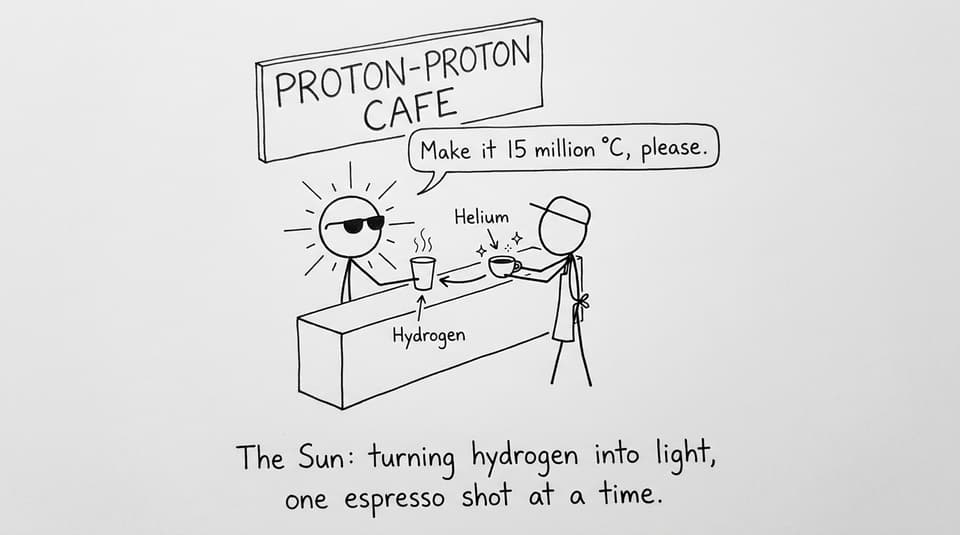
Inside the Sun, hydrogen nuclei fuse through sequences such as the proton-proton chain, gradually forming helium and releasing energy that eventually reaches us as light and heat. The Sun stays stable because outward pressure from fusion energy balances inward gravitational collapse.
If you also take Physics, the crossover is worth using: E.5 Fusion and stars Questionbank is a great way to deepen the story while keeping the explanation exam-ready.
Conditions required for nuclear fusion (and how to phrase them)
To get fusion, you need nuclei moving fast enough to get extremely close.
In IB Chemistry terms, that means:
-
very high temperature (so particles have high kinetic energy)
-
high pressure/density (so collisions are more likely)
-
confinement long enough for collisions to occur
On Earth, research tries to create these conditions using:
-
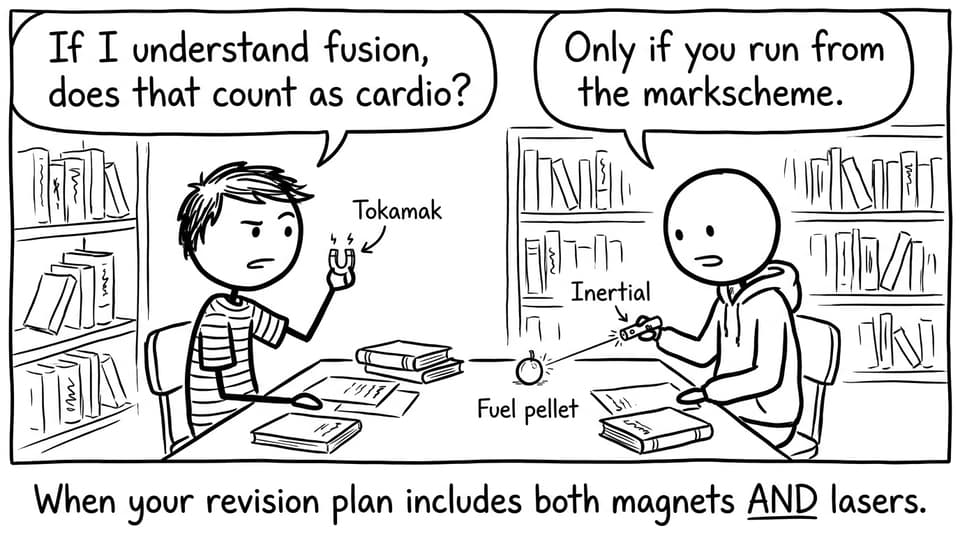
magnetic confinement (tokamak-style devices)
-
inertial confinement (powerful lasers compress fuel)
The challenge is not starting fusion. The challenge is sustaining it and getting net useful energy while materials handle intense neutron bombardment.
Fusion vs fission (a fast comparison that earns marks)
Students sometimes blur these together under “nuclear energy.” Don’t.
-
Fusion: combines light nuclei into heavier ones; minimal long-lived waste; needs extreme conditions.
-
Fission: splits heavy nuclei; produces significant radioactive waste; can happen with much less extreme conditions.
For IB Chemistry, the clean way to score is to state both the direction (combine vs split) and one consequence (conditions or waste).
Common IB Chemistry misunderstandings
A few traps appear repeatedly in exam scripts:
-
“Fusion is a chemical reaction.” Chemical reactions involve electrons; fusion changes the nucleus.
-
“Fusion can run at room temperature.” Real fusion needs extreme conditions; anything “cold” is not part of standard IB exam answers.
-
“Fusion and fission are basically the same.” They both release nuclear energy, but the mechanisms and conditions are different.
To lock these down with active recall, use the C.7 Nuclear fusion and nuclear fission Flashcards.
Closing: make fusion feel small, then score big
Fusion is not hard because it is mysterious. It is hard because it is dense: forces, stability, mass defect, and exam phrasing all meet in one place. But once you can say, in clean IB Chemistry language, that fusion combines light nuclei and releases energy because products are more stable and (\Delta m) becomes energy, you have the core.
When you are ready to turn understanding into marks, build your routine with RevisionDojo: Study Notes for clarity, Questionbank for precision, Flashcards for retention, AI Chat for quick feedback, Grading tools for exam-style corrections, Predicted Papers and Mock Exams for timed rehearsal, plus the Coursework Library and Tutors when you want the fastest improvement.