
Writing a strong IB English Literature essay rarely fails because a student “doesn’t get the text.” It fails because, under timed pressure, good thoughts don’t land in a shape the examiner can reward. You can feel that moment: you have something true to say about the poem or novel, but it slips away while you’re trying to introduce it politely.
A good IB English essay is less like a performance and more like a well-built bridge. It doesn’t need fireworks. It needs load-bearing parts: a clear thesis, purposeful evidence, analysis that explains how meaning is made, and a structure that keeps you moving forward when the clock gets loud.
This guide gives you a repeatable method for Paper 1 and Paper 2, plus a checklist you can run before every practice. If you want extra scaffolding, RevisionDojo’s Literary Hub, Study Notes, Flashcards, AI Chat, and Grading tools turn this method into a routine you can actually stick with.
The quick checklist (save this for every IB English essay)
Use this as your 90-second reset before writing any IB English Literature essay:
-
Task: Is this Paper 1 (unseen analysis) or Paper 2 (comparative essay)?
-
Thesis: Can you state your interpretation in 1-2 sentences?
-
Technique: Have you named 2-3 authorial choices you will analyze (imagery, structure, tone, narration, symbolism, contrast, rhythm)?
-
Evidence: Do you have 2-4 short quotations or precise references per main point?
-
Paragraph engine: Are your paragraphs built around analysis, not plot?
-
Linking: Does each paragraph end by reconnecting to the thesis?
-
Timing: Do you know when you will stop planning and start writing?
If you want a dedicated place to practice this loop, start with RevisionDojo’s IB English A Lit Resources, then switch to timed practice using the Mock Exams and Predicted Papers features.
Know what you’re building: Paper 1 vs Paper 2
In IB English Literature, your essays change slightly depending on the paper, but the examiner’s core question stays the same: Can you explain how the writer constructs meaning?
Paper 1: guided literary analysis (unseen text)
Paper 1 rewards close reading under pressure. Your job is to identify patterns quickly and build a focused interpretation.
A practical way to train is to use RevisionDojo’s IB English study techniques that actually work and apply them to unseen extracts: one timed plan, one timed paragraph, one reflection.
Paper 2: comparative essay (two studied works)
Paper 2 rewards synthesis. You’re not writing two mini-essays. You’re building one argument that constantly compares methods and effects.
For structure options you can rely on, see How to Structure a Comparative Essay in IB Literature and keep one template as your default.
The core skill: write analysis, not description
The fastest way to improve an IB English essay is to stop retelling and start explaining.
-
Description says: what happens.
-
Analysis says: how the author’s choices shape meaning, reader response, and purpose.
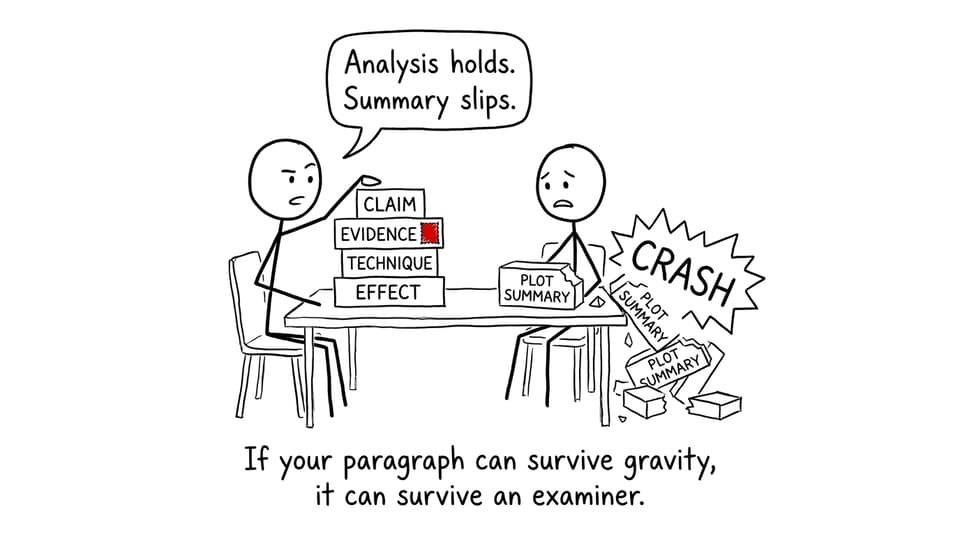
A simple paragraph formula that keeps you analytical:
-
Claim: Your point answering the question.
-
Evidence: A short quotation or precise reference.
-
Technique: Name the writer’s choice (diction, contrast, syntax, motif).
-
Effect: Explain the impact and why it matters.
-
Link: Tie back to thesis.
If you want feedback on whether you’re analyzing enough, run a paragraph through RevisionDojo’s AI Chat for a quick “analysis vs summary” check, then use the Grading tools to map your work to criteria.
Step-by-step: how to plan a good IB English essay (fast)
Planning is not optional in IB English. It’s how you protect your best ideas from the clock.
Start with a thesis that is debatable and specific
A strong thesis is not a theme. It’s an interpretation.
Instead of: “The poem is about power.”
Try: “Through shifts from intimate address to impersonal imagery, the speaker frames power as a relationship that requires complicity, not just force.”
For more thesis examples and a reliable checklist, use What Makes an Effective Thesis Statement?.
Choose 2-3 main moves (not 7)
Under exam conditions, depth beats coverage.
Pick a small set of “authorial moves” you can analyze well:
-
Structure: progression, turning points, stanza breaks, juxtaposition
-
Language: imagery fields, word connotations, repetition, modality
-
Voice: narration, perspective, distance, reliability
If you’re studying multiple texts, store these moves as quick-recall Flashcards in RevisionDojo so your brain can retrieve them on demand.
Build a micro-outline you can actually finish
Write a one-line plan per paragraph:
-
P1: thesis + framing
-
P2: main technique 1 + evidence
-
P3: main technique 2 + evidence
-
P4: main technique 3 + evidence
-
P5: conclusion
For Paper 2, decide early whether you’re doing point-by-point or block comparison. If you’re unsure, this guide helps: Structuring Your IB English Paper 2 Essay.
Writing the introduction (without wasting time)
In IB English, introductions are not a place to warm up. They are a contract with the examiner.
A high-functioning intro does three things:
-
Names the text(s) and gives minimal context
-
Answers the question with a thesis
-
Previews your line of analysis (2-3 techniques)
One calm template:
The extract presents __ as __. Through __, __, and __, the writer constructs meaning by __, revealing __.
Short, controlled, and easy to execute when you’re nervous.
Body paragraphs that score: make the examiner’s job easy
A strong IB English paragraph feels inevitable. Not because it’s fancy, but because every sentence has a job.
Use short quotations and zoom in
Long quotes often become hiding places. Prefer short fragments you can dissect.
Instead of dropping four lines of poetry, quote two or three words and explain:
-
Why that verb?
-
Why that image?
-
Why that shift?
Track patterns and shifts
Examiners love pattern recognition because it proves control. Look for:
-
repetition with variation
-
a tonal pivot
-
widening or narrowing of perspective
-
structural symmetry or disruption
RevisionDojo’s Questionbank is useful here because you can repeatedly practice identifying patterns in new extracts without having to hunt for materials.
End each paragraph with a link sentence
A link sentence is not a summary. It’s a return to the thesis.
Try: “This structural compression doesn’t just intensify tension; it supports the essay’s argument that __ is presented as __.”
Paper 2: the comparative moves that lift your essay
A Paper 2 IB English essay rises when comparison is constant, not occasional.
Compare methods, not morals
Avoid: “Text A is more hopeful than Text B.”
Prefer: “Text A uses irony to expose false hope, while Text B uses fragmented narration to make hope feel private and unstable.”
Balance your evidence
Examiners notice when one text becomes the “main” one.
A practical rule: if you write 6 sentences on Text A, write 6 on Text B, then add a comparative sentence that fuses them.
For a clean overview of what Paper 2 expects, see Understanding the IB English A Literature Paper 2 Exam Structure.
Revision and improvement: how to get better between practices
Most students “practice” IB English by writing another full essay and hoping the next one is better. Improvement is faster when you tighten the feedback loop.
Use a rubric-driven edit pass
After writing, do one focused pass for each category:
-
Thesis clarity: Is it arguable and specific?
-
Evidence quality: Is it precise and integrated?
-
Analysis depth: Did you explain technique and effect?
-
Organization: Does each paragraph build the argument?
A great companion habit is peer feedback. Use Peer Editing for IB English A Literature Essays as a structure so comments don’t drift into vague praise.
Use tools like an athlete, not a perfectionist
RevisionDojo is strongest when you treat it like training equipment:
-
Study Notes to rebuild weak knowledge quickly
-
Flashcards to automate literary terms and text-specific quotes
-
AI Chat to ask “Is this thesis debatable?” or “What technique is this?”
-
Grading tools to see which criterion is leaking marks
-
Mock Exams to build timing stamina
-
Coursework Library and Tutors if you want high-quality models and human guidance
If you want an overall workflow that keeps things simple, this is worth bookmarking: RevisionDojo App: The Smarter Way to Prep for IB Exams.
Closing: build your IB English essay like something you can trust
A good IB English Literature essay isn’t “perfect writing.” It’s disciplined thinking made visible: a thesis that takes a stand, evidence that’s precise, and analysis that explains how authorial choices create meaning. When you practice with that lens, your essays stop feeling like guesses and start feeling like tools.
If you want one home base for that training, use RevisionDojo to turn the method into routine: study with Study Notes, recall with Flashcards, practice with the Questionbank, get rapid feedback with AI Chat and Grading tools, and build calm timing with Mock Exams and Predicted Papers. Your next IB English essay doesn’t need luck. It needs a system you’ll repeat.