



If you ask a room of IB students which Group 4 subject feels “safe,” you’ll hear the usual trio: Physics, Chemistry, Biology.
But ask which one feels unknown, and the same answer shows up again and again: IB Design Technology.
It’s the button on the subject-selection form that looks exciting, practical, and slightly suspicious. Like choosing the weird-looking item on a menu and hoping it isn’t secretly painful.
So let’s make the decision less dramatic. IB Design Technology can be an excellent Group 4 choice, but it rewards a specific kind of student: someone who likes applying science to real situations, explaining design decisions, and treating feedback like fuel instead of insult.
What Group 4 is actually testing (and why IB Design Technology fits)
Group 4 is not a “memorise facts and survive” club (even if it sometimes feels like it). At its core, the IB wants you to practise scientific thinking: understanding systems, analysing evidence, and solving problems with logic.
IB Design Technology does that through applied contexts: materials, manufacturing, human factors, sustainability, and product design. Instead of proving you can remember every detail, you often prove you can justify choices: why this material, why this process, why this trade-off.
If you want a clear map of the course, keep this open as a home base: IB Design Technology resources hub.
Quick checklist: is IB Design Technology your “kind of hard”?
Use this fast check before you commit to IB Design Technology:
-
You like improving something real (products, systems, user experience), not just talking about it.
-
You’re comfortable writing explanations that sound like: “because the evidence suggests…”
-
You can manage a long project without leaving everything to the last month.
-
You enjoy evaluation: comparing options, acknowledging limitations, and making justified decisions.
-
You’ve checked university prerequisites first.
If that list feels natural, IB Design Technology is probably not risky for you. It’s aligned.
IB Design Technology vs Physics, Chemistry, and Biology
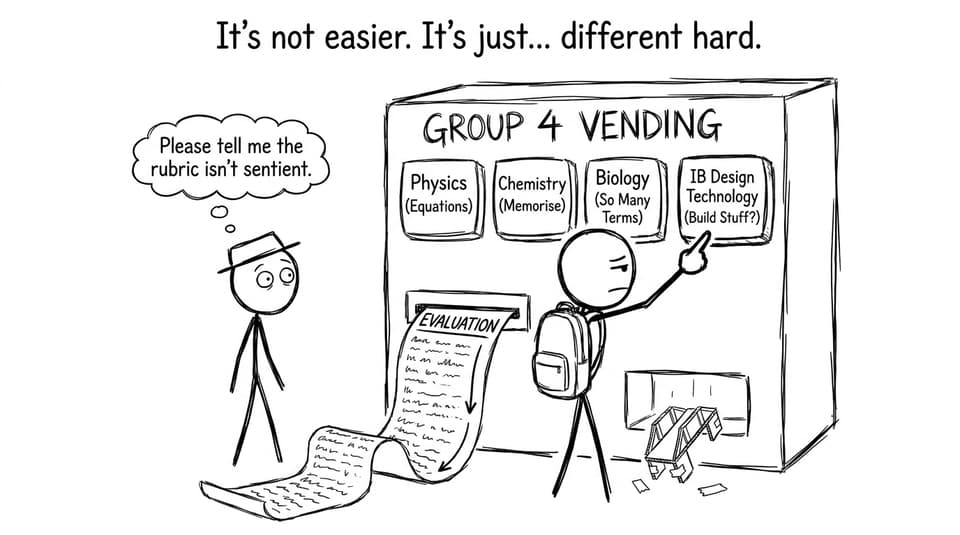
The cleanest way to decide is to stop asking “which is easiest?” and start asking “which difficulty matches me?” IB Design Technology is not easier. It is different hard.
IB Design Technology vs Physics
Physics is equation-heavy and abstract. It rewards students who enjoy modelling the world mathematically.
IB Design Technology is more concrete and decision-focused. You’ll still use scientific principles, but the marks often come from reasoning and evaluation rather than long calculations.
If you prefer building an argument over chasing a number, IB Design Technology may feel more natural.
IB Design Technology vs Chemistry
Chemistry often demands precise content mastery and accuracy under time pressure.
IB Design Technology leans into trade-offs: performance vs cost, sustainability vs durability, user needs vs manufacturing constraints. That’s a different kind of precision: clarity in justification.
IB Design Technology vs Biology
Biology can feel like a large landscape of terms and processes.
IB Design Technology typically has fewer “pure memorisation” moments, but deeper application. You don’t just state what something is; you explain why it matters in a design context.
When IB Design Technology is a strong Group 4 choice
IB Design Technology shines when it balances your overall diploma.
It’s often a strong choice if:
-
You already have a heavy theoretical load (for example Math AA HL + another intense HL).
-
You’re interested in engineering, product design, architecture, business, or entrepreneurship.
-
You want a science subject that builds transferable skills: evaluation, justification, systems thinking.
A lot of students discover a quiet advantage here: IB Design Technology trains you to think like an examiner. You learn to show your reasoning, not just your conclusion.
If you want a practical revision workflow designed specifically for IB Design Technology, this is worth bookmarking: Best study strategies for IB Design Technology students.
When IB Design Technology might be the wrong pick
The biggest reason to avoid IB Design Technology has nothing to do with status. It’s requirements.
Choose something else if:
-
Your intended university course explicitly requires Biology/Chemistry/Physics.
-
You strongly dislike long coursework and iterative improvement.
-
You want a subject that stays mostly in the exam lane.
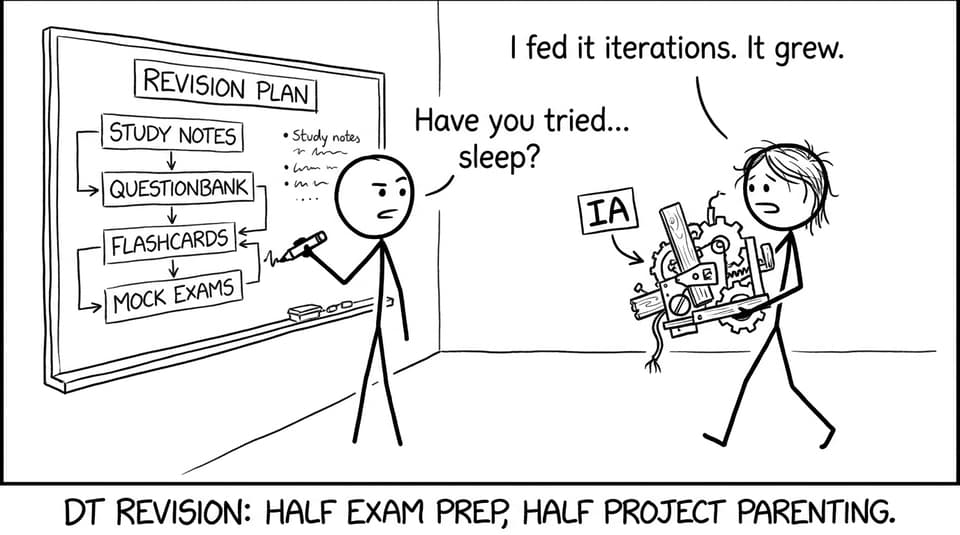
It’s also worth being honest about your habits. IB Design Technology punishes the “I’ll sort it out later” mindset because design work grows best in steady weekly progress.
For time-management structure across Group 4, this guide helps: Best study schedule for IB Group 4 sciences.
How universities view IB Design Technology
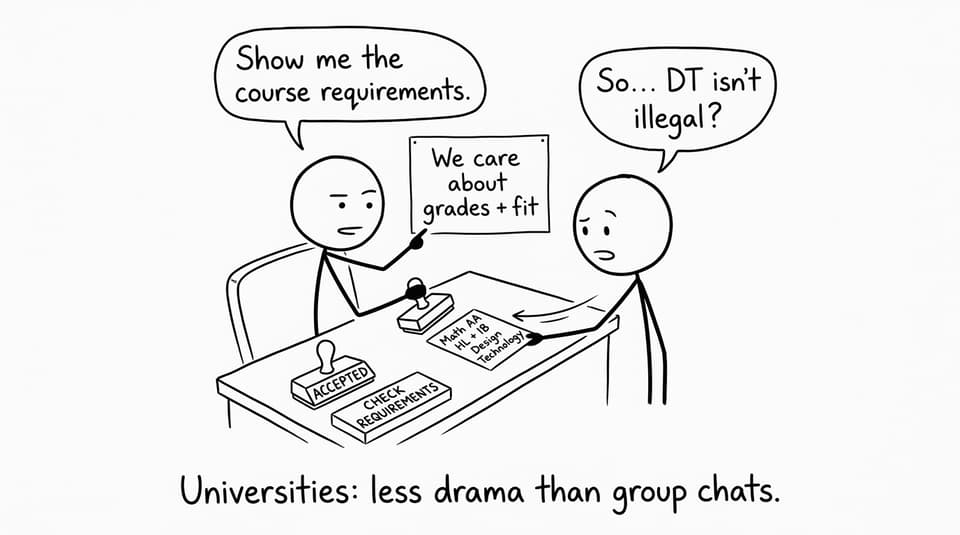
Universities generally don’t dismiss IB Design Technology because it’s “different.” They look at:
-
whether you meet prerequisites,
-
your overall subject combination,
-
and the grades you achieve.
For engineering or design-adjacent pathways, IB Design Technology can even signal fit. The key move is simple: check requirements early, then build your DP combination around them.
Exam prep: how to score well in IB Design Technology
If you pick IB Design Technology, the winning strategy is a loop: learn, practise, fix, repeat.
RevisionDojo is built for that loop:
-
Use Study Notes to learn topics quickly without drowning.
-
Drill exam technique with the Questionbank.
-
Keep definitions and processes alive with Flashcards.
-
Get unstuck fast using AI Chat (Jojo) and tighten your wording to match markscheme logic.
-
Train timing with Mock Exams and Predicted Papers.
-
For coursework support, lean on the Coursework Library and Grading tools to see what “top band” really looks like.
If you want an end-to-end walkthrough, use: How to use RevisionDojo for IB Design Technology success.
Conclusion: is IB Design Technology a good choice for Group 4?
IB Design Technology is a smart Group 4 choice when it matches how you learn, what you want to study later, and how you manage long projects. It rewards students who enjoy applied problem-solving, clear justification, and steady iteration.
If you’re leaning toward IB Design Technology, make it official by building a revision system early. Start with the IB Design Technology resources hub, then run a simple weekly loop using RevisionDojo’s Questionbank, Study Notes, Flashcards, AI Chat, Grading tools, Predicted Papers, Mock Exams, Coursework Library, and Tutors.
In the IB, confidence usually isn’t a personality trait. It’s what happens when your preparation finally feels inevitable. And IB Design Technology gives you a very practical way to get there.