
Choosing a sixth-form qualification can feel uncomfortably permanent. Parents naturally worry that selecting the wrong programme might quietly close a university door two years later.
The reassuring answer is that both the IB Diploma and A-Levels are highly respected university-entry qualifications. Universities generally do not admit a student simply because one qualification appears at the top of the transcript. They consider performance, academic rigour, required subjects, predicted or achieved grades, and the wider application.
In the IB vs A Levels decision, neither route is universally better for university admissions. The IB offers breadth, sustained assessment, and independent research. A-Levels offer greater specialisation in fewer subjects. The better choice is the programme in which the student can take the right subjects, earn strong grades, and remain intellectually engaged.
The short answer for parents
Use this checklist before comparing league tables or theoretical grade equivalencies:
- Both qualifications are accepted: Leading universities routinely publish entry requirements for IB and A-Level applicants.
- Course-specific subjects matter: A strong total cannot always compensate for missing the required Mathematics, Chemistry, language, or other subject.
- Performance matters more than the label: A student needs an academically suitable programme in which they can achieve consistently.
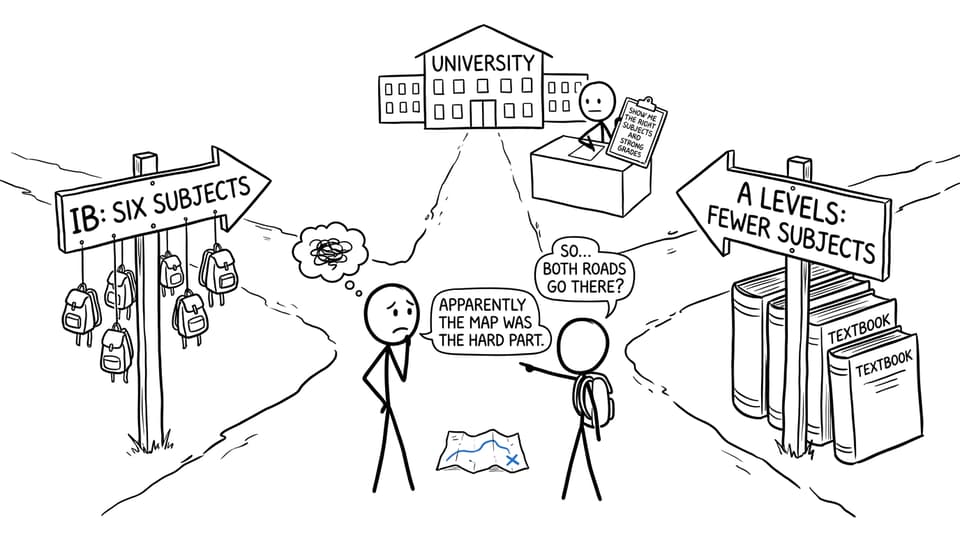
- IB provides breadth: Students study six subjects alongside Theory of Knowledge, the Extended Essay, and Creativity, Activity, Service.
- A-Levels provide concentration: Students typically focus on three subjects, although arrangements vary by school and student.
- The practical decision is personal: Learning style, subject availability, workload management, and intended degree should guide the choice.
Parents wanting a broader curriculum comparison can read RevisionDojo’s guide to choosing between A-Levels and the IB Diploma.
What is the IB Diploma?
The IB Diploma Programme is a two-year pre-university programme built around six subjects and a compulsory core. Students normally take three subjects at Higher Level and three at Standard Level, although the programme permits some variation.
Each subject receives a grade from 1 to 7. The six subjects can contribute 42 points, while Theory of Knowledge and the Extended Essay can contribute up to three additional core points. This produces a maximum Diploma score of 45. Creativity, Activity, Service does not add numerical points, but completing it is required.
That structure matters for admissions because it presents universities with two kinds of evidence. Higher Level subjects show where a student has pursued greater depth, while the full Diploma demonstrates continued engagement across languages, mathematics, sciences, humanities, and other disciplines. RevisionDojo’s explanation of how many subjects IB students take provides a useful overview for families new to the programme.
The core adds another dimension. The Extended Essay requires sustained independent research, while Theory of Knowledge asks students to examine how knowledge is created and justified. These are not automatic admissions advantages, but they can develop research, argument, and time-management skills relevant to university study. Families can explore the IB core requirements for TOK, EE, and CAS in more detail.
How A-Levels differ
A-Levels usually allow students to study fewer subjects in greater depth. A prospective engineering student might concentrate on Mathematics, Further Mathematics, and Physics. A future humanities student might combine English Literature, History, and a language.
This specialisation can be valuable when a student already knows what they want to study. It creates more curriculum space for the subjects most closely connected to a future degree. It can also remove areas in which the student is less confident, such as continuing a language or mathematics.
The trade-off is narrower academic breadth. A student who changes direction late may discover that a required subject was dropped earlier. This is why the best comparison begins with possible university courses rather than with assumptions about which qualification sounds more prestigious.
| Consideration | IB Diploma | A-Levels |
|---|---|---|
| Academic structure | Six subjects plus the core | Usually three main subjects |
| Main strength | Breadth with depth at Higher Level | Deeper specialisation |
| Scoring | Total out of 45, including up to three core points | Separate letter grade for each subject |
| Independent work | Extended Essay, TOK, CAS, and subject coursework | Varies by subject and awarding body |
| Best suited to | Students who value breadth or want to keep options open | Students ready to specialise |
| Main risk | Workload becomes fragmented across many deadlines | Early subject choices may narrow later options |
Do universities prefer the IB or A-Levels?
There is no reliable basis for saying that universities universally prefer one. Admissions teams understand both systems and publish separate requirements so applicants can be assessed within the qualification they actually studied.
Oxford illustrates the principle clearly. Its published requirements accept both routes and translate course expectations into qualification-specific offers. Depending on the course, Oxford’s IB offers generally require a total of 38, 39, or 40 points, including core points, with 6s and 7s at Higher Level. Its A-Level offers are stated separately, commonly between AAA and A*A*A depending on the course. The important point is not a universal conversion. It is that the institution recognises both and identifies the achievement it expects within each system.
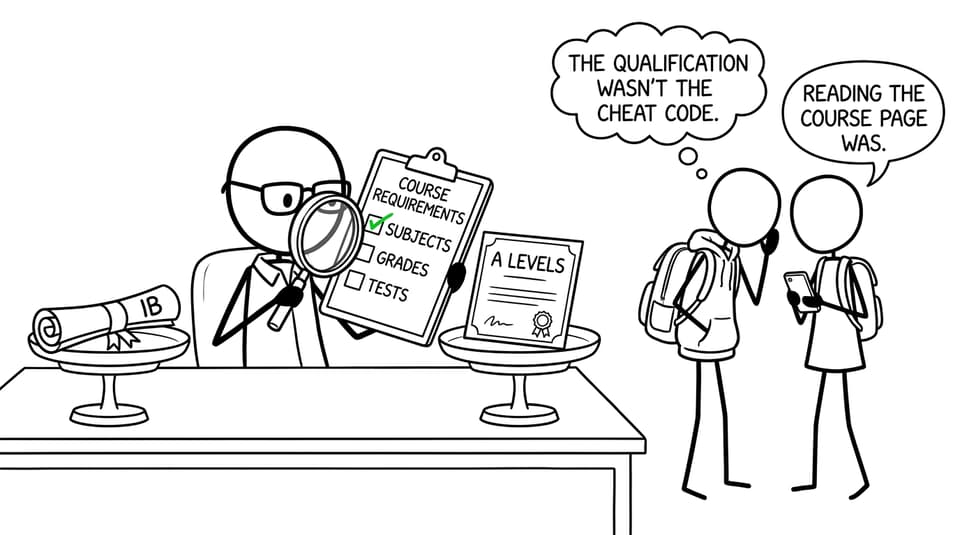
Universities may also care more about subject configuration than headline total. For example, a degree that requires advanced Mathematics may specify an appropriate IB Mathematics course at Higher Level or Mathematics at A-Level. RevisionDojo’s parent-focused guide to how universities evaluate IB Higher and Standard Level subjects explains why these details deserve early attention.
What the HESA research actually tells us
Research using UK Higher Education Statistics Agency data offers encouraging evidence about how IB students progress after school. An IB-commissioned study of UK higher education outcomes compared IB Diploma and A-Level students entering UK universities between the academic years 2013-14 and 2018-19.
After creating matched samples to account for differences in background and academic preparation, the researchers reported that Diploma students were significantly more likely to attend a top-20 UK higher education institution, graduate with honours, and enter further study after graduation. A later IB research brief reported that matched Diploma students were around three times as likely to enrol at a top-20 institution in that dataset.
Those findings should be interpreted carefully. They show an association across matched groups, not proof that choosing the IB itself causes admission to a more selective university. IB students and A-Level students can differ in geography, school context, subject choices, ambitions, and other ways that statistical matching may not fully capture. The research supports the conclusion that IB students can thrive in UK higher education. It does not establish a blanket admissions preference.
The studies also used UCAS Tariff information when comparing qualifications and prior attainment. The current UCAS Tariff calculator assigns numerical values to eligible qualification components, but not every university uses tariff-based offers. Selective courses often state exact IB totals, Higher Level grades, A-Level grades, and required subjects instead. Families should therefore treat tariff points as a comparison tool, not a universal admissions formula.
When the IB may be the stronger choice
The IB may fit a student who enjoys several academic areas, writes confidently, works steadily across long projects, and has not yet committed to a narrow specialism. Its breadth can preserve flexibility, particularly when future plans might cross disciplinary boundaries.
It can also suit internationally mobile families because the programme follows a shared global framework. Recognition does not mean identical requirements everywhere, however. Students must still check each university, country, and course individually. RevisionDojo’s global IB university application guide can help families organise that research.
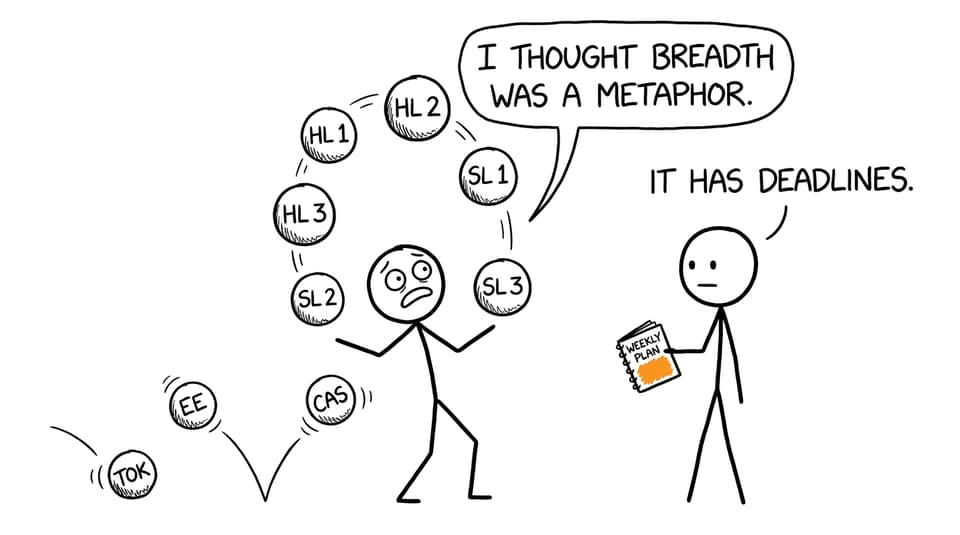
The crucial caution is workload. Six subjects plus internal assessments, TOK, the Extended Essay, and CAS create overlapping responsibilities. A student does not need to be perfect at everything, but they do need systems. Without them, one neglected Standard Level subject can quietly reduce the overall score while major coursework deadlines compete for attention.
When A-Levels may be the stronger choice
A-Levels may suit a student with a clear degree direction and pronounced strengths in a smaller group of subjects. Someone who is certain about Mathematics, Physics, and engineering may prefer spending more curriculum time in those areas rather than maintaining six disciplines.
They can also be a sensible option when the student’s strongest learning pattern is intensive subject immersion. Fewer subjects do not automatically mean easy study. A-Level courses can demand substantial depth, and competitive university offers still require excellent results.
The risk lies in choosing too narrowly without checking degree requirements. A student considering medicine, economics, engineering, or another subject-sensitive course should investigate required and recommended combinations before enrolment. Changing ambitions is easier when the original choices leave room to move.
How to make the decision without guessing
Begin with a shortlist of possible degrees, even if it is provisional. For each one, examine several university course pages and record required subjects, preferred subjects, typical offers, admissions tests, and any written-work expectations.
Then ask four practical questions:
- Does the school offer the necessary IB Higher Level or A-Level subjects?
- Which programme matches the student’s strongest way of learning?
- Can the student manage either broad, continuous deadlines or concentrated subject depth more effectively?
- Where is the teaching, counselling, and academic support stronger?
For IB applicants, predicted grades can influence decisions made before final results are available, particularly where universities issue conditional offers. Consistency therefore matters well before the final examination period. The guide to IB predicted grades in early university applications explains how schools and universities use these estimates.
The qualification matters less than the system behind it
A curriculum is only valuable if a student can manage it well enough to show what they know. This is especially true for the IB. Its breadth is an educational strength, but six subjects and the core can make revision feel like trying to keep nine clocks set to different time zones.
That is why structure matters. RevisionDojo brings the work into one clear system: Study Notes to repair understanding, Flashcards to strengthen recall, a Questionbank for targeted application, and AI Chat for difficult concepts. Grading tools, Predicted Papers, and Mock Exams help students practise under realistic conditions, while the Coursework Library and Tutors provide support when independent work needs sharper direction. Families can begin with the complete collection of RevisionDojo IB resources.
The final answer is reassuring. Universities respect both routes. The IB is not automatically superior because it is broader, and A-Levels are not automatically superior because they are more specialised. The strongest qualification is the one that provides the right subjects, fits the student’s abilities, and supports grades that meet the chosen course requirements.
Choose the programme carefully. Then stop comparing labels and build the habits that turn potential into an offer.