



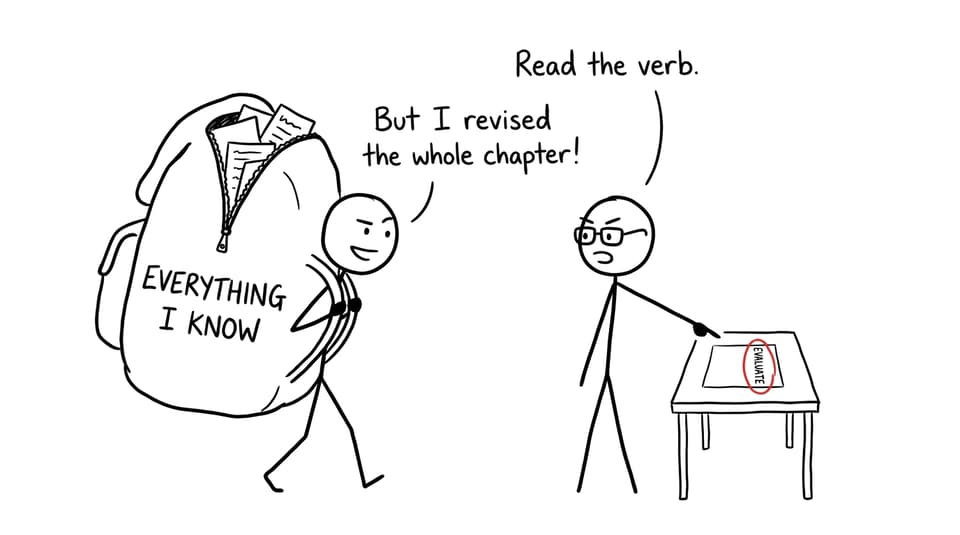
There is one piece of IB teacher advice that appears across subjects with remarkable consistency: students often answer the topic they revised instead of the question they were asked.
They recognize a familiar concept, remember several pages of notes, and begin writing. The knowledge may be accurate. Yet the answer does not perform the command term, respect the boundaries of the prompt, or provide the evidence the assessment requires.
That is the mistake. Not ignorance or a lack of ambition. It is failing to convert knowledge into a response that can earn marks.
The teacher checklist in 30 seconds
Before answering an IB question, identify five things:
- Command: What must you do, such as explain, compare, evaluate, or calculate?
- Content: Which exact concept must you address?
- Boundary: Is the question limited by a case, source, period, example, or method?
- Depth: How much development do the available marks suggest?
- Evidence: What must be visible for the answer to receive credit?
If one remains unclear, pause before writing. Ten thoughtful seconds can prevent ten minutes of irrelevant work.
The central IB teacher advice: answer the verb
IB command terms are not decorative wording. Official IB assessment guidance describes them as words or phrases indicating what a response requires. Their precise application can vary by subject, so students should learn the terminology in each current subject guide.
An explanation is not automatically an evaluation. A description is not an analysis. A correct numerical result may not display the reasoning requested by the question.
Consider a student who sees a familiar economics policy and writes everything remembered about it. If the prompt asks them to evaluate the policy, description is only the beginning. They need a reasoned judgment supported by evidence, limitations, and context.
This is why learning how IB command terms shape answers matters. The content tells you what to discuss. The command term tells you what to do with it.
Why strong students make this mistake
Under pressure, the brain reaches for what feels known. A student sees “photosynthesis,” “market failure,” or “authorial choice” and retrieves a prepared response. Unfortunately, the question may ask for one mechanism, a comparison in a specific context, or a judgment based on supplied evidence.
This is among the most important common mistakes during IB revision. Students practise reproducing information, then expect that habit to become analysis during an assessment. Exam technique must be developed as deliberately as content knowledge.
What answering the question actually looks like
Translate the prompt into a deliverable before writing.
| Prompt feature | Question to ask yourself |
|---|---|
| Command term | What kind of thinking must be visible? |
| Topic | Which knowledge is directly relevant? |
| Qualifier | What must I include, exclude, or prioritize? |
| Marks | How many developed steps or ideas are realistic? |
| Evidence | What working, examples, data, or reasoning should I show? |
If the command term is compare, refer to both items throughout rather than describing one and forgetting the relationship. If it is explain, build a chain connecting cause, mechanism, and outcome. If it is evaluate, establish a basis for judgment, consider relevant strengths or limitations, and reach a supported conclusion.
The exact response shape depends on the subject and assessment. Students should inspect current course guidance and ask teachers what successful performance looks like. Understanding how IB markschemes work also helps distinguish answers that sound intelligent from answers containing visible, creditworthy reasoning.
Other common IB student mistakes teachers notice
Answering the wrong task is the central problem, but it appears in several forms.
Writing before thinking
Students sometimes begin with the first relevant fact that enters their minds. The paragraph then decides the argument instead of the argument deciding the paragraph.
For an extended response, write a one-line position or route before drafting. For calculations, identify the target quantity and method. For source questions, decide which evidence directly addresses the prompt.
Treating feedback as a verdict
A score shows where the performance landed. It does not automatically explain what to change. Productive review identifies the failure precisely: content, command term, method, structure, evidence, or timing.
“Revise biology” is too broad to guide action. “When explaining transport, connect the concentration gradient to net particle movement” is a reusable correction rule. Record what the question required, what your answer did instead, and how you will respond next time. Then reattempt a similar task within 24-48 hours.
The process in turning IB mistakes into useful feedback is simple, but that is its strength. Improvement becomes easier once the error has a name.
Practising only in comfortable conditions
Untimed work helps while learning a method, but it cannot fully test whether that method survives pressure. Progress from individual questions to timed sections and realistic simulations.
RevisionDojo’s guide to using an IB Questionbank effectively recommends reviewing patterns rather than accumulating completed questions. The Questionbank builds targeted skill, Grading tools clarify weaknesses, and Predicted Papers and Mock Exams test timing, selection, and stamina.
A five-step routine that fixes the problem
Use this cycle during revision and assessments.
Decode
Circle the command term. Underline the content. Box qualifiers such as “using the data,” “with reference to,” or “to what extent.”
Translate
Finish this sentence: “To earn credit, my answer must show...” Make the output observable. For example, “two explicit similarities and one meaningful difference” is better than “a good comparison.”
Plan
Choose the smallest structure capable of completing the task. Do not plan an entire chapter when the question needs three connected ideas.
Produce
Write so the reasoning is visible. State relationships directly, show relevant working, and use precise subject vocabulary. Do not expect an examiner to infer a conclusion you never expressed.
Review
Before moving on, ask: “Did I perform the command term?” This catches answers that are knowledgeable but misaligned.
For weekly practice, use RevisionDojo’s Study Notes and Flashcards to repair knowledge gaps, then apply that material in the Questionbank. AI Chat and Grading tools can identify descriptive, incomplete, or unsupported answers. The RevisionDojo guide to effective IB revision can help make this cycle sustainable.
Coursework has the same hidden problem
The mistake is not confined to timed assessments. An Internal Assessment, Extended Essay, or TOK task can contain impressive research while responding weakly to its criteria or research question.
Before adding another source, ask what the criterion requires and where the draft demonstrates it. RevisionDojo’s Coursework Library helps students examine how successful work makes structure, analysis, and reflection visible. When feedback remains unclear, Tutors can diagnose a specific bottleneck rather than recommending another vague round of revision.
Make every answer easier to reward
The lesson is not to know less. It is to select better.
Knowledge gives you options. Question reading tells you which option belongs. Structure makes your thinking visible, while feedback prevents the same mistake from returning under another topic.
The strongest advice for new IB students is rarely glamorous: learn the criteria early, practise retrieval, attempt questions regularly, and review the mistake rather than only the score.
RevisionDojo brings that cycle together through Study Notes, Flashcards, the Questionbank, AI Chat, Grading tools, Predicted Papers, Mock Exams, the Coursework Library, and Tutors. The ultimate IB resource is not simply the place containing the most information. It is the one that helps turn what you know into what the question can reward.