If you have ever stared at your IB subject choices and felt your confidence leak out through your ears, you are not alone. The decision between IB SEHS and Physics rarely feels like a clean fork in the road. It feels like two different versions of you arguing at 1 a.m.: one wants real bodies, real movement, real health; the other wants clean laws, elegant equations, and the quiet satisfaction of getting the same answer twice.
This guide is for exam-focused IB students who want clarity. We will compare IB SEHS and IB Physics by content, assessment style, skills, and university direction, then end with a simple way to decide (and revise) with less stress.
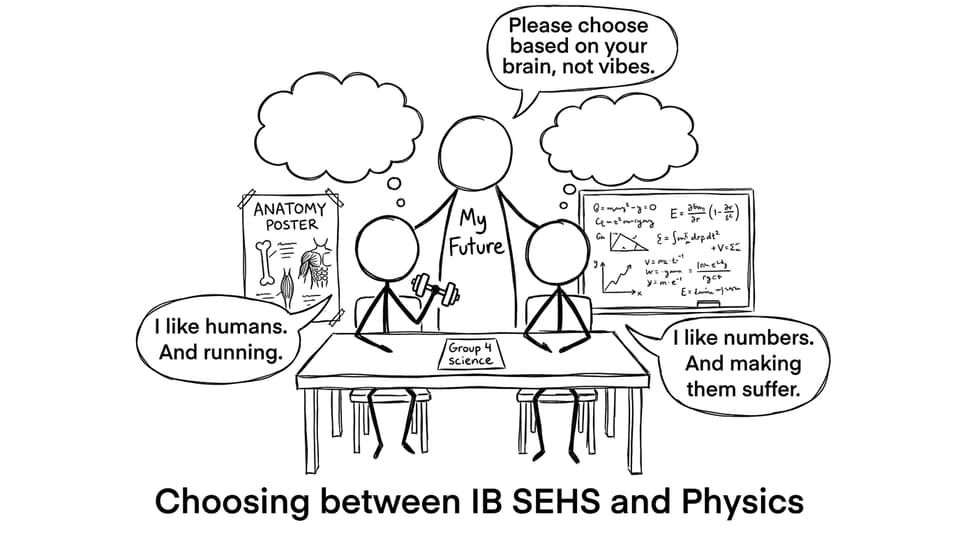
Choosing between IB SEHS and Physics
Quick checklist before you choose IB SEHS or Physics
Use this as a fast filter. If most of your answers land on one side, your choice is usually hiding in plain sight.
You want human biology, performance, and health contexts (lean IB SEHS).
You enjoy abstract models, problem sets, and heavy maths practice (lean Physics).
You want an IA that can be built from applied measurements on people or performance variables (often IB SEHS).
You want an IA that rewards precision, uncertainty handling, and technical modelling (often Physics).
You want your revision to feel like real-world case studies (often IB SEHS) vs. a puzzle gym (often Physics).
IB SEHS leans into the science of people: how bodies work, why performance changes, and what health means across populations. You will meet:
Anatomy and physiology
Energy systems, fatigue, hydration, and nutrition
Biomechanics and movement analysis
Sport psychology and skill acquisition
Broader health challenges and interventions
A good clue is the kind of curiosity it rewards: in IB SEHS, a question often starts with a person (an athlete, a patient, a population), then asks you to explain what is happening and why.
Physics is the opposite kind of powerful. It takes a messy world and tries to compress it into models that still predict reality. You will meet:
Mechanics (motion, forces, momentum)
Electricity, waves, thermal physics
Modern physics topics like quantum and nuclear ideas
Mathematical modelling across contexts
In Physics, the person disappears and the system becomes the story. Your job is to choose the right model, apply it cleanly, and communicate reasoning under time pressure.
IB SEHS exams still demand precision, but the thinking often feels closer to applied biology and data interpretation. Many students find they can anchor revision in scenarios: a training plan, a fatigue curve, an injury mechanism, a nutrition choice.
For coursework, IB SEHS Internal Assessments commonly suit investigations tied to performance, physiology, or simple biomechanics, with meaningful discussion of variables and limitations.
To strengthen your coursework workflow, RevisionDojo also has a Coursework Library and grading support. You can browse subject-specific coursework spaces like: SEHS Coursework Exemplars.
Physics assessment style
Physics exams reward clean method and consistency. Marks often come from setting up correctly, showing steps, handling units, and managing uncertainties.
For the Physics IA, your experimental design and evaluation matter as much as your final graph. Many students lose marks not because they are “bad at physics,” but because their uncertainty analysis, controls, or justification is thin.
To practice under realistic conditions, RevisionDojo supports timed practice loops with tools like the Questionbank and exam-style sets. Start with the subject hub: IB Physics Resources.
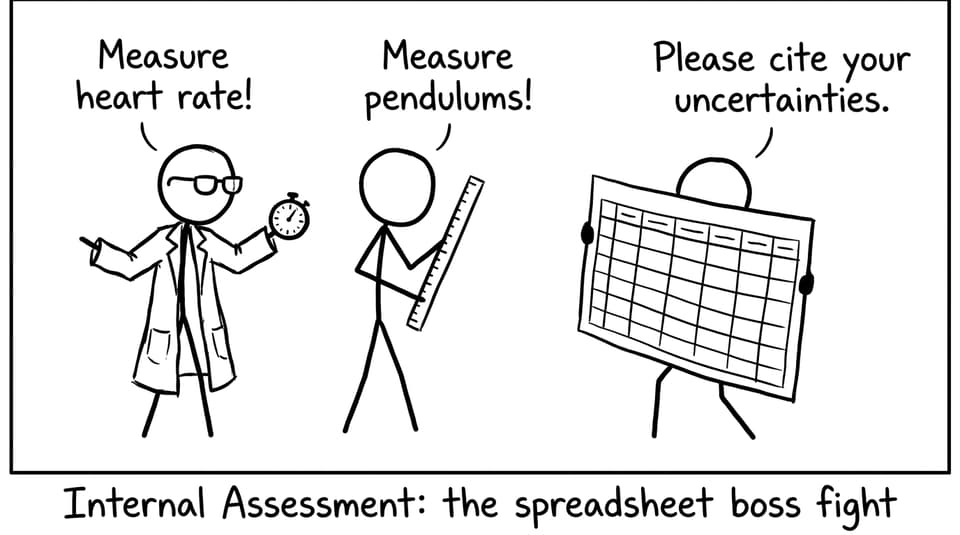
Internal Assessment: the spreadsheet boss fight
Skills you build (and what that means for revision)
Here is the honest difference: IB SEHS often builds breadth across human systems and evidence-based explanation, while Physics builds depth in modelling and quantitative problem-solving.
If you pick IB SEHS, you will likely strengthen
Applied lab and research design thinking
Evaluation and real-world interpretation
Clear scientific writing tied to health and performance
Data handling with context (what the numbers mean for people)
If you pick IB SEHS, your exam prep typically improves fastest when you combine short notes with constant application. That is why many students use a tight loop of Study Notes, Flashcards, and the Questionbank.
If you pick Physics, you will likely strengthen
Algebraic fluency and multi-step reasoning
Abstraction (seeing the same structure in different problems)
Precision with measurement, units, and uncertainties
Stamina for longer problem sets
For Physics, volume matters, but only if feedback is immediate. RevisionDojo’s Questionbank feature is built for exactly that: practice at scale, then fix the specific mistake pattern.
University pathways: which doors each subject opens
Choose IB SEHS if you are excited by pathways like:
Sports science, kinesiology
Physiotherapy, rehabilitation
Nutrition, wellness, public health
Coaching, PE, human performance
Choose Physics if you are aiming at pathways like:
Engineering (mechanical, electrical, civil)
Physics, space science, technology
Robotics, certain quantitative STEM tracks
Also note the hybrid space: biomechanics, sports engineering, and medical technology can benefit from either subject (and sometimes both), depending on the degree requirements.
A simple decision method (that IB students actually stick to)
If you are torn between IB SEHS and Physics, do this:
Spend 45 minutes on one SEHS topic and 45 minutes on one Physics topic.
Do 10 exam-style questions for each right after.
Ask yourself: which one made you feel “challenged but steady” instead of “lost and annoyed”?
Then commit and build routine. RevisionDojo makes that routine easier because everything connects: Study Notes, Flashcards, Questionbank, AI Chat when you are stuck, plus Mock Exams and Predicted Papers for realistic practice. If you want a burnout-resistant structure, use: How to Study for IB Mocks (Without Burning Out).
FAQ
Is IB SEHS respected as a Group 4 science?
Yes, IB SEHS is a Group 4 science and is treated as a serious academic subject. Universities typically evaluate it based on relevance to the degree, not on stereotypes about sport. If you are applying to health, human performance, physiotherapy, or sport-related programs, IB SEHS can be directly aligned with what you will study next. The key is how you present it: highlight the scientific skills (data analysis, evaluation, research design), not just the topic area. During exam prep, show that seriousness by doing consistent exam-style practice rather than only reading notes. On RevisionDojo, that usually means mixing Study Notes, Flashcards, and targeted Questionbank sets.
Is IB SEHS easier than Physics?
It depends on what your brain finds “natural.” Many students find IB SEHS more intuitive because it is grounded in people and real situations, while Physics can feel abstract and maths-heavy. But SEHS can still be demanding because you must learn precise terminology, apply concepts, and evaluate evidence clearly under time pressure. Physics can be very learnable if you enjoy repetition and pattern recognition, because similar models appear across many questions. The real predictor is not the label “easy” or “hard,” but whether you can sustain weekly practice without avoiding the subject. If you can see yourself opening practice questions regularly, you will usually do well.
Can I take IB SEHS and Physics together?
If your timetable allows, taking IB SEHS and Physics together can be a strong combination. It suits students interested in biomechanics, sports technology, rehabilitation engineering, or medical tech where both human systems and physical modelling matter. The challenge is workload: both subjects require labs, write-ups, and steady revision across the year. To make that manageable, you need a clear system for practice and feedback, not just motivation. RevisionDojo helps because you can run the same workflow in both subjects: learn with Study Notes, retain with Flashcards, apply with the Questionbank, then simulate pressure with Mock Exams and Predicted Papers. If you get stuck, AI Chat and Tutors can help you break through a specific block without losing a week.
Conclusion: choose the science you will actually revise
The best choice between IB SEHS and Physics is the one you can practice when you are tired, busy, and two weeks from exams. IB SEHS rewards students who like applied human science and evidence-based explanation. Physics rewards students who like modelling, maths, and disciplined problem-solving.
If you want to make either subject feel simpler, build your revision around RevisionDojo: use the Questionbank for daily exam practice, Study Notes for clarity, Flashcards for retention, AI Chat for quick explanations, and Mock Exams plus Predicted Papers when you are ready to simulate pressure. Start with the hub that matches your choice: IB Sports, exercise and health science Resources or IB Physics Resources.
IB SEHS goal setting in sport made simple: goal types, SMART targets, common mistakes, and exam-ready tips using RevisionDojo practice tools.