Global health problems rarely arrive with a warning label.
They show up quietly: a rising resting heart rate in a family member, a friend who stops sleeping, a community where cheap calories beat nutritious meals, a post-injury limp that never fully goes away. Then you open your notebook and realize IB SEHS has been describing these same stories all along -- just with better vocabulary.
This is why IB SEHS can feel unusually “real” compared to other subjects. You are not only learning how bodies move and adapt; you are learning how societies drift toward disease, and how small interventions can scale into public health change.
If you are revising for exams, this connection to global health issues is more than interesting context. It is a shortcut to better answers: clearer examples, stronger evaluation, and more memorable mechanisms.
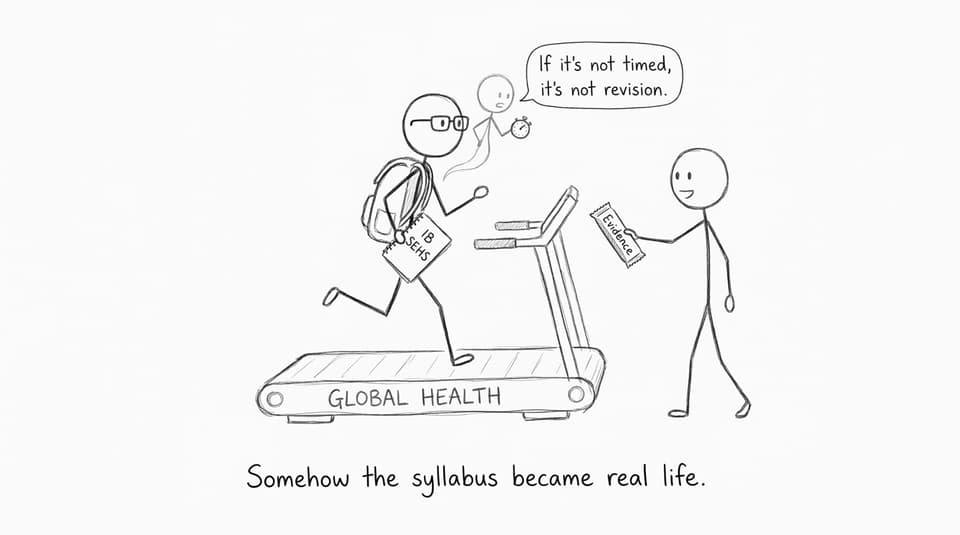
Student revising global health on a treadmill
Quick checklist: global health themes you can spot in IB SEHS
Use this as a fast scan while you revise IB SEHS topics (and while you practise exam questions):
Obesity and inactivity: energy balance, behaviour change, barriers to exercise
Cardiovascular disease (CVD): training adaptations, risk factors, prevention
Nutrition challenges: macro/micronutrients, hydration, access and sustainability
Mental health: stress, anxiety, motivation, adherence and wellbeing
IB SEHS and obesity: the “normal” lifestyle that becomes a disease
One of the hardest parts of obesity as a global health issue is that it often looks like everyday life: sitting, snacking, rushing, repeating.
In IB SEHS, you are given the tools to explain why this becomes biologically expensive over time. You can connect energy balance to metabolism, link inactivity to reduced cardiovascular fitness, and discuss how adherence (not motivation speeches) drives long-term outcomes.
In exams, this helps you avoid vague statements like “exercise is good.” Instead, you can describe mechanisms and evaluate interventions: structured training plans, progressive overload, and realistic behaviour change strategies.
IB SEHS and cardiovascular disease: prevention is a training adaptation story
Cardiovascular disease remains a leading global cause of mortality, and IB SEHS gives you a practical lens: prevention is not abstract -- it is physiological adaptation.
When you revise aerobic training, you are revising a prevention toolkit: changes in stroke volume, cardiac output responses, vascular function, and the long-term effects of consistent physical activity. You can also evaluate risk factors (diet, smoking, inactivity, stress) without turning your answer into a generic health poster.
A good revision move is to anchor theory to a specific topic page and then practise. For example, if you are revising how the body coordinates systems under stress, link it to: A.1.1 Inter-system communication.
IB SEHS and nutrition: when the science meets the supply chain
Nutrition in global health is not only about “what is ideal.” It is also about what is available, affordable, and culturally normal.
IB SEHS lets you discuss nutrition with scientific precision: macronutrients for energy and recovery, micronutrients and deficiency risks, hydration and electrolyte balance, and the way fuelling choices interact with training and health outcomes.
If you want a clean revision path here, use a single focused page and build from it: Hydration and nutrition.
Then convert knowledge into marks with active recall: turn the definitions you keep forgetting into Flashcards, and test the tricky application points with the Questionbank. RevisionDojo is built for that loop (Study Notes, Flashcards, Questionbank, AI Chat), so you do not just “cover content,” you actually retain and apply it.
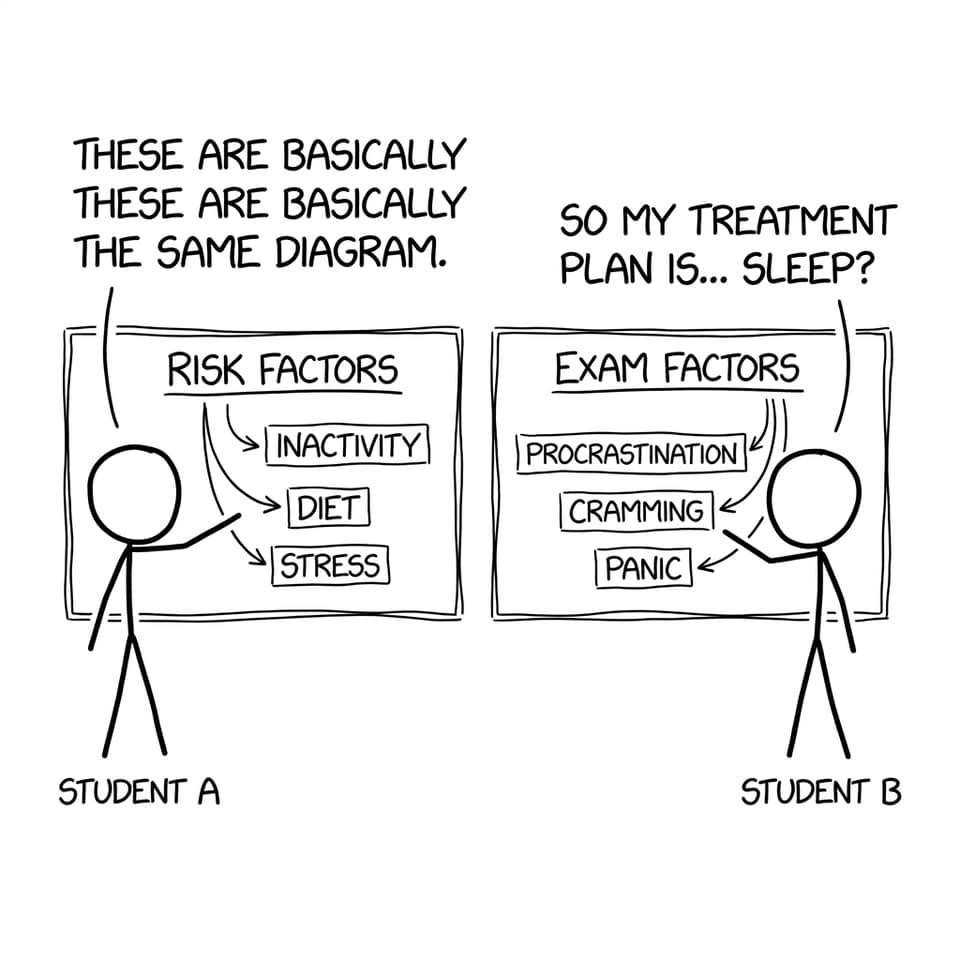
Two diagrams: health risk factors vs exam risk factors
IB SEHS and mental health: the global issue hiding inside performance psychology
Mental health can feel like a separate conversation from sport and exercise, but IB SEHS makes the bridge obvious: physical activity affects mood, stress regulation, sleep quality, and social connection.
The psychology content also helps you write better exam responses because it forces you to define terms carefully and link them to outcomes: adherence, anxiety, coping strategies, motivational climate, and goal setting.
IB SEHS and injury rehab: the “global health” version of sports injuries
Injury is not only an elite-sport storyline. Globally, musculoskeletal injuries, overuse, and chronic pain shape workplace participation, mental health, and quality of life.
IB SEHS helps you explain injury in a way that earns marks: causes and risk factors, prevention strategies, rehabilitation principles, and how interventions should be justified with evidence. It also connects naturally to coursework thinking: how would you measure recovery? how would you control variables? what makes a method valid?
If you are working on your IA skills alongside revision, the Coursework Library is a strong shortcut to understanding examiner expectations: IB SEHS IA Examples and SEHS Exemplars Library.
A simple exam-focused way to revise IB SEHS through global health
Try this weekly structure (it is calm, repeatable, and designed for marks):
Clarify (20 minutes): use RevisionDojo Study Notes on one subtopic from the IB SEHS hub.
Recall (10 minutes daily): Flashcards for definitions and key processes.
Apply (30--45 minutes): a targeted Questionbank set on that exact subtopic.
Simulate (weekly): a timed paper-style session using IB Predicted Papers where relevant.
Fix (10 minutes): use AI Chat to resolve one confusion, and log one mistake pattern.
How do I use global health examples without drifting off-topic in IB SEHS answers?
Treat global health as your example bank, not your main essay. Start with the IB SEHS concept the question is testing (for example, risk factors, training adaptation, or adherence). Then add one real-world link that directly illustrates that concept: obesity prevention campaigns, mental health and exercise adherence, or CVD risk reduction through aerobic training. After that, return immediately to the mark-focused language: define terms, explain mechanisms, and evaluate limitations. This keeps your answer disciplined while still sounding thoughtful and relevant. If you practise with timed questions in the IB SEHS Questionbank, you will get faster at this balance.
Which IB SEHS topics connect most strongly to global health issues for exam examples?
The strongest overlaps are the ones that show up in public messaging and in real healthcare costs: inactivity and obesity, cardiovascular disease prevention, nutrition and hydration, mental wellbeing, and injury prevention/rehabilitation. These topics let you use examples that examiners recognize as authentic, while still staying inside the syllabus. They also work for evaluation because you can discuss barriers, confounding variables, and individual differences. To make the connection concrete, revise one theme at a time using topic pages like Hydration and nutrition and then immediately apply it in questions. That apply step is where knowledge becomes exam performance.
How can RevisionDojo help me improve faster in IB SEHS specifically?
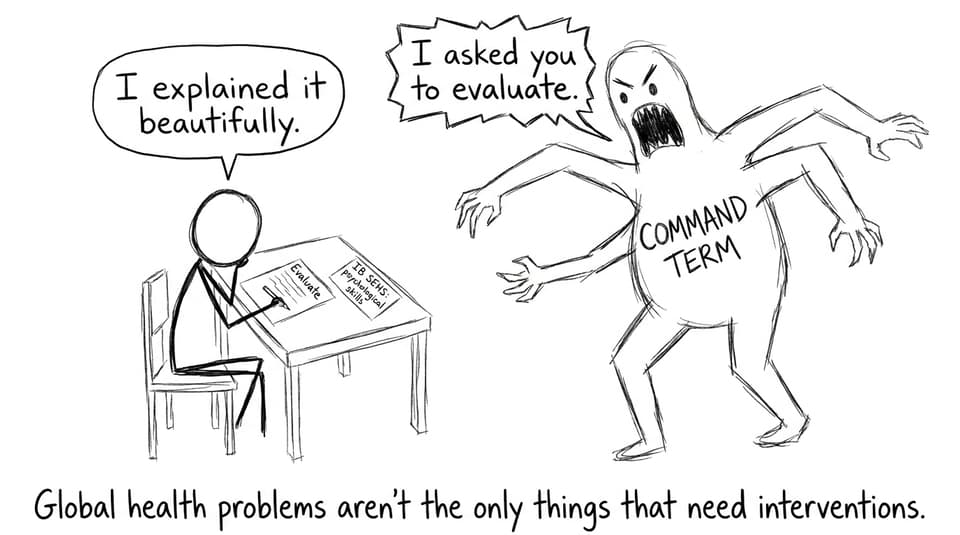
RevisionDojo helps because it turns IB SEHS revision into a feedback loop rather than a reading project. You can start with syllabus-aligned Study Notes to remove confusion, then lock in the hard-to-remember material using Flashcards. After that, you use the Questionbank to practise exam-style wording and command terms under time pressure, which is where most marks are won or lost. If you get stuck mid-session, AI Chat helps you clarify a mechanism or fix a definition without breaking your momentum. When you want realism, Predicted Papers and Mock Exams train pacing and decision-making so your knowledge survives the clock. And if coursework is part of your stress, the Coursework Library plus Grading tools and Tutors can help you improve drafts with targeted guidance rather than guesswork.
Conclusion: IB SEHS is global health, just written in exam language
Once you see it, you cannot unsee it: IB SEHS is a subject about the world as it is, not only the exam as it appears.
Obesity, cardiovascular disease, nutrition inequality, mental health strain, and injury rehabilitation are not separate from your syllabus. They are the syllabus, scaled up.
If you want your revision to feel clearer and more motivating, build your routine around that reality: learn with the IB SEHS resources hub, drill with the Questionbank, retain with Flashcards, and rehearse under pressure with timed practice and Predicted Papers. Your future self walks into the exam calmer when your preparation has already lived in the real world of IB SEHS.
IB SEHS goal setting in sport made simple: goal types, SMART targets, common mistakes, and exam-ready tips using RevisionDojo practice tools.