


Introduction: when sitting still makes your brain louder
The strange thing about IB revision is that it often asks you to behave like a person you’re not.
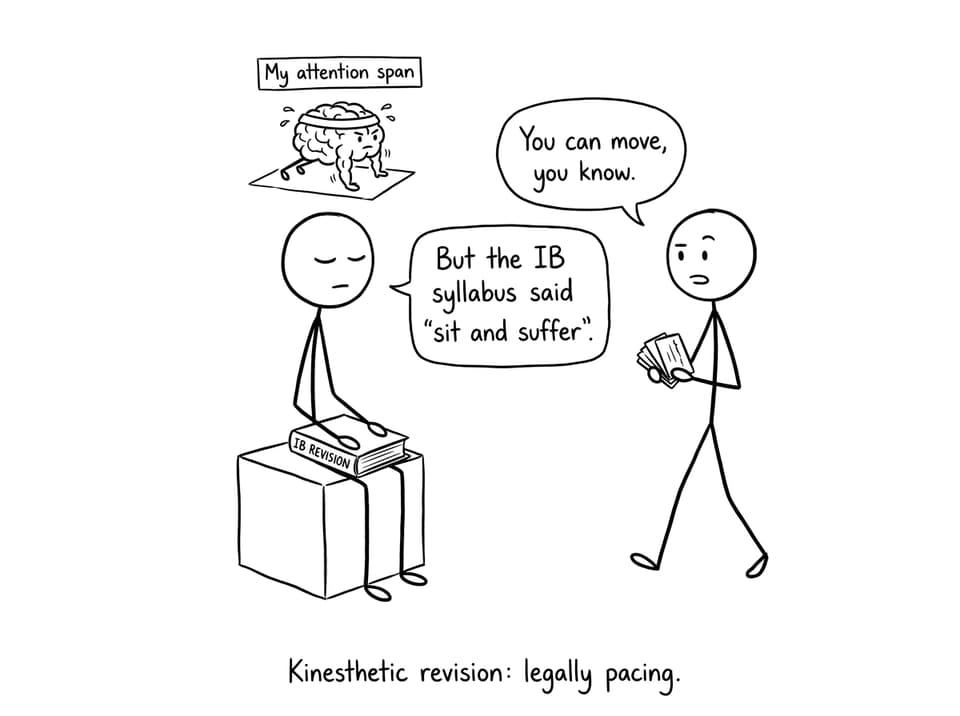
If you’re a kinesthetic learner, “quiet desk, highlighter, and willpower” can feel like trying to charge a phone by staring at it. You understand faster when you do something: build, move, sort, act, sketch big, test yourself out loud, then physically correct what went wrong.
This guide shares IB revision techniques designed for kinesthetic learners who need hands-on strategies that turn effort into marks. And because good intentions don’t survive exam season, we’ll also show how to plug these methods into RevisionDojo’s tools so your practice stays structured: Questionbank, Study Notes, Flashcards, AI Chat, Grading tools, Predicted Papers, Mock Exams, Coursework Library, and Tutors.
Quick checklist: the kinesthetic IB revision loop
Use this simple loop to keep IB revision active (not passive):
-
Learn one small chunk with Study Notes
-
Turn it into movement-based recall (whiteboard, cards, sorting, role-play)
-
Prove it with timed practice in the Questionbank
-
Ask one targeted question in [AI Chat] via the RevisionDojo app workflow
-
Schedule one weekly full rehearsal using IB Predicted Papers
What “kinesthetic learning” actually means in IB revision
Kinesthetic learning isn’t “I can’t focus.” It’s “my focus turns on when my body is involved.” For many IB students, that looks like:
-
You remember content better after you build or recreate it.
-
You understand essays once you’ve spoken an outline and physically moved pieces around.
-
You learn processes (Bio, Chem, Econ chains) by acting them out or sequencing steps.
The goal isn’t to replace reading. It’s to convert reading into action. That conversion is where retention and exam performance show up.
Hands-on IB revision techniques that work across subjects
Build it: models, manipulatives, and “make it real” learning
For IB sciences, anything you can hold becomes a memory anchor.
-
Chemistry: use model kits (or paper cut-outs) to build shapes, then explain VSEPR or polarity while rotating the model.
-
Biology: recreate processes (like transcription/translation) with labeled cards you physically move in sequence.
-
Math: use mini-whiteboards to rewrite a method from scratch, then cover it and redo it faster.
If you need content clarity before you build, start with a tight topic page like the IB Biology hub, then immediately turn what you learned into an object, a sequence, or a diagram you can redraw from memory.
Sort it: flashcards you can physically manipulate
Flashcards are naturally kinesthetic if you treat them like pieces on a table, not just prompts on a screen.
Try this IB routine:
-
Create three piles: “Easy,” “Almost,” “Unstable.”
-
Stand up and walk cards to the correct pile after answering.
-
Once a pile gets large, shuffle and retest while pacing.
RevisionDojo’s IB Flashcards (and the dedicated Flashcards feature page) make this easy to sustain because spaced repetition handles timing automatically. Your job is to show up, answer, and move on.
Perform it: acting out scenarios for Humans, Languages, and TOK
Some IB content is basically a story with structure. Kinesthetic learners can use performance to lock in sequence and causality.
-
History: stage a 60-second “event replay” and narrate causes, key actors, consequences.
-
English: stand and deliver thesis statements like mini-speeches until your argument sounds inevitable.
-
Economics/TOK: role-play two perspectives and physically switch chairs when you switch viewpoints.
The trick is to keep it short and repeatable. One minute, then test yourself with questions.
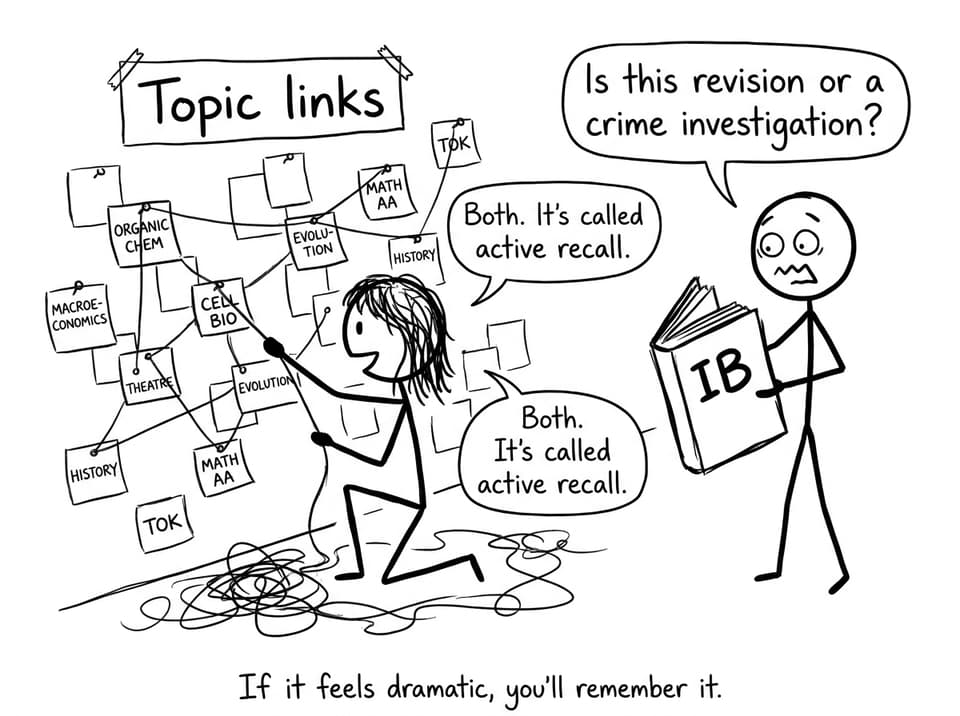
Write big: wall mind maps and whiteboard recall
Kinesthetic learners often think better when ideas take up space.
-
Put a topic in the middle.
-
Add branches with big keywords.
-
Step back and explain each branch without looking at notes.
-
Then fill gaps using your notes.
For fast, syllabus-aligned summaries you can translate into a wall map, use IB Cheatsheets as a launchpad.
Add movement without losing seriousness (the IB exam is still a desk)
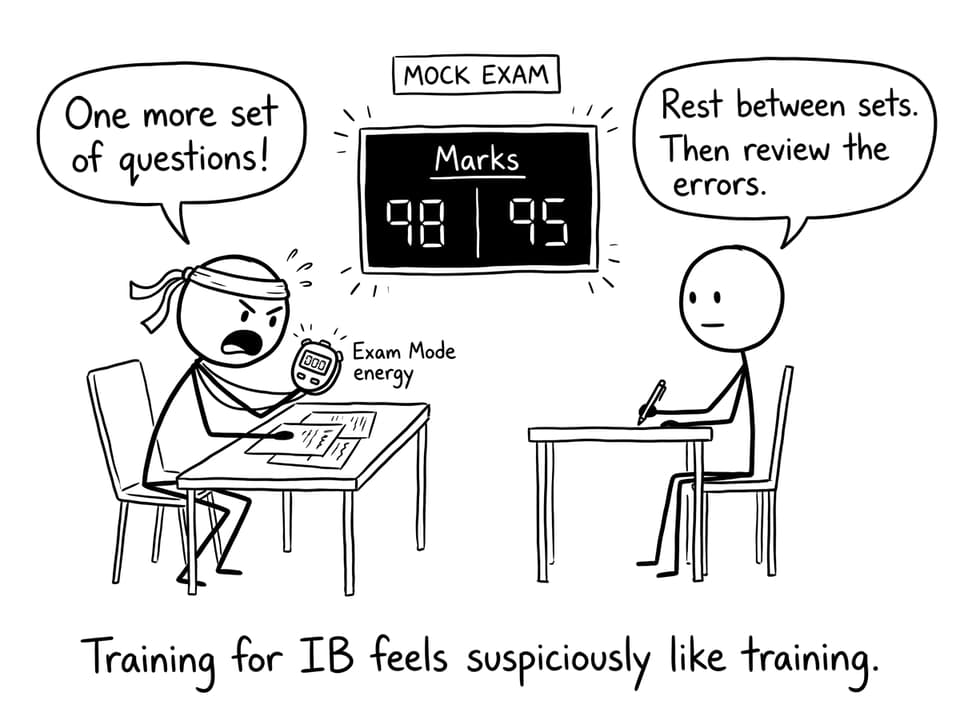
A common fear: “If I revise while moving, will I collapse when I’m forced to sit in the exam?” Not if you train both.
Use movement for learning and error-fixing, then sit-down conditions for performance.
A practical split:
-
Movement mode (learning): flashcards while pacing, whiteboard recall, sorting sequences.
-
Desk mode (performance): timed sets and full papers.
To build desk-mode stamina, borrow the structure from Custom IB Mock Exams and run one weekly rehearsal. That’s where your active learning turns into exam-ready output.
Turn hands-on revision into marks with RevisionDojo
Kinesthetic IB revision improves fastest when you can immediately do something with feedback.
-
Learn with Study Notes, then recreate the idea physically (model, map, sequence).
-
Practice with the Questionbank and keep an “error rule” list (one sentence per mistake pattern).
-
Use AI Chat support inside the RevisionDojo routine to ask: “What step am I skipping?” or “Which command term am I not answering?”
-
Rehearse with IB Predicted Papers and keep the loop tight: attempt, review, targeted drills, retake.
FAQ
How do I know if I’m a kinesthetic learner in IB?
You’ll notice it in the difference between understanding and remembering. In IB classes, you may understand a teacher explanation in the moment, then forget it later unless you recreated it yourself. You might also find that rereading notes feels “busy” but doesn’t translate into better performance on questions. Another sign is that your best study sessions happen when you’re drawing on a whiteboard, sorting flashcards, or talking through an answer while pacing. Kinesthetic learning doesn’t mean you can’t learn from reading; it means reading becomes effective after you convert it into action. If you want a structured way to explore this, start with Ways to Optimize IB Revision for Different Learning Styles and test a few methods for a week.
What are the best IB revision techniques for kinesthetic learners close to exams?
Close to exams, kinesthetic learners should prioritize techniques that create fast feedback loops. That means short bursts of active recall (standing flashcards, whiteboard brain-dumps, sorting sequences) followed immediately by exam-style questions. In IB, the difference between “I learned it” and “I can score on it” is usually practice under time pressure, so you want movement for learning but seated timing for performance. A strong approach is: 10 minutes movement-based recall, 25 minutes Questionbank practice, 10 minutes error review, then 5 minutes redoing one tricky question. Use RevisionDojo’s tools to keep the loop frictionless: Flashcards for recall, Questionbank for marks, and AI Chat when you’re stuck. Finally, add one weekly full rehearsal using Predicted Papers or Mock Exams so your body learns the exam rhythm too.
How can I use RevisionDojo if I need hands-on, active study?
RevisionDojo works well for kinesthetic IB students because it supports “do, check, adjust” instead of “read, hope, repeat.” Start by learning a single concept with Study Notes, then immediately recreate it using a physical method: a whiteboard explanation, a card sequence, or a quick role-play summary. Then open the Questionbank and do targeted questions on that exact topic so your understanding becomes exam output. When you miss marks, don’t just note the correct answer; use AI Chat to diagnose the mistake pattern (wrong command term, missing step, unclear definition) and write an “error rule” you can act out or rewrite. For bigger practice blocks, use Predicted Papers and Mock Exams to build stamina and pacing, then review results to choose your next hands-on drill. If coursework stress is draining your energy, the Grading tools and Coursework Library can reduce uncertainty fast, and Tutors can turn feedback into a concrete weekly plan.
Conclusion: make IB revision physical, then make it precise
If you’re a kinesthetic learner, the solution isn’t to “try harder” at silent rereading. It’s to make IB revision physical on purpose: build, sort, perform, map, and move. Then, when it counts, sit down and translate that energy into timed, mark-focused answers.
If you want one home base for that whole process, use RevisionDojo to run the loop: Study Notes for clarity, Flashcards for daily recall, Questionbank for exam practice, AI Chat and Grading tools for feedback, plus Predicted Papers, Mock Exams, the Coursework Library, and Tutors when you need extra support. Your learning style isn’t a weakness in the IB. It’s a lever, if you pull it the right way.