



Introduction
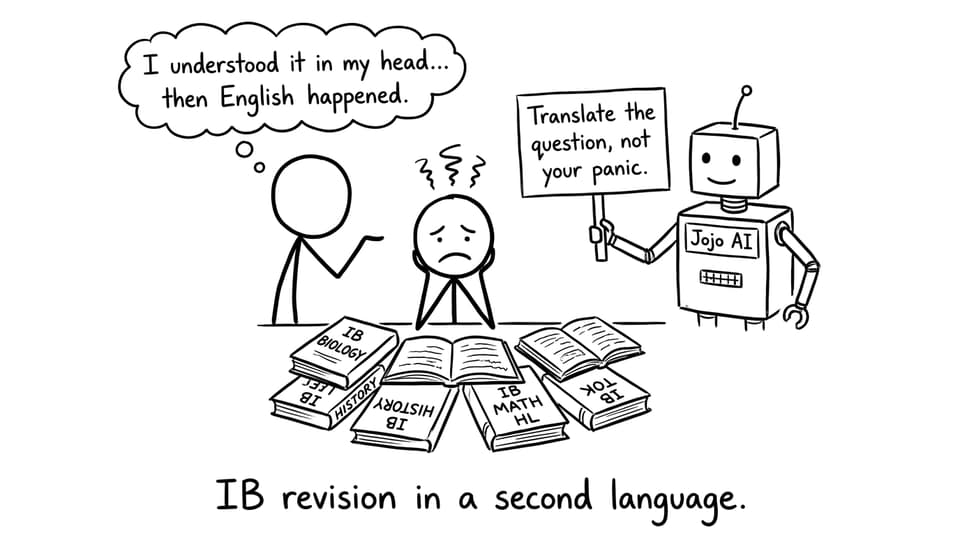
The hardest part of IB revision as a non-native English speaker often isn’t the content. It’s the moment you almost understand something… then an exam question wraps it in unfamiliar phrasing, command terms, and dense academic tone.
That’s a uniquely frustrating feeling: you studied, you know the topic, but English becomes the final boss.
The good news is that you can train for this. Not by “getting perfect English,” but by building a system where IB language becomes predictable. With the right habits (and the right tools), you can reduce misunderstanding, write clearer answers under time pressure, and walk into exams with calm confidence.
A quick IB language checklist (save this)
Use this short checklist at the start of every IB study session:
-
Pick one topic to learn (not “the whole chapter”).
-
List 10 key terms you must be able to define quickly.
-
Add 3 command terms you might see (e.g., analyse, evaluate, compare).
-
Do 5 targeted questions to see how English appears in real exam-style prompts.
-
Write one short paragraph aiming for clarity, not complexity.
When you need structured support, RevisionDojo helps you run this loop using Study Notes, Flashcards, and the Questionbank.
Build vocabulary that actually earns marks in IB
Learn “subject terms” and “command terms” separately
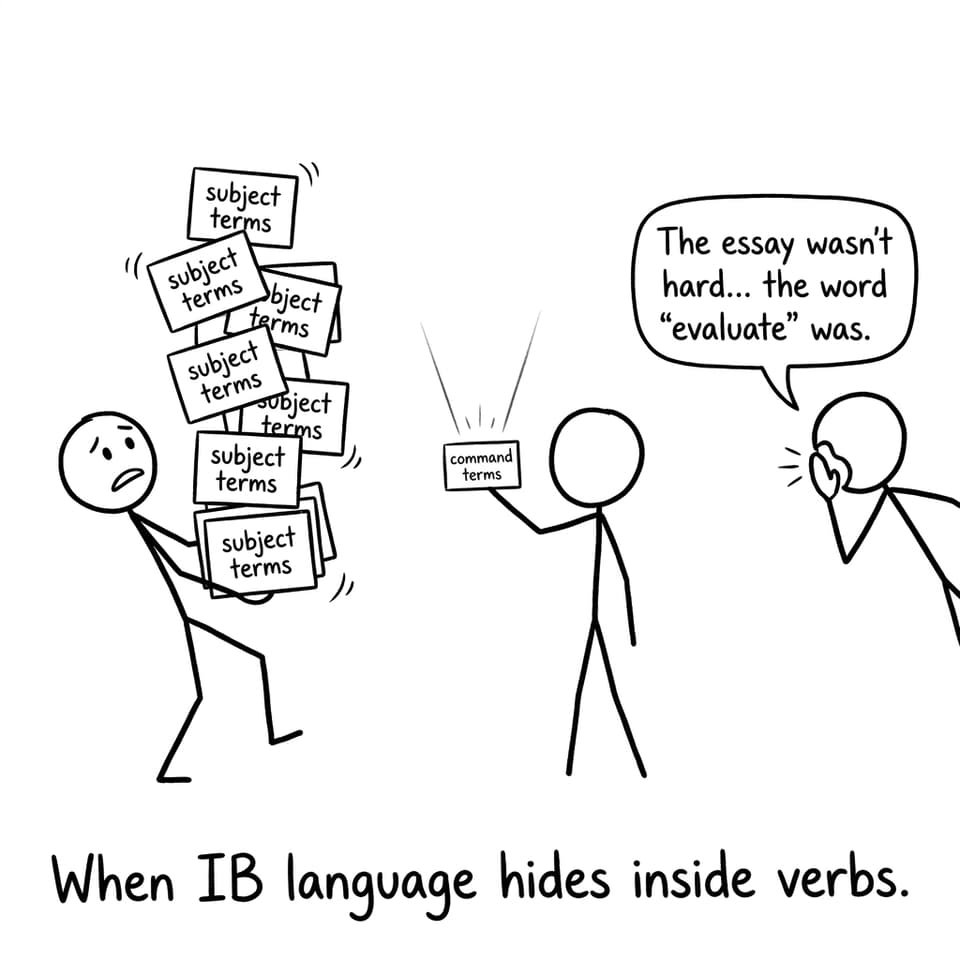
Non-native speakers often focus on subject vocabulary (osmosis, hegemony, elasticity). That matters. But IB also hides meaning in verbs.
If you misread “evaluate” as “explain,” your content may be correct but your marks won’t be.
A practical approach:
-
Create a mini bank of subject terms per unit.
-
Create a separate bank of command terms (with what examiners expect).
-
For each command term, write one sentence starter you can reuse (e.g., “A limitation of this model is…”).
To make this easy to review daily, use spaced repetition with IB Flashcards with Spaced Repetition (SRS). Short sessions compound fast in the IB.
Turn definitions into application
In IB, definitions are rarely the finish line. After you learn a word, add one “use it” prompt:
-
“Define X” (recall)
-
“In a data-based question, how would X affect Y?” (application)
RevisionDojo’s flashcards and linked practice flow make this smoother: learn with RevisionDojo for IB, then immediately apply in timed question practice.
Reading comprehension: train for exam phrasing, not comfort
Practice skimming like it’s a skill (because it is)
In the IB, time pressure makes language harder. Skimming helps you find what matters:
-
Read the question first.
-
Circle command terms.
-
Underline the exact thing you must produce (a comparison, a conclusion, a calculation, a justification).
If you’re studying English B specifically, targeted practice helps you get used to how prompts are written in exams. Try the IB English B Questionbank for structured reading and writing practice.
Annotate for meaning, not translation
It’s tempting to translate every sentence. But translation is slow, and exams punish slowness.
Instead:
-
Write 3-5 word margin summaries in simple English.
-
Mark “signal words” (however, therefore, whereas).
-
Keep a “confusing phrase list” and ask for clarification quickly (a tutor, teacher, or an AI explanation).
Writing: clarity is your advantage in IB
Use a repeatable paragraph structure
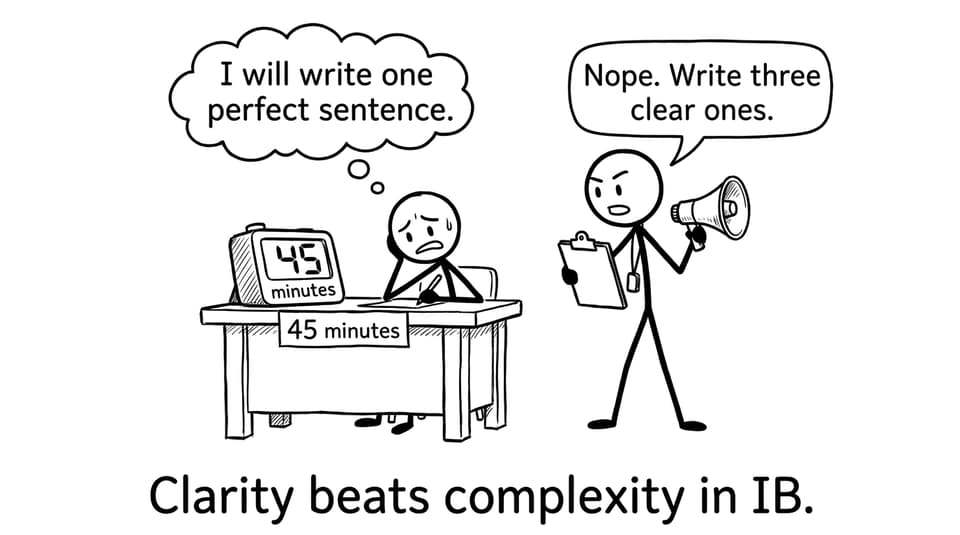
Under exam stress, complex English collapses. A simple structure holds:
-
Point (answer the question directly)
-
Evidence (data, quote, concept, example)
-
Explain (link evidence to the point)
-
Link back (to the question / command term)
This is exactly why exam practice matters. The IB rewards clear thinking expressed clearly.
Edit for “mark-friendly English”
Before you submit practice answers, do a 60-second edit:
-
Replace vague words (things, stuff) with subject terms.
-
Reduce sentence length.
-
Add one signpost: “This shows that…” or “Therefore…”
If you’re revising essay-heavy subjects, you’ll also benefit from examiner-style technique guidance like IB English Study Techniques That Actually Work.
Use RevisionDojo to reduce language friction
When language slows you down, the best tool is the one that removes decisions.
RevisionDojo acts like a single revision home base for IB students:
-
Study Notes to learn content in simpler, syllabus-aligned language: Study Notes
-
Flashcards for daily recall without overthinking: Flashcards
-
Questionbank for exam-style phrasing and feedback loops: Questionbank
-
AI Chat to quickly unpack confusing wording
-
Grading tools to improve writing against rubrics
-
Predicted Papers and Mock Exams to build timing confidence
-
Coursework Library to see what strong academic writing looks like
-
Tutors when you need human explanation and accountability
To build a full strategy around these habits, pair this article with The Science Behind Effective IB Revision: How to Study Smarter Not Harder.
FAQ
How can I do IB revision if my English is slower than my classmates?
Start by separating “slow English” from “slow understanding.” In IB, many students understand the content but lose time decoding the question. Train the decoding step directly by practicing small sets of exam-style questions and highlighting command terms first. Then build a personal list of repeated phrases that appear across questions (for example: “to what extent,” “justify,” “using evidence”). Over time, these stop feeling like new English and start feeling like familiar signals. Finally, keep your writing structures simple and repeatable, because clarity is faster than creativity in exams.
Should I translate my notes into my native language for IB?
Translation can help at the start, but it often becomes a trap close to IB exams. Exams happen in English, so you eventually need English retrieval, not just English recognition. A better compromise is bilingual support: keep tough words with a short native-language hint, but write your final definition in English. Try adding one example sentence in English too, because examples reduce ambiguity. If you use flashcards, make the front side English and keep any translation as a small support on the back. This trains you to think in exam language without feeling lost.
What are the best resources for non-native English speakers doing IB?
The best resources are the ones that combine clear explanations, spaced review, and exam-style practice, because that’s where language and marks meet in IB. Start with syllabus-aligned notes to reduce confusion and save time, then convert key content into flashcards so you can recall it under pressure. Add a question bank to get used to how prompts are phrased and which command terms appear most often. If possible, get fast feedback on writing so you don’t repeat the same language mistakes for weeks. RevisionDojo is built around that full loop: Study Notes, Flashcards, Questionbank, AI Chat, Grading tools, Predicted Papers, Mock Exams, a Coursework Library, and Tutors in one place.
Conclusion
Being a non-native English speaker in the IB can feel like doing two courses at once: the subject, and the language of the subject. But language is trainable. When you build vocabulary around command terms, practice reading like an exam skill, and write with clear structures, your effort finally turns into predictable marks.
If you want a calm, repeatable system for IB revision, use RevisionDojo as your home base: learn with notes, lock it in with flashcards, and prove it with question practice. Then repeat until exam day feels familiar.