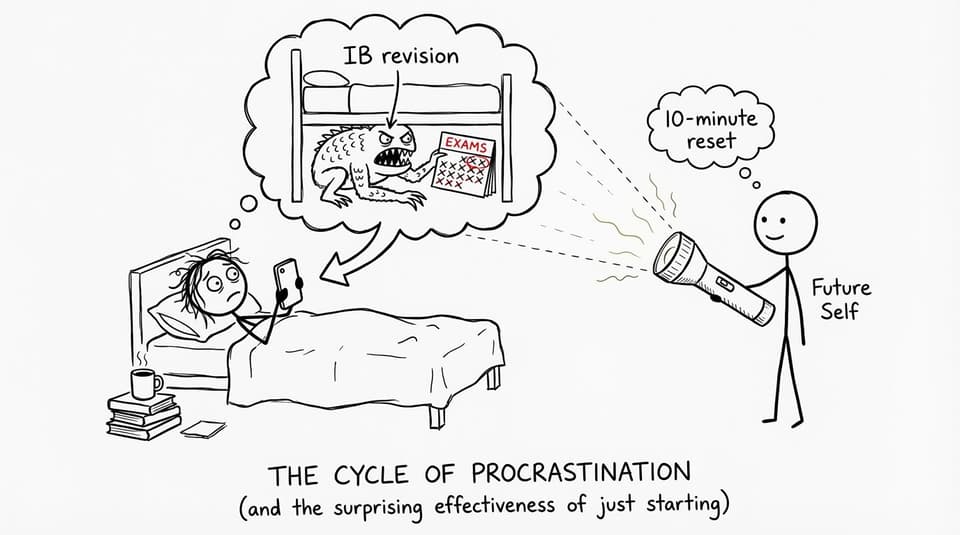

A week disappears, and the IB clock gets louder
On Sunday night, it hits in a very specific way.
You open your notes. You scroll your to-do list. You try to remember what you actually did this week, and your brain offers a suspiciously short highlight reel: two half-sessions, one stressed nap, and a lot of low-grade panic.
If you're an IB student preparing for exams, a completely unproductive week doesn't just feel like lost time. It feels like proof. Proof that you're behind, proof that you're not disciplined enough, proof that everyone else is coping better.
But here's the quieter truth most people learn late: a bad week isn't a verdict. It's data.
And in IB, data is useful because it tells you what to do next.
This article is a recovery plan for the week that went missing. Not a motivational speech. A reset that works when your confidence is low, your energy is inconsistent, and the IB workload still exists.
The IB unproductive-week reset checklist (save this)
If you only do one thing after an unproductive week, do this sequence. It's designed to restart your IB momentum without pretending you can suddenly become a different person.
- Forgive the week in one sentence: "That week was unproductive. I'm resetting today."
- Choose one subject to lead with (the one with the closest exam or biggest weakness).
- Do a 25-minute 'proof block': questions, not rereading.
- Write 3 mistake notes: what went wrong, why, what you'll do next time.
- Plan tomorrow's first task before you stop.
- Sleep like it matters (because for IB, it does).
A system beats guilt. Especially in IB.
Why an unproductive week happens more often in IB than anywhere else
An unproductive week rarely comes from laziness. It usually comes from one of these IB traps:
The "too many fronts" problem
Six subjects. Different formats. Different mark schemes. Plus coursework and deadlines. The IB isn't just hard; it's fragmented. Fragmentation creates decision fatigue, and decision fatigue creates avoidance.
The "I'll start when I feel ready" problem
In IB, readiness is a myth. You don't feel ready before you start. You feel ready after you've collected evidence that you can do the work.
The "studying without feedback" problem
If you reread notes for hours but never test yourself, your brain can't tell whether you're improving. No feedback means no confidence. No confidence means no momentum. This is why practice-first revision is so stabilizing for IB students.
If this is landing a little too accurately, keep a helpful companion tab open: IB Stress: Stay Motivated Without Burning Out.
Step one: run a calm, 30-minute IB triage (not a rewrite of your life)
The goal after an unproductive week is not to "catch up." It's to stop the bleeding and regain control.
Set a timer for 30 minutes and do only these actions:
- List your next 7 days (not the entire term).
- Identify the two nearest deadlines (exam, test, IA draft, anything real).
- Choose three priority topics for exam revision (not ten).
- Pick one daily minimum you can realistically hit even on low-energy days.
This is your new rule: you're allowed to do less, but you're not allowed to be vague.
When your plan is vague, the IB feels infinite. When it's specific, it becomes survivable.
Step two: rebuild IB momentum with "proof blocks"
A proof block is a short session designed to produce a measurable outcome. It's how you rebuild trust in yourself after a lost week.
A simple proof block for IB looks like this:
- 5 minutes: skim one subtopic using Study Notes
- 15 minutes: answer exam-style questions
- 5 minutes: review mistakes and write one rule
On RevisionDojo, this is exactly what the workflow supports:
- Use Study Notes for syllabus-aligned clarity
- Switch to the Questionbank for targeted practice
- Use Jojo AI Chat to get unstuck fast without derailing the session (more on that below)
If you want the full platform workflow in one place, this guide is worth bookmarking: RevisionDojo App: The Smarter Way to Prep for IB Exams.
The key idea (and why it works)
In IB, motivation is often the result of evidence. Evidence comes from doing the thing that can be scored, checked, or clearly finished.
A proof block gives you evidence quickly.
Step three: clean up the "unproductive week" with an IB mistake audit
This part is gentle but powerful: you're not auditing your intelligence. You're auditing your system.
Write down answers to these three questions:
- What did I intend to do last week?
- What did I actually do?
- What kept derailing me?
Then choose one fix from each category:
- Time fix: shorter sessions, earlier start, or a hard stop time.
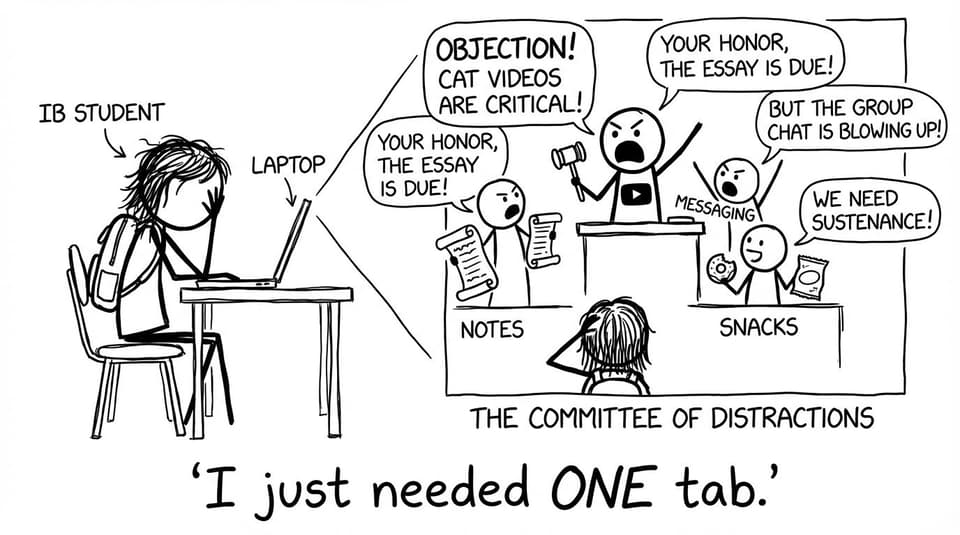
- Environment fix: phone in another room, one-tab rule, library table.
- Task fix: switch from rereading to questions, or shrink the topic.
In IB, small environmental changes are often more effective than big emotional promises.
Step four: use RevisionDojo to turn "stuck" into "next step"
A completely unproductive week often includes a familiar pattern: you sit down, hit one confusing concept, and your session dissolves.
This is where RevisionDojo's features are designed to protect your momentum:
Use AI Chat as the "unstuck button"
When you don't understand something in IB, the worst move is opening ten tabs and hoping clarity will appear.
Instead, ask Jojo AI Chat one tight question, then immediately test it with practice.
Example prompts:
- "Explain this concept using the IB wording and then give me 3 quick questions."
- "Why is my answer missing marks? Show me what the mark scheme wants."
- "What does 'evaluate' look like in this topic?"
For how Jojo is designed (and how it protects momentum and privacy), see: Inside Jojo AI: Curriculum-Tuned Support.
Use Flashcards for low-energy days (and still count it as revision)
After an unproductive week, your energy may be inconsistent. Your plan should respect that.
Daily flashcards keep recall alive without demanding heroic focus. RevisionDojo's Flashcards feature is built for short, spaced-repetition sessions that compound.
Use Grading tools when coursework is stealing your brain
Sometimes the "unproductive week" isn't about revision at all. It's coursework anxiety leaking into everything.
If IA/EE/TOK drafts are haunting you, get fast, rubric-aligned feedback with the IB Coursework Grader, then use the Coursework Library to see what strong work looks like.
When you reduce uncertainty, you reduce avoidance. That's an IB superpower.
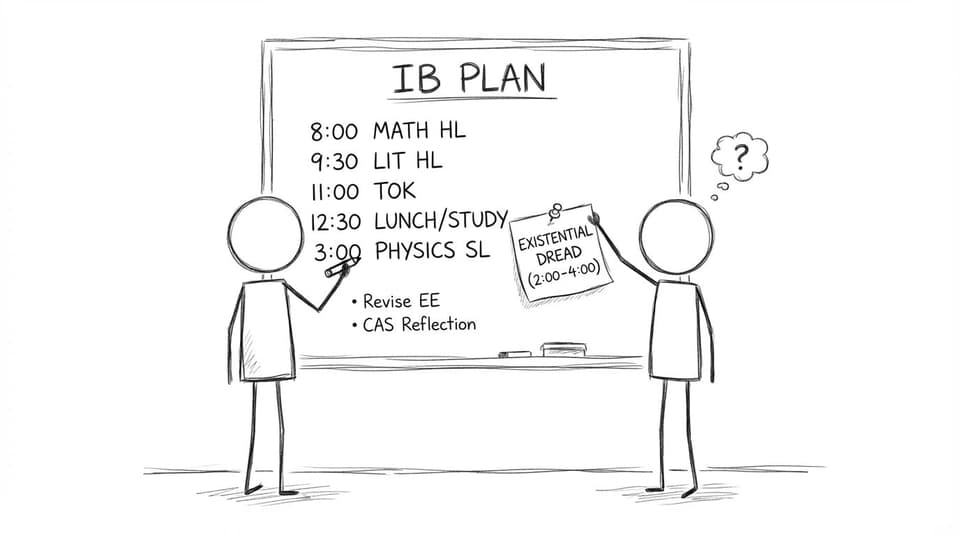
Step five: rebuild your IB week with a realistic structure (3 layers)
A recovery week should be simpler than your ideal week. Think of it as scaffolding.
Daily layer: 10-15 minutes
- Flashcards or a tiny question set
- Goal: keep recall warm, keep identity intact ("I'm still an IB student who studies.")
Core layer: 4 proof blocks per week (45-75 minutes)
Each block:
- Study Notes (short)
- Questionbank practice (main)
- Review mistakes (brief)
If you want more routines that last, this pairs well with: IB Motivation: How to Stay Driven in Exam Season.
Pressure layer: 1 timed session per week
You don't do this to suffer. You do it to make the exam familiar.
Use Mock Exams and Predicted Papers inside RevisionDojo as controlled simulations, then review your errors like a scientist.
For a step-by-step setup guide, bookmark: How to Stay Sane During IB Exam Season.
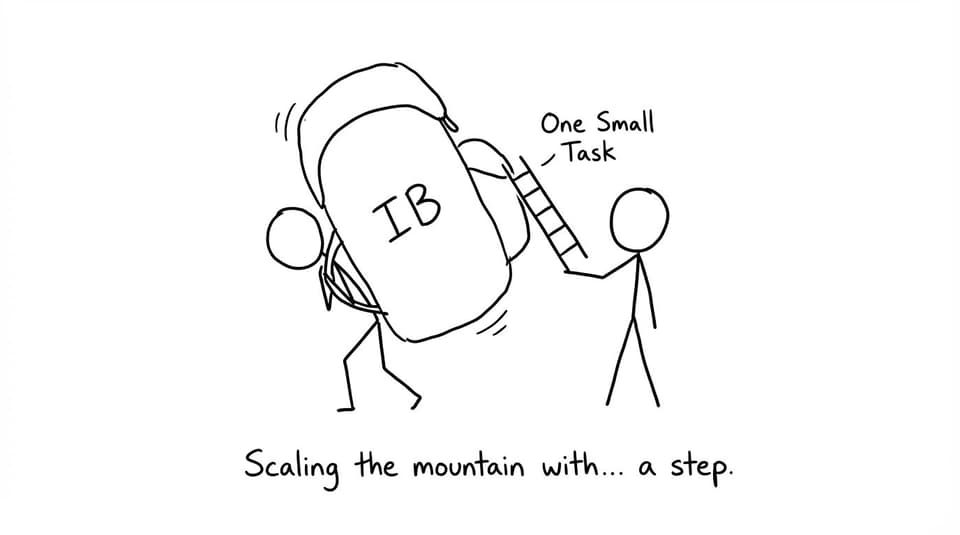
The "48-hour recovery" plan for IB students
If you need something very concrete, here's a two-day reset designed for IB exams.
Day 1: Triage and proof
- 10 min: choose 3 topics for the week
- 25 min: Questionbank set on the weakest topic
- 15 min: review errors and write 3 rules
- 10 min: flashcards
Day 2: Repair and stabilize
- 15 min: Study Notes on the same weak topic
- 25 min: another Questionbank set
- 15 min: review and tag what to redo
- 10 min: plan your next proof block
This is also a good time to install fast access on your phone so friction stays low: Install the RevisionDojo App (iOS/Android).
Closing: the IB comeback is quiet, not dramatic
A completely unproductive week feels dramatic. The recovery rarely is.
The IB comeback is usually quiet: one proof block, one corrected mistake, one short flashcard session on a day you didn't feel like studying. Evidence accumulates. Panic fades. You start trusting yourself again.
RevisionDojo is built for that exact kind of recovery loop: Study Notes that remove confusion quickly, Flashcards that keep daily recall alive, the Questionbank that turns effort into measurable progress, AI Chat that keeps you moving when you're stuck, Grading tools and the Coursework Library to reduce coursework uncertainty, plus Mock Exams, Predicted Papers, and Tutors when you need realism and support.
If last week was empty, let this week be simple. Open one subject. Do one set. Collect one piece of proof.
That's how IB momentum returns.