
The biggest adjustment shock in IB Philosophy is simple to describe and difficult to accept: having an interesting opinion is not the same as making a philosophical argument.
New students expect discussions about freedom, identity, morality, or consciousness. Those discussions happen, but the course asks for something more disciplined. You must define what you mean, justify important claims, examine objections, and reach a reasoned conclusion.
That shift sits behind many IB Philosophy first term struggles. A student may understand a thinker and contribute perceptive ideas in class, yet receive disappointing feedback because the written response summarizes, asserts, or wanders instead of analysing. The solution is not less imagination. It is giving imagination a structure.
The first-term adjustment checklist
By the end of your first term, aim to be able to:
- identify a claim, its supporting reasons, and its conclusion
- distinguish explanation from evaluation
- define important philosophical terms precisely
- state a clear thesis
- present a serious objection fairly
- respond to its strongest point
- use examples to test an argument
- finish with a reasoned conclusion
These skills support the course's emphasis on knowledge, analysis, evaluation, balanced argument, philosophical vocabulary, and justified conclusions. The complete IB Philosophy course guide shows how they connect across the subject.
Why adjusting to IB Philosophy feels difficult
In some subjects, early progress comes from learning more content. Philosophy creates a stranger problem. You can know more theories and definitions while continuing to write weak answers.
Consider a hypothetical student answering, "Are humans genuinely free?" They explain determinism, mention a philosopher, and conclude that freedom matters because society depends on responsibility. Everything sounds relevant, but the central reasoning remains hidden.
What does freedom mean? Why would determinism threaten it? Does responsibility require the ability to have acted differently? Could freedom instead mean acting according to your reasons without external coercion?
Philosophy begins when those hidden steps are exposed and tested.
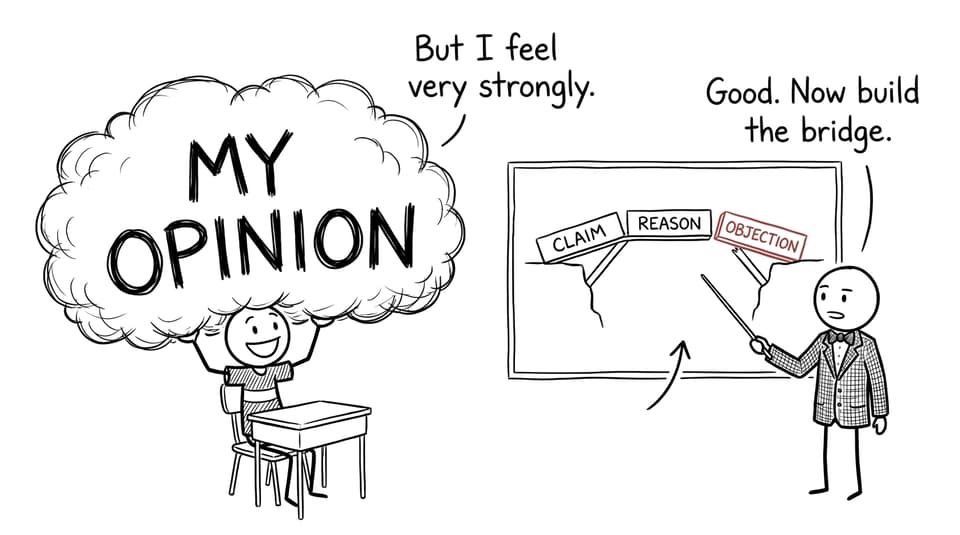
This is why rereading can feel productive without producing improvement. Familiarity does not prove that you can reconstruct an argument or judge whether its premises support its conclusion.
The difference between summary and analysis
Summary answers, "What does this philosopher say?" Analysis asks what conclusion is being defended, which reasons support it, what assumptions connect those reasons, and whether the reasoning succeeds. Evaluation goes further by weighing the argument after considering objections and replies.
A useful paragraph pattern is:
Claim: State one focused point.
Reason: Explain why it should be accepted.
Example: Clarify or test the reason.
Objection: Present the strongest reasonable challenge.
Reply: Defend, refine, or partly concede the claim.
Judgment: Explain what the exchange establishes.
This is a diagnostic tool, not a script. If your paragraph contains only a philosopher's view and an example, you probably have explanation but little evaluation.
Learn concepts as tools
Students often organize notes around names: what Descartes, Mill, or Sartre believed. That helps initially, but assessment questions concern philosophical problems. Thinkers become useful when you can place their arguments within those problems.
For every position, record the problem, central claim, supporting reasons, key assumption, strongest objection, possible response, and your provisional judgment.
Start with RevisionDojo's Being Human notes and questions. If agency, personhood, determinism, or authenticity remains unclear, review the Being Human key definitions. Precision matters because an argument may appear coherent only because one word changes meaning halfway through it.
Build your philosophical voice through revision
An independent voice does not require an original theory. It means making your intellectual commitments visible: state what you think, justify it, recognize what could weaken it, and adjust your conclusion when necessary.
Suppose your first thesis is, "Determinism makes moral responsibility impossible." After considering compatibilism, you might revise it: "Determinism threatens moral responsibility only if responsibility requires genuine alternative possibilities." The second claim is narrower but stronger. Revision has made your voice more precise.
Use the IB Philosophy Paper 1 practice area for a focused response, then ask AI Chat, a teacher, or a Tutor to identify where explanation becomes evaluation. Rewrite the weakest paragraph. Frequent small corrections teach more than collecting comments on work you never revisit.
A first-term routine that develops the skill
You do not need to write a complete essay every evening. Short, deliberate practice is more sustainable.
Reconstruct one argument twice a week
Choose a passage or theory. Write its conclusion, supporting reasons, and assumptions in plain language. Compare your reconstruction with the relevant IB Philosophy Study Notes.
Write one evaluative paragraph each week
Use the claim, reason, example, objection, reply, and judgment pattern. Submit it through RevisionDojo's Grading tools, or discuss it with your teacher or a Tutor.
Practise retrieval and track errors
Use Paper 1 philosophy flashcards to recall definitions without notes, then apply one recovered concept in an argument. Keep an error log covering weaknesses such as vague definitions, unsupported claims, excessive summary, or weak objections. Make one weakness the target for your next session.
RevisionDojo's guide to using an IB Questionbank effectively explains how to turn mistakes into focused practice instead of simply completing more questions.
What not to worry about yet
During the first term, do not make perfect timing, memorizing every thinker, or sophisticated prose your priority. Those goals are premature if the underlying argument is unclear.
Focus on intellectual visibility. Can your reader see the thesis and its supporting reasons? Can they understand why the objection matters and how your reply affects the final judgment?
Later, the IB Philosophy exam survival guide can connect these habits to timed assessment. Mock Exams and Predicted Papers become more useful once you possess a repeatable method to test under pressure.
The adjustment is the subject
The first term feels uncomfortable because philosophy removes a familiar hiding place. Memorized information cannot fully conceal uncertain reasoning, and elegant language cannot rescue an unsupported conclusion.
Yet philosophical writing is trainable. You improve by repeatedly moving from claim to reason, from reason to objection, and from objection to a more careful judgment.
RevisionDojo brings that process together. Study Notes and Flashcards build clarity, the Questionbank creates opportunities to apply ideas, and AI Chat plus Grading tools make weaknesses visible. As the course develops, Predicted Papers, Mock Exams, the Coursework Library, and Tutors support the transition from first-term practice to confident assessment performance.
The goal is not to sound like a philosopher. It is to make your reasoning clear enough for another person to test. That is the initial shock of IB Philosophy, and eventually it becomes the skill that makes the subject rewarding.