


When you sit down for IB Philosophy, the first thing you notice isn’t the difficulty of a definition or the obscurity of a philosopher.
It’s the silence right before you commit to an argument.
That moment is the real exam.
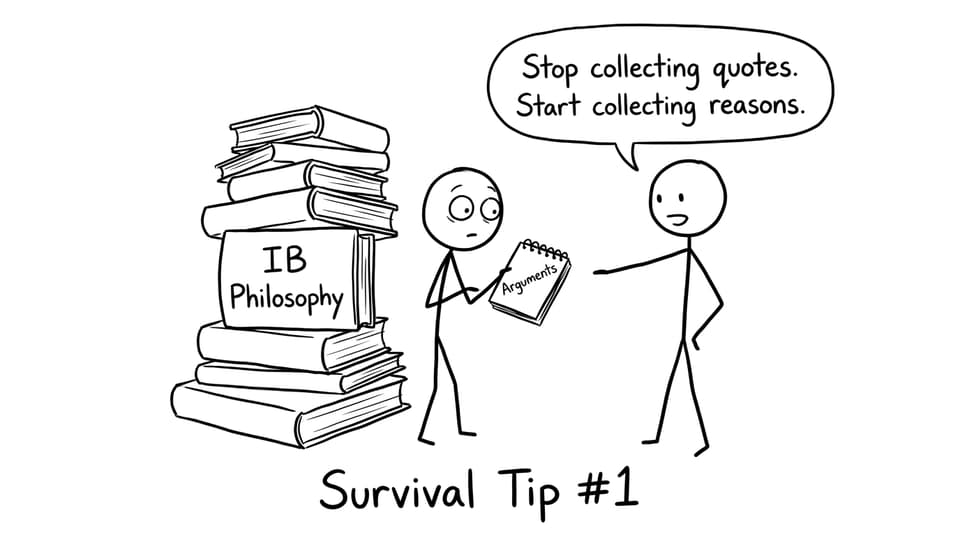
Because IB Philosophy doesn’t reward collecting quotes. It rewards building reasons, testing them, and then having the calm to revise your own thinking under time pressure. This survival guide walks you through what to expect in SL and HL exams (and the IA), what examiners actually want, and how to prepare with fewer spirals and more structure.
IB Philosophy exam survival checklist
Use this the night before a timed practice session, or the week you start serious revision:
-
I can explain the core theme: Being human in my own words (not memorized lines).
-
I can define key terms precisely (and use them naturally in sentences).
-
I can write an argument with a clear thesis, objections, and evaluation.
-
I can handle the prescribed text without retelling it.
-
If I’m HL, I can analyze an unseen text without panicking.
-
I’ve practiced under timed conditions at least once per paper.
If you need one home base for the whole course, start with Philosophy on RevisionDojo. It’s easier to stay calm when everything is organized the way the syllabus thinks.
The course structure (SL vs HL) in plain English
All IB Philosophy students share the same foundation:
-
The core theme: Being human (RevisionDojo supports this directly with Being human notes and questions)
-
One prescribed philosophical text
-
The Internal Assessment: Philosophical analysis (based on a non-philosophical stimulus)
Where SL and HL diverge is breadth and pressure:
-
SL studies one optional theme.
-
HL studies two optional themes and the HL extension: Philosophy and contemporary issues.
So the main jump to HL isn’t that the ideas get “smarter.” It’s that you have more perspectives to hold at once, and less room for vague writing.
Paper 1: Extended response (SL and HL)
Paper 1 is where IB Philosophy feels most like a mirror. You’re given a prompt, and the examiner can immediately tell whether you’re thinking or performing.
What SL students do
-
Answer one stimulus-based question on the core theme
-
Answer one essay question on the optional theme
Time: 1 hour 45 minutes
Weighting: 50%
What HL students do
-
Answer one stimulus-based question on the core theme
-
Answer two essay questions on the two optional themes
Time: 2 hours 30 minutes
Weighting: 40%
What this paper is really testing is disciplined argumentation: interpret the question carefully, define your key terms, build a line of reasoning, and evaluate competing views. If you want targeted practice for this style, RevisionDojo’s IB Philosophy Paper 1 page is built around exam-aligned questions and mark-focused structure.
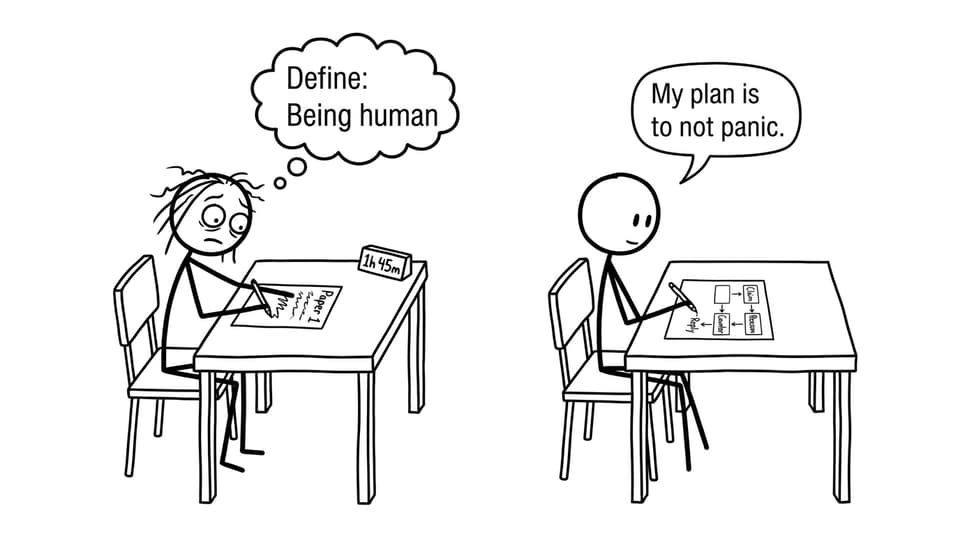
A survival structure that works under pressure
When your mind goes blank, don’t invent brilliance. Use a template:
-
Thesis: one sentence that answers the question directly.
-
Reason 1: explain + justify.
-
Reason 2: deepen or qualify.
-
Objection: the strongest serious counter.
-
Reply: why your thesis still stands (or how it must change).
-
Mini conclusion: restate the answer, not the topic.
That’s also where tools matter. RevisionDojo’s Questionbank helps you practice the same skill repeatedly, and the platform’s AI Chat can be used like a tutor: paste your paragraph and ask what is descriptive vs genuinely evaluative.
Paper 2: Prescribed text (SL and HL)
Paper 2 catches students off guard because it feels familiar: “I know the text.”
But IB Philosophy doesn’t give marks for familiarity. It gives marks for philosophical control: identifying distinctions, explaining arguments accurately, and then evaluating what the text is doing.
Who takes it: SL and HL
Time: 1 hour
Weighting: 25% (SL) and 20% (HL)
Your best prep here is twofold:
-
Build precision with terminology using IB Philosophy Key Definitions.
-
Train yourself to write “text-grounded evaluation,” not summary.
If you’re looking for a broader overview of how the course and papers fit together, Your Complete Guide to IB Philosophy Course and Exams is a helpful reference point.
Paper 3 (HL only): Unseen text on contemporary issues
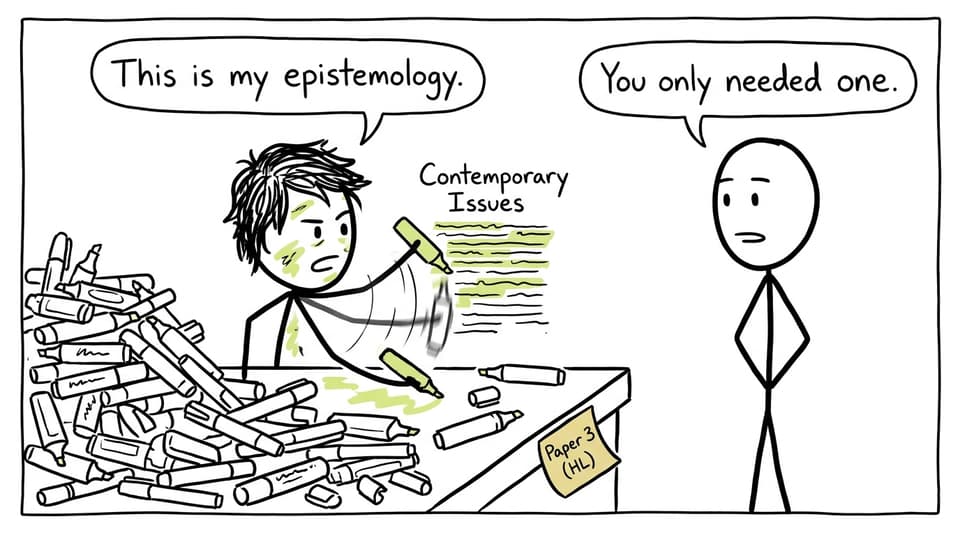
Paper 3 is the HL rite of passage: an unseen philosophical text (around 800 words) tied to Philosophy and contemporary issues.
Time: 1 hour 15 minutes
Weighting: 20%
This paper rewards students who can stay steady. The text is new, but the skills are not: identify the issue, map the argument, test assumptions, evaluate implications.
RevisionDojo supports this with IB Philosophy Paper 3 notes, which is useful for building a repeatable approach.
The Internal Assessment: Philosophical analysis (SL and HL)
The IB Philosophy IA is a 2000-word philosophical analysis of a non-philosophical stimulus (a film scene, lyrics, an image, a news article, an ad). It’s worth 25% at SL and 20% at HL, and the IB recommends 20 teaching hours.
A strong IA does three things clearly:
-
Extracts a real philosophical problem from the stimulus
-
Uses concepts and arguments to analyze it
-
Evaluates perspectives and reaches a reasoned conclusion
When you’re drafting, it helps to see what success looks like. You can browse IB Philosophy IA Examples and the wider IB Philosophy Examples library. Then, tighten your own work with the rubric-focused IB Philosophy IA Grader (RevisionDojo’s grading tools are designed to make the rubric feel concrete).
What examiners are actually rewarding in IB Philosophy
In IB Philosophy, high marks come from a particular kind of clarity:
-
Knowledge with purpose: concepts used to answer the question, not decorate it.
-
Analysis: unpacking assumptions, distinctions, and logical moves.
-
Evaluation: weighing arguments, not just presenting them.
-
Structure: paragraphs that build a case, not a pile.
-
Precision: definitions and vocabulary used accurately.
If you feel like you “know the content” but don’t score as expected, your bottleneck is usually evaluation and structure. That’s why practicing with feedback loops matters. RevisionDojo is designed as an all-in-one system: Study Notes to understand, Flashcards to retain, Questionbank to apply, AI Chat to unblock confusion, and Mock Exams plus Predicted Papers to make exam pressure feel familiar.
For a calm study routine that doesn’t collapse in week two, RevisionDojo App: The Smarter Way to Prep for IB Exams lays out a sustainable workflow.
Closing: the calm way to survive IB Philosophy
The secret of IB Philosophy is that you don’t win by having the most thoughts.
You win by having the most usable thoughts: clear definitions, defendable claims, and the habit of evaluating what you say. Build a repeatable practice loop, and the exam stops being a performance and starts being a conversation you’re prepared for.
If you want one place to run that whole system, RevisionDojo brings it together: Study Notes, Flashcards, Questionbank, AI Chat, Grading tools, Predicted Papers, Mock Exams, Coursework Library, and Tutors. Start with the IB Philosophy hub, pick one paper skill to train this week, and let consistency do what last-minute motivation can’t.