A short parent-teacher conference can feel strangely high-stakes. You may have ten minutes, six subjects to think about, approaching examinations, unfinished coursework, and a teenager who would prefer that nobody discuss any of it.
Your concern is reasonable. The best way to use the meeting is not to ask whether your child is “doing well.” It is to identify where current performance differs from expected performance, understand the evidence behind that judgment, and agree on one or two actions that can be reviewed later.
This IB parent teacher conferences guide will help you prepare focused questions, interpret vague feedback, discuss predicted grades calmly, and turn the conversation into a realistic exam plan. The goal is not to leave with complete reassurance. It is to leave with useful clarity.
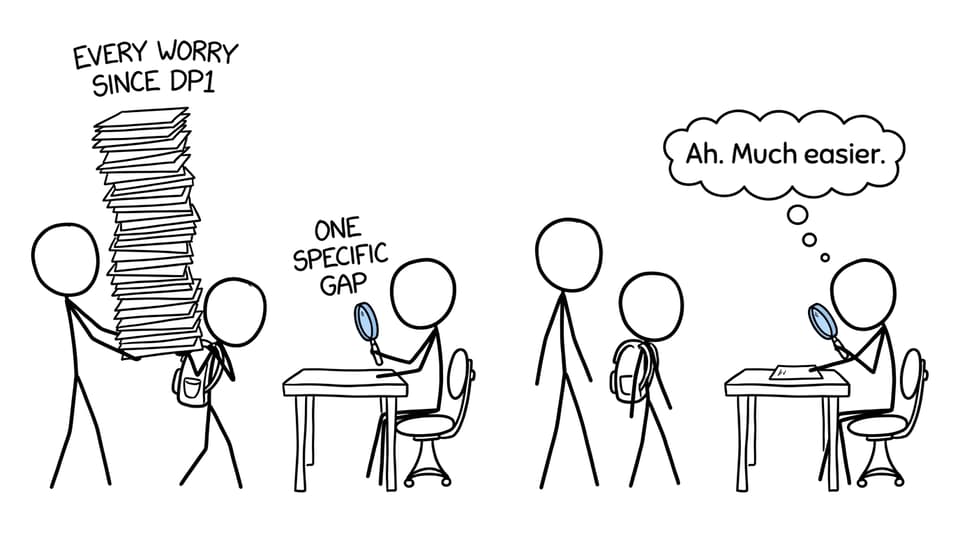
A parent brings every worry to an IB conference while a teacher searches for one specific gap
The Parent-Teacher Conference Checklist
Before the meeting, keep the process simple:
Ask your child what they think is going well and what feels difficult.
Review recent reports, assessment comments, mock results, and coursework deadlines.
Choose three priority questions rather than bringing a long general list.
Ask about specific subject gaps and the evidence revealing them.
Clarify whether a problem concerns knowledge, application, exam technique, timing, or organization.
Discuss predicted grades without treating them as promises or negotiations.
Record one student action, one support action, and a review date.
4.7
X
Share on WhatsApp
Share on LinkedIn
Share on Facebook
A conference is most valuable when it produces decisions. If you leave knowing that mathematics needs “more effort,” little has changed. If you leave knowing that your child understands calculus concepts but loses marks when setting up unfamiliar problems, you have something concrete to address.
Understand What the Conference Is Measuring
For IB Diploma parents, progress can be difficult to read because no single test tells the whole story. The Diploma Programme is generally a two-year course for students aged 16 to 19. Full Diploma students study six subjects alongside the core: Theory of Knowledge, the Extended Essay, and Creativity, Activity, Service.
IB assessment includes externally assessed work and internal assessment. Written examinations form the basis of assessment in most subjects, while internal components vary by discipline and can include investigations, oral work, laboratory work, fieldwork, or performances. Results are awarded against defined standards rather than according to a student’s rank in the class.
That means a teacher may be considering several kinds of evidence:
Topic tests and class assessments
Mock examination performance
Internal assessment progress
Essays, oral responses, investigations, or practical work
Use of subject-specific terminology and methods
Responses to IB command terms
Consistency, organization, and completion of work
Parents unfamiliar with the programme may benefit from first exploring RevisionDojo’s overview of IB resources. Understanding what the IB Diploma involves makes it easier to ask questions that fit the programme rather than relying on assumptions from other school systems.
Prepare With Your Child, Not Around Them
The most revealing preparation often happens before the teacher enters the conversation. Ask your child three questions:
Which subject currently feels least predictable?
Where do you understand lessons but still lose marks?
What do you think your teacher will say?
These questions distinguish surprise from an already recognized difficulty. They also reduce the chance that the conference feels like adults exchanging judgments about an absent student.
Where school policy allows, involving the student directly can be useful. If they will not attend, agree beforehand on the main concerns you will raise. RevisionDojo’s advice on talking to teachers about an IB student’s progress offers a helpful principle: approach the discussion to understand and plan, not to defend or prosecute.
Bring only relevant evidence. One recent marked response, a report, and a deadline list are usually more helpful than a folder containing everything completed since DP1.
Ask Questions That Produce Specific Answers
Broad questions invite broad reassurance. “How are things going?” may produce “Generally fine.” Neither person has said anything false, but neither has created a plan.
Use questions that connect performance, evidence, and action:
Instead of asking
Ask this
Is my child doing well?
Which assessment evidence best represents their current level?
Do they need to work harder?
Which two skills or topics are currently costing the most marks?
Are they on track?
What is the gap between current performance and their target grade?
How can I help?
What support at home would be useful, and what might create unnecessary pressure?
Will the grade improve?
What observable improvement would indicate progress by our next review?
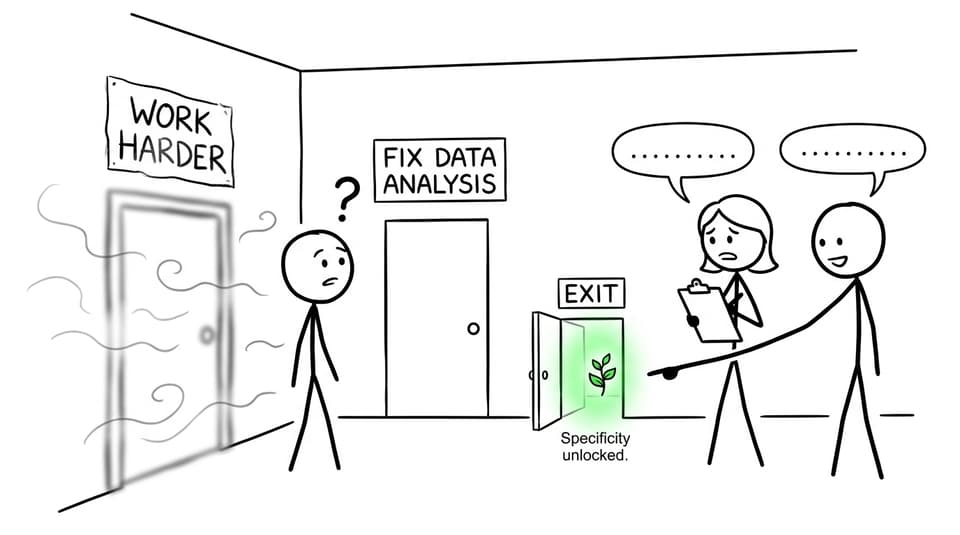
The most important prompt is simple: ask about specific subject gaps. Then continue until the gap is precise enough to practise.
For example, “weak in Chemistry” is too broad. “Cannot reliably explain periodic trends using effective nuclear charge” identifies a content gap. “Knows the chemistry but misreads command terms” identifies an exam-technique gap. The remedies are different.
A student discovers that specific feedback is the exit from a vague IB escape room
Decode Vague Teacher Feedback
Teachers sometimes use compressed language because conference slots are short. Your task is not to challenge every phrase. It is to ask for its operational meaning.
“They need to participate more”
Ask whether this affects the teacher’s access to evidence, the student’s understanding, or both. A quiet student may understand the material but rarely test their reasoning aloud. Alternatively, silence may be concealing confusion. Ask what participation could realistically look like: answering one question, bringing a prepared query, or attending subject support.
“They know the content but struggle in assessments”
This often points toward application, structure, command terms, timing, or pressure rather than simple recall. Ask to see one representative response and identify exactly where marks were lost. A student in this position may need timed, exam-style practice more than another round of note-taking.
“They need to be more consistent”
Consistency can mean attendance, homework completion, assessment scores, concentration, revision frequency, or quality across components. Ask which pattern the teacher has observed and over what period. A label becomes useful only when attached to behavior.
“Their coursework needs development”
Clarify which assessment criterion requires attention and what feedback the teacher is permitted to provide. Academic integrity rules matter, and school procedures differ. The parent’s role is to support planning, time management, and appropriate use of feedback, not to edit or reshape assessed work.
Discuss Predicted Grades Without Turning Them Into a Verdict
An IB predicted grade is a teacher’s professional estimate of the grade a student is expected to achieve, based on available evidence and knowledge of IB standards. It is not the final result, and it should not be treated as a reward for effort alone.
Ask calmly:
What evidence currently supports the prediction?
Is the strongest concern subject knowledge, assessment technique, or consistency?
Which future assessments can provide evidence of improvement?
When does the school finalize grades used for applications?
What would performance at the next grade level look like?
The school’s procedures and calendar matter, so confirm them locally. If the prediction is disappointing, focus on the evidence rather than asking for a higher number. Students can use this guide to responding when predicted grades are missed to build a measured response.
Predictions may also matter for university applications. Universities use them differently, and entry conditions vary by institution, course, country, total score, and Higher Level subjects. Families should verify current IB university requirements directly with each institution rather than relying on a general score range. RevisionDojo’s explanation of IB predicted grades in early university applications provides useful context for that conversation.
Turn Feedback Into a Two-Week Action Plan
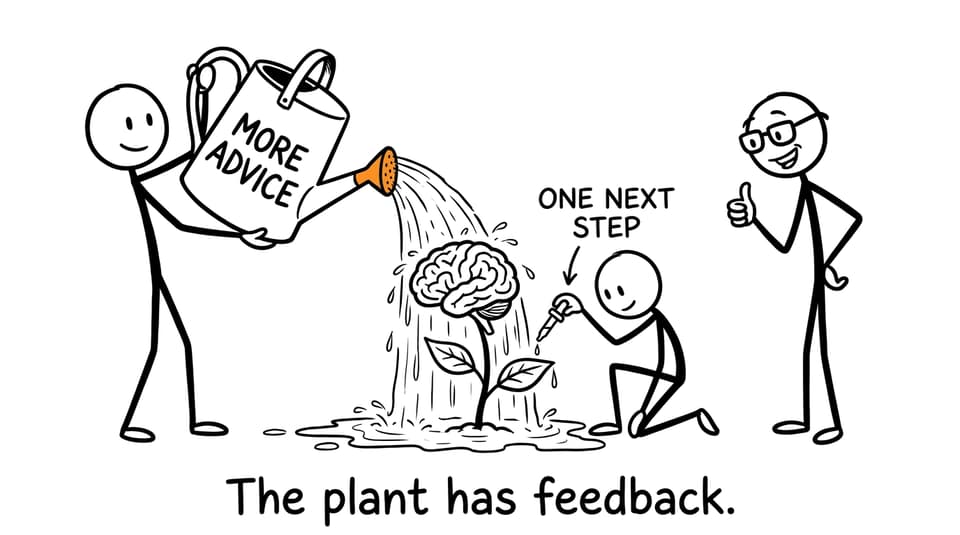
A conference should end with a small experiment, not a dramatic reinvention. Choose one or two high-impact gaps and create a plan that can generate new evidence within two weeks.
Gap identified
Student action
Evidence to review
Missing subject knowledge
Review one narrow topic, then answer targeted questions
Accuracy on a fresh question set
Weak command-term response
Practise answers using the required structure
Improved teacher or rubric feedback
Poor timing
Complete short timed sections twice weekly
Completion rate and mark pattern
Repeated careless errors
Maintain an error log and retest mistakes
Fewer repeated error types
Coursework organization
Break the next milestone into dated tasks
On-time completion of each stage
Agree on who owns each action. The student might complete two targeted practice sets. A parent might protect a quiet study window without monitoring every minute. A teacher might recommend a topic or review evidence at the next appropriate opportunity.
A parent learns that one precise next step is better than flooding an IB student with advice
Know When to Contact the IB Coordinator
Subject teachers are best placed to explain progress within their classes. Questions about the Diploma as a whole, school implementation, assessment administration, or communication with the IB may need to go to the school’s DP coordinator.
Consider requesting a separate conversation when:
Difficulties span several subjects or the core.
Conflicting deadlines are affecting performance.
University plans depend on understanding school prediction procedures.
You need clarification about assessment administration or school policy.
Well-being concerns require coordinated support.
The IB’s regulations identify the school’s DP coordinator as the intermediary for student and guardian communication with the organization. The conference can reveal when a subject problem is actually part of a wider workload or support issue.
Act on Subject Gaps With RevisionDojo
Once the meeting identifies a gap, the question changes from “What is wrong?” to “What should happen next?” This is where RevisionDojo becomes especially useful as the ultimate IB resource.
A student can open the relevant Study Notes for a focused explanation, use Flashcards for retrieval, and move into the Questionbank to test the exact topic. AI Chat can clarify a difficult concept or command term, while Grading tools help identify why an answer is missing marks. Predicted Papers and Mock Exams provide timed rehearsal when the weakness involves application or pacing.
For internal assessments, the Extended Essay, or TOK, the Coursework Library can help students understand strong structures while respecting academic integrity. When a gap remains difficult to diagnose, Tutors add human guidance. The RevisionDojo exam-preparation app guide explains how these tools connect in one learning cycle.
The practical sequence is straightforward: understand, practise, review, and retest. Parents do not need to become subject teachers. They can help the student follow the agreed process and return to the next conversation with evidence.
Leave With Clarity, Not Just Comfort
A useful IB parent-teacher conference may not remove every concern. It should make the concern more precise.
Before leaving, summarize what you heard: the main strength, the specific gap, the next action, and the date or assessment that will show whether the plan is working. Confirm that the student understands the same plan. Then allow time for the work to produce evidence.
The meeting is only the diagnosis. Progress comes from what happens afterward. With focused teacher feedback and RevisionDojo’s connected notes, practice, feedback, coursework, and tutoring tools, an uncertain conversation can become a calm and measurable route toward stronger IB performance.
Li holds an MEd from the University of Hong Kong and has taught IB Chinese A and B for over 15 years. Her focus is IB Chinese character recognition and the higher-level essay, drawing on moderation experience to show what lifts a response into the top band.
Learn whether universities see IB paper and IA component scores, what appears on official transcripts, and when detailed marks may still affect admission.