


Introduction
The first time most students open the formula booklet in an exam setting, it feels like a safety net. The second time, it can feel like a trap: too many pages, too little time, and the creeping thought that the formula is probably in here somewhere.
That’s why this IB Math Booklet Guide for IB HL & SL Students isn’t about collecting more formulas. It’s about building calm navigation. Because on exam day, the booklet doesn’t reward memory as much as it rewards recognition and speed with structure.
If you’re in AA or AI, HL or SL, this IB Math Booklet Guide for IB HL & SL Students will help you turn the booklet into a tool you actually control.
Quick checklist: set up your booklet routine
Use this mini checklist before your next timed practice session:
-
Get the correct booklet for your course (AA vs AI) and keep it beside you every time you practise.
-
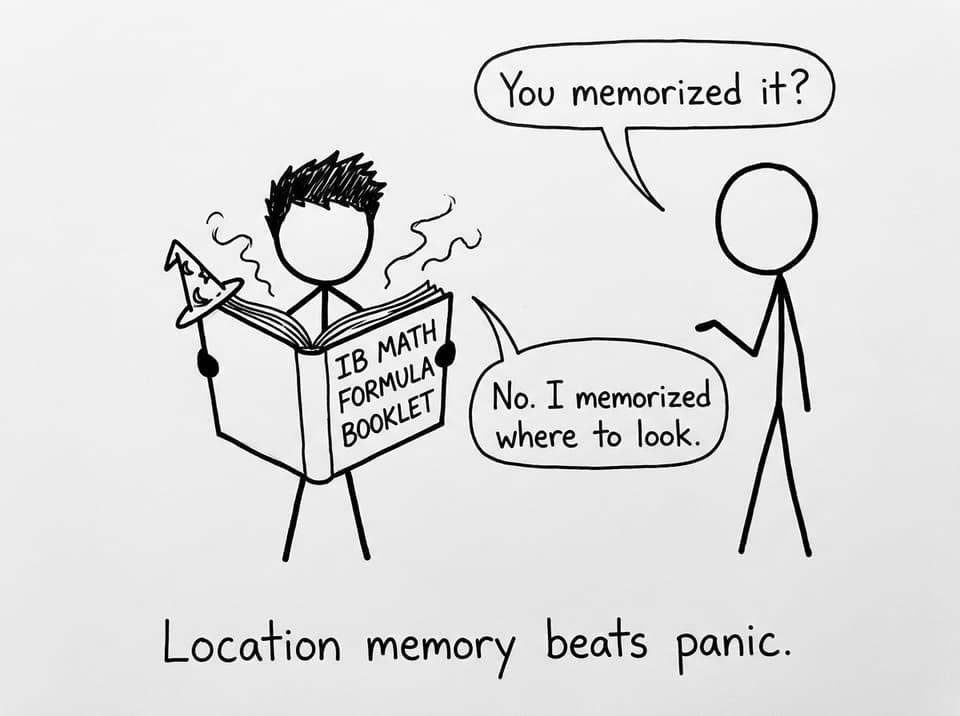
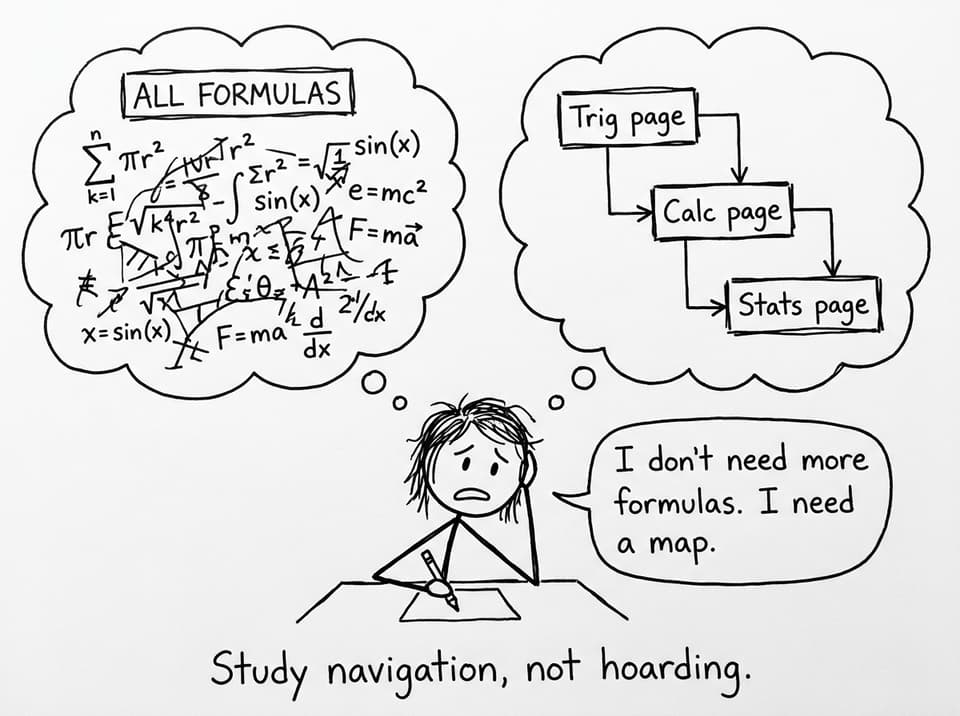
Build “page memory”: know which sections hold trig, calculus, stats, and probability.
-
Memorise a few high-frequency identities so you stop pausing mid-solution.
-
Notice what’s not explained: the booklet gives formulas, not decision-making.
-
Pair booklet navigation with exam-style practice and feedback (this is where patterns become automatic).
For a clean starting point, open the official course hubs: IB Mathematics Analysis and Approaches Resources and IB Mathematics Applications & Interpretation Resources.
What the IB Math booklet actually contains
At its core, the IB mathematics formula/data booklet is a shared language: algebraic rules, trig relationships, calculus results, and statistics tools written in consistent IB notation.
Depending on your pathway, you’ll most often see:
-
Algebra and functions (exponents, logs, sequences/series)
-
Trigonometry (sine rule, cosine rule, identities)
-
Calculus (core derivatives/integrals and standard forms)
-
Statistics and probability (distributions, regression, definitions)
-
HL-only depth in areas like vectors and extended calculus/probability
RevisionDojo keeps the booklets easy to access and topic-aligned for both tracks: IB Mathematics Analysis and Approaches Data Booklet and IB Mathematics Applications & Interpretation Data Booklet.
Why the booklet isn’t enough (and why that’s good news)
The hardest part of IB Math isn’t writing down a formula. It’s choosing the right one under pressure.
A cosine rule sitting on a page doesn’t tell you:
-
whether the diagram is hiding a non-right triangle,
-
whether you should form an equation first,
-
or whether the question is really testing modeling/interpretation rather than geometry.
Same with calculus: the integration rules might be there, but many questions require substitution, rearrangement, or a clever setup before the booklet becomes useful.
So treat the booklet as a prompt. Your job is to connect the prompt to the method. If you want practice that trains those connections, RevisionDojo’s Questionbank is built for repeated, syllabus-aligned decisions with feedback.
How to practise with the booklet like HL and SL students who score higher
This IB Math Booklet Guide for IB HL & SL Students comes down to one habit: practise the way you’ll perform.
Build navigation speed first
Do short drills where your only goal is locating what you need quickly. Then solve.
If you’re AA, it helps to practise inside the exact topic areas you revise, like IB Mathematics Analysis and Approaches Calculus or IB Mathematics Analysis and Approaches Statistics and Probability.
Run “booklet-open” sessions
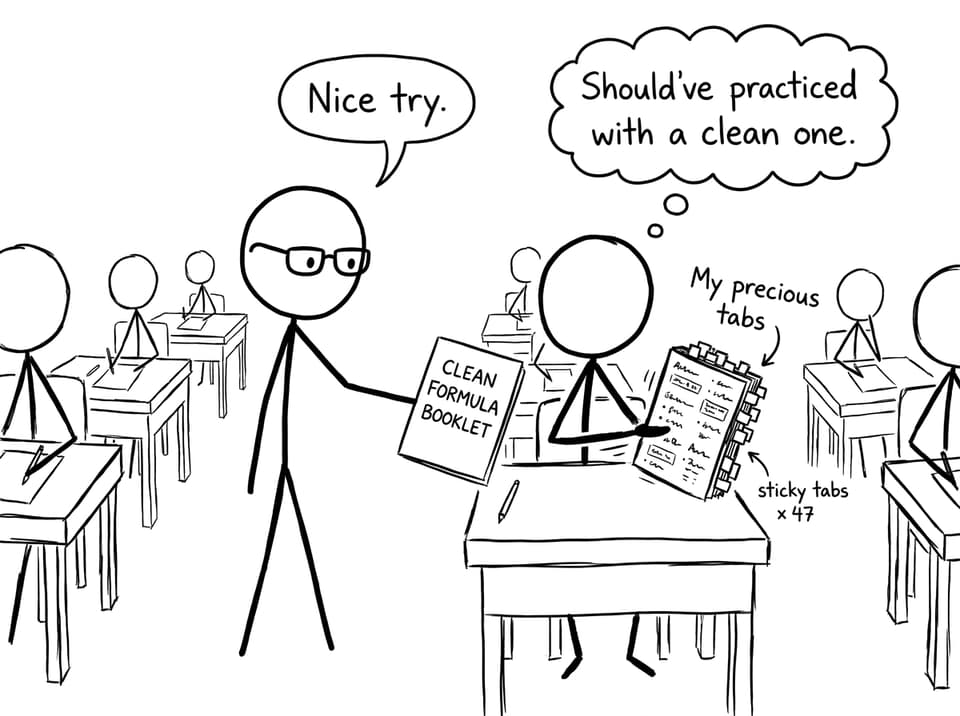
When you do timed practice, keep a clean copy next to you. Your exam copy will be clean too, so you’re training the right conditions.
Turn mistakes into flashcards, not stress
If you repeatedly forget which identity unlocks a trig simplification, don’t reread the booklet for comfort. Convert the pattern into recall.
RevisionDojo makes that loop easy: Study Notes for clarity, Questionbank for application, then Flashcards for spaced repetition. If you hit a wall mid-solution, AI Chat can walk you through the “why this formula here” reasoning without breaking your momentum.
For an example of a targeted formula focus, see IB Math - Cosine Rule & Trigonometric Identities.
Common mistakes students make with the booklet
Most booklet problems are not knowledge problems. They’re workflow problems.
-
First-time use happens too late: the booklet feels unfamiliar because it is.
-
Random flipping replaces a mental map.
-
Assuming everything is included: some steps still require recall and technique.
-
Not learning the symbols: small notation confusion causes big method loss.
If you want a broader system around this IB Math Booklet Guide for IB HL & SL Students, combine it with RevisionDojo strategy posts like How to Revise IB Math AA and AI Effectively and Best Time Management Tips for IB Math Exams.
FAQ
Do I get the booklet in the IB Math exam?
Yes, students are provided a clean formula/data booklet in the exam, and you should assume it will be unmarked and unannotated. That matters because many students practise with highlighted tabs and then feel slower on the day. The aim of this IB Math Booklet Guide for IB HL & SL Students is to make your navigation resilient even without your personal markings. A good habit is to do at least one timed session per week using a clean copy only. That way, the booklet feels like a familiar tool instead of a surprise object you’re decoding under pressure. If you want to simulate real conditions more closely, RevisionDojo’s Mock Exams and Grading tools help you practise with feedback loops that match exam logic.
Should I memorise the entire booklet?
No, and trying usually backfires because it steals time from learning when to use the formulas. Instead, memorise a small set of high-frequency results you use constantly (core trig identities, common derivative rules, a few geometry relationships) so your working stays fluent. Then rely on the booklet for less frequent formulas and for checking accuracy. The deeper skill is recognition: noticing a question type and immediately knowing which section of the booklet supports it. RevisionDojo helps by turning recognition into repetition: you learn the method in Study Notes, practise it in the Questionbank, and then lock weak points in Flashcards. Over time, you memorise more than you planned, but it comes from use, not force.
How do HL and SL students use the booklet differently?
HL students usually face higher cognitive load: more multi-step questions, more technique stacking, and an extra paper in some routes, so speed matters more. That means HL students benefit disproportionately from “page memory” and from memorising a slightly larger set of high-frequency tools. SL students often benefit most from reducing hesitation: knowing where trig, basic calculus, and statistics tools live so they can spend time writing clear method. In both levels, the booklet will not tell you which method earns marks in a given prompt, so you still need exam-style practice. That’s why this IB Math Booklet Guide for IB HL & SL Students keeps returning to the same idea: practise decisions, not just formulas. RevisionDojo’s Predicted Papers and Mock Exams are useful here because they force realistic pacing and method selection.
Conclusion: turn the booklet into a calm advantage
A formula booklet is not a shortcut. It’s a permission slip to spend your limited exam energy on reasoning instead of recitation.
If you take one thing from this IB Math Booklet Guide for IB HL & SL Students, make it this: practise navigation until it’s boring. Boring is good. Boring means automatic.
When you’re ready to make that automatic loop easier, build your routine inside RevisionDojo: Study Notes to learn, Flashcards to retain, Questionbank to apply, AI Chat to unblock, Grading tools to tighten method, and Predicted Papers plus Mock Exams to rehearse the real thing. This IB Math Booklet Guide for IB HL & SL Students works best when it’s not a one-time read, but a system you repeat.