


If you’ve ever opened the IB Math formula booklet in the middle of a timed question, you know the feeling: relief, followed immediately by panic. The formula is there… but so are ten others that look almost identical, and suddenly you’re negotiating with a minus sign like it’s a person.
That’s the real point of the IB Math booklet. It doesn’t replace understanding. It buys you mental space, so you can choose the right tool quickly, write clean working, and keep your accuracy when stress tries to make every triangle look the same.
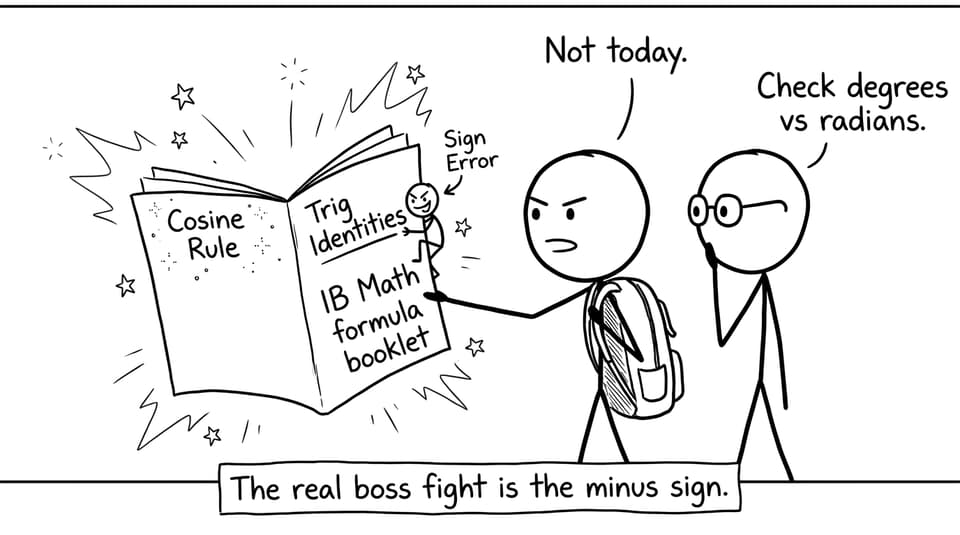
Quick exam checklist for IB Math booklet speed
Use this mini-routine any time you see a triangle or a trig expression in IB Math:
-
Open the correct section fast (practice this, don’t “hope” for it)
-
Sketch the triangle or unit-circle idea before substituting
-
Decide: find a side/angle (cosine rule) vs simplify/prove/solve (identities)
-
Write the formula first, then substitute carefully
-
Do a 10-second sanity check (size of angle, sign, degree vs radian mode)
For a clean copy aligned to your course, start with RevisionDojo’s IB Math AA Data Booklet or the IB Math AI Data Booklet.
Where the cosine rule saves you in IB Math
In IB Math, the cosine rule is your go-to for non-right-angled triangles when Pythagoras can’t help.
The standard form you’ll use most often is:
- c² = a² + b² - 2ab cos C
Two common exam situations:
-
Two sides and included angle (SAS): find the third side.
-
Three sides (SSS): find an angle using (\cos C = \frac{a^2+b^2-c^2}{2ab}).
A practical habit: before you plug numbers in, label your triangle so the side opposite angle (C) is actually (c). This single alignment step prevents the most common cosine-rule error in IB Math: using the right formula on the wrong angle.
Want targeted practice for this exact skill? RevisionDojo’s Geometry and Trigonometry Questionbank (Math AA) is built around exam-style triangle questions with worked solutions and feedback.
Trigonometric identities: the “grammar” of IB Math trig
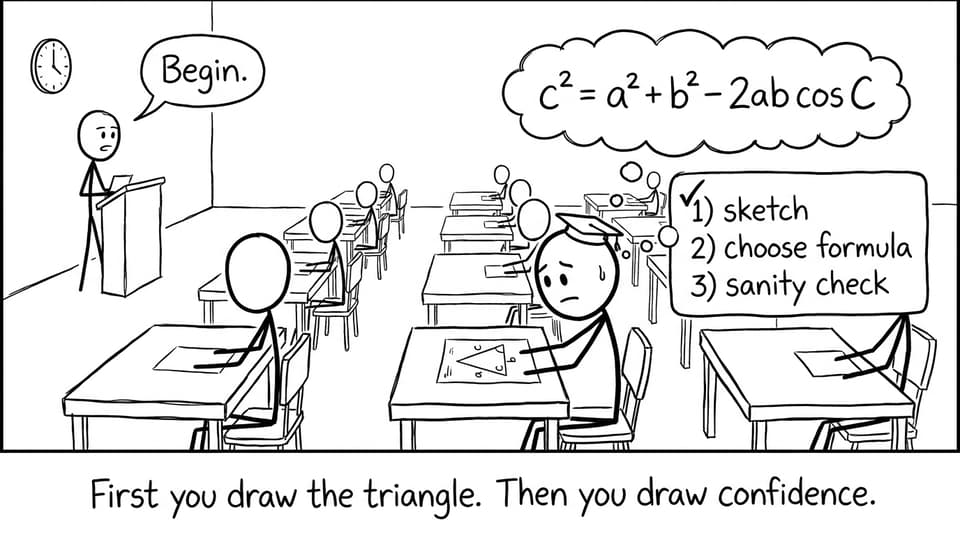
Trigonometric identities in IB Math are less like formulas and more like grammar rules: they let you rewrite expressions into something solvable, provable, or differentiable.
The highest-frequency identity families include:
-
Pythagorean identity: (\sin^2\theta + \cos^2\theta = 1)
-
Tangent relationship: (\tan\theta = \frac{\sin\theta}{\cos\theta})
-
Double-angle identities (for (\sin 2\theta), (\cos 2\theta))
-
Sum and difference identities (for (\sin(A\pm B)), (\cos(A\pm B)))
In practice, identities appear in IB Math when you’re asked to:
-
simplify an expression into a single trig function
-
solve trig equations (often with multiple solutions)
-
prove a statement in “Show that…” style questions
If trig equations are the part that keeps multiplying solutions unexpectedly, keep this guide open while you practise: Why Do Trigonometric Equations Have So Many Solutions in IB Maths?
Memorize vs look up: a calm IB Math strategy
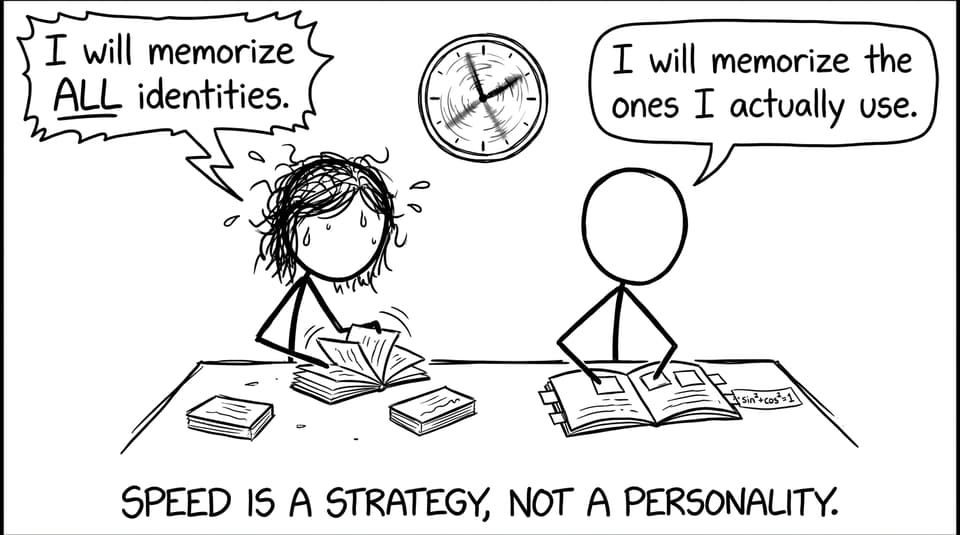
Yes, the booklet contains the cosine rule and trig identities. But in IB Math, time pressure turns “I can look it up” into “I lost 5 minutes and forgot what I was doing.”
A good rule:
-
Memorize for speed: cosine rule, (\sin^2+\cos^2=1), (\tan=\sin/\cos), the most-used double-angle forms.
-
Look up as backup: less common rearrangements and longer compound-angle identities.
This isn’t about proving you’re smart. It’s about reducing decision fatigue. RevisionDojo’s Flashcards make this easier because you can drill the high-frequency identities in short bursts, then immediately apply them in the Questionbank while your recall is still warm.
Common IB Math mistakes (and how to avoid them)
Most errors with the IB Math formula booklet are not “I didn’t know the formula.” They’re execution mistakes:
-
Wrong angle-side pairing in cosine rule (fix: label opposite sides clearly).
-
Sign errors in identities (fix: rewrite slowly, one line per transformation).
-
Degree vs radian mode on your calculator (fix: check once per question set).
-
Jumping steps so the examiner can’t follow (fix: show substitution, then simplify).
If you want a bigger strategy for using formula sheets effectively across topics, read: The Importance of Formula Sheets in IB Math Exams.
How RevisionDojo turns formulas into marks
The formula booklet helps you start. RevisionDojo helps you finish.
A strong IB Math loop looks like this:
-
Learn the concept quickly with Geometry and Trigonometry Notes (Math AA)
-
Drill the skill with the Geometry and Trigonometry Questionbank (Math AA)
-
Use AI Chat when you’re stuck mid-solution (so you don’t cement the wrong method)
-
Take Mock Exams to practise timing with the booklet open
-
Use Grading tools to understand how method marks are earned
-
Review weak areas with Study Notes and Flashcards
For trig-specific support, these two are worth bookmarking:
FAQ
Do I need to memorize the cosine rule for IB Math exams?
In IB Math, you technically don’t need to memorize the cosine rule because it appears in the booklet. But memorizing it often saves time, especially when you’re switching between triangle questions quickly. More importantly, memorization reduces the chance you copy the formula incorrectly under pressure. The best compromise is to memorize the standard form and also understand how to rearrange it for (\cos C) when finding an angle. Then use the booklet as verification, not as your first stop. That approach keeps you fast and accurate.
Which trigonometric identities matter most in IB Math?
The most important identities in IB Math are the ones that show up across multiple question types. (\sin^2\theta + \cos^2\theta = 1) is the backbone because it lets you convert between (\sin) and (\cos) forms and simplify expressions. (\tan\theta = \sin\theta/\cos\theta) is essential when an equation mixes (\tan) with (\sin) or (\cos). Double-angle identities frequently appear when angles are halved or doubled inside functions. Sum and difference identities appear less often, but when they do, they usually unlock a “Show that…” proof or a simplification step. If you’re short on time, master the high-frequency set first, then expand.
Are trig identities and the cosine rule tested in both SL and HL IB Math?
Yes, both SL and HL students meet trig identities and the cosine rule in IB Math, but the depth changes. At SL, you’ll mostly apply identities to simplify or solve relatively direct equations and use cosine rule in geometry contexts. At HL, the questions often layer skills, for example combining identities with calculus steps or building longer proofs. HL also increases the chance that a problem requires multiple identities chained together cleanly. That’s why timed practice matters more than just “knowing” the identity list. RevisionDojo’s topic hubs for IB Math AA and IB Math AI help you focus on what your level is actually expected to do.
Conclusion: make the IB Math booklet your ally
The IB Math formula booklet is not a magic spellbook. It’s a map. The cosine rule and trigonometric identities are printed there, but your score comes from recognising the situation, substituting correctly, and presenting steps an examiner can reward.
If you want that calm, repeatable confidence, build your routine around RevisionDojo: learn with Study Notes, lock in recall with Flashcards, pressure-test with the Questionbank, and rehearse with Mock Exams and Predicted Papers. In IB Math, consistency turns formulas into marks, and marks into momentum.