


If you have ever looked at a perfectly computed answer and still felt unsure what it means, you already understand the heart of IB Math Applications and Interpretation.
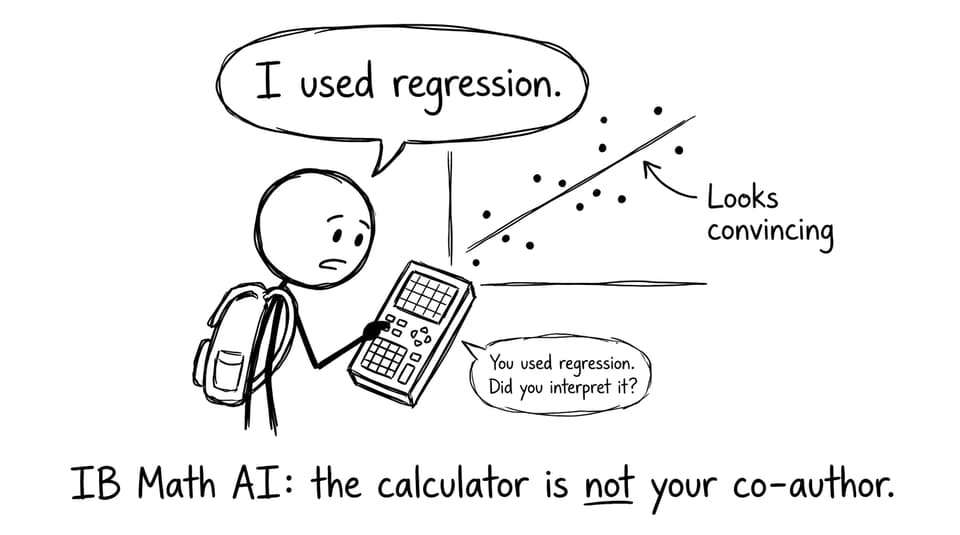
Math AI is the course where the numbers don’t get the final word. The story behind the numbers does. A regression line is not a trophy. A probability is not a promise. A model is not the world. In IB Math, especially Math AI, you’re rewarded for noticing the gap between calculation and reality and explaining it clearly.
In this guide, you’ll get a complete, exam-focused explanation of IB Math AI: what it covers, how SL and HL differ, how the exams and IA work, what universities typically expect, and how to revise without relying on hope (or your calculator’s confidence).
IB Math AI (Applications and Interpretation): the plain-English definition
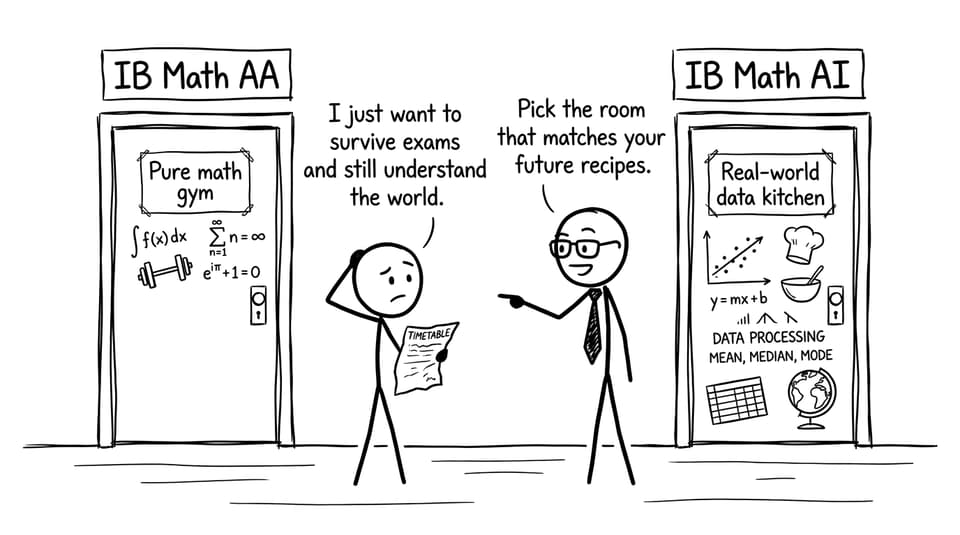
IB Math Applications and Interpretation (AI) is one of the two IB Diploma Programme mathematics pathways. Where Analysis and Approaches (AA) leans toward formal technique and proof-like thinking, Math AI leans toward using mathematics to make decisions in context.
That means Math AI focuses on:
-
modelling real situations (often with messy data)
-
statistics and probability as everyday tools, not side chapters
-
technology use (especially your GDC) as part of the method
-
interpretation: what your result implies, and what it doesn’t
If you want a central place to browse topic coverage and resources, start with the IB Mathematics Applications and Interpretation hub.
Quick checklist: what you should know before you commit to IB Math AI
Use this quick checklist as your “am I built for Math AI?” test:
-
You like math that connects to real decisions (health, business, psychology, environment).
-
You are willing to explain results in sentences, not just symbols.
-
You are comfortable using a calculator strategically, without outsourcing your thinking.
-
You can learn topic skills through practice loops (not just rereading notes).
-
You understand that in IB Math, method marks often require clear reasoning steps even when tech does the heavy lifting.
If you are already revising for exams, the most practical next step is this: use a structured plan like IB Math AI exam study plan that actually works.
IB Math AI SL vs HL: what actually changes?
Both levels share the same philosophy: applied thinking, technology, and interpretation. The difference is depth, pace, and how far you’re expected to push models.
In IB Math AI SL
You’ll build strong foundations across the syllabus and learn to handle common modelling tasks. The goal is fluent use of tools and solid interpretation under exam conditions.
A good benchmark guide is What are the key topics in IB Math AI SL?.
In IB Math AI HL
You go further into modelling complexity and analysis. You’re expected to make more nuanced judgments: choosing models, checking fit, discussing limitations, and defending assumptions.
In other words: HL is not just “more content.” It’s more decision-making.
Core topics in IB Math AI (and what examiners really reward)
The official topic headings are familiar, but the marking focus is different from what many students expect in IB Math.
Number and algebra (applied, not abstract)
You’ll use arithmetic and algebra to represent real constraints: growth, decay, finance, rates, indices, and quantities that have units and meaning.
For targeted practice and resources, use Math AI Number and Algebra and the matching Number and Algebra questionbank.
Functions and equations (the modelling engine)
Functions show up everywhere in Math AI because they let you describe how one variable behaves as another changes. Examiners love when students:
-
define variables clearly
-
interpret parameters in context
-
state domain restrictions and why they matter
Revision help: Math AI Functions and the Functions questionbank.
Geometry and trigonometry (real-world measurement thinking)
This topic is often underestimated. In IB Math, geometry questions can quietly test modelling: assumptions, diagram interpretation, and whether your final answer fits the situation.
Statistics and probability (the heartbeat of Math AI)
This is where Math AI separates itself. You don’t just compute values. You explain uncertainty.
If you want a revision shortcut that actually earns marks, read IB Math: interpret data in Math AI using technology and practise directly in Math AI Statistics and Probability.
Calculus (less about elegance, more about meaning)
Yes, Math AI includes calculus. But in IB Math AI, calculus is often used as a tool for change, optimisation, and interpreting rates, not as a purely algebraic workout.
Use Math AI Calculus when you need clean explanations and structured practice.
IB Math AI vs IB Math AA: choosing with honesty
The cleanest way to decide is not “which is easier?” but “which thinking style fits my next two years?”
-
IB Math AA suits students who enjoy algebraic technique, formal manipulation, and more theoretical paths.
-
IB Math AI suits students who want applied modelling, data interpretation, and technology-supported problem solving.
If you’re torn, use Should I take IB Math AA or AI? and decide based on your likely university direction.
Exams and the IA: how IB Math AI is assessed
Math AI is not a course you can “calculator” your way through. Exams reward structure, justification, and interpretation.
Exams: what you’re really being tested on
Across papers, you are repeatedly asked to:
-
extract meaning from graphs, tables, and context
-
choose or build a model and defend it
-
use technology appropriately and communicate results clearly
-
interpret parameters (not just calculate them)
To make practice feel real, RevisionDojo gives you two powerful options:
-
Mathematics Applications and Interpretation predicted papers for full-paper rehearsal
-
Custom IB mock exams: build practice tests by topic when you want targeted pressure-testing
The Math AI IA (Exploration): applied curiosity, measured carefully
A strong IA usually starts with a question that is simple to say, but rich to investigate:
-
What factors best predict sleep quality in my class?
-
Which model best describes local population change?
-
Does a pricing change correlate with demand shifts?
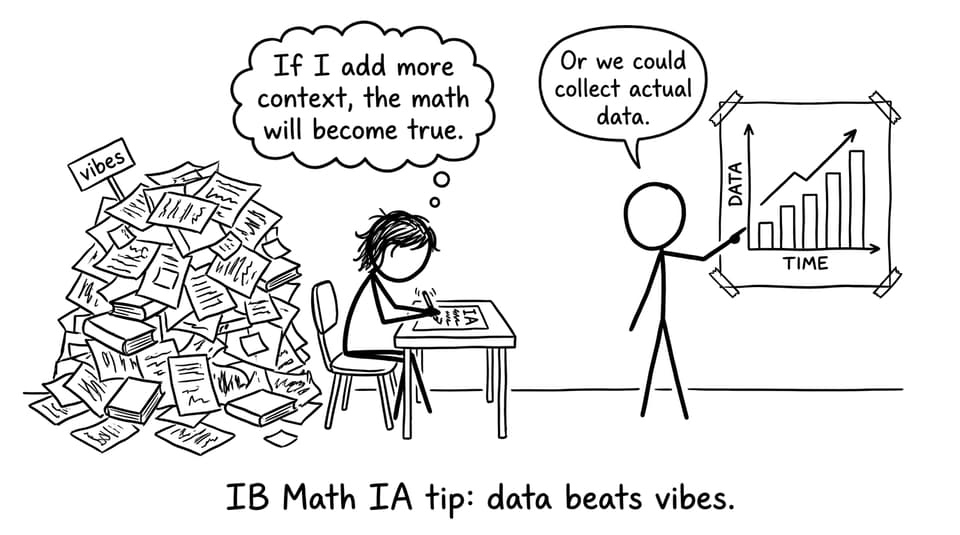
The best IAs avoid two traps: vague questions and fake data. In IB Math, examiners can feel when the maths is pasted onto a story. Your job is to make the maths necessary.
A RevisionDojo routine that fits IB Math AI (and your attention span)
Most students don’t fail IB Math because they’re incapable. They fail because their revision is unstructured: random videos, random questions, random stress.
Here’s a calmer loop built around RevisionDojo:
-
Learn quickly: Use syllabus-aligned Study Notes (start at the IB Math AI hub).
-
Practice with intent: Drill in the Questionbank so mistakes become patterns you can fix (see How to use the Questionbank for targeted math revision).
-
Remember: Convert recurring errors into Flashcards.
-
Get unstuck fast: Use AI Chat when you’re stuck on interpretation or calculator workflow.
-
Improve like an examiner: Use Grading tools to see what earns method vs interpretation marks.
-
Simulate pressure: Use Predicted Papers and Mock Exams for timing and stamina.
-
Build coursework confidence: Use the Coursework Library for exemplars and structure.
-
Add human feedback: Use Tutors when you need a personalised diagnosis.
This is how RevisionDojo becomes more than a website. It becomes a system.
FAQ: IB Math AI explained
Is IB Math AI easier than IB Math AA?
“Easier” is the wrong word, but IB Math AI is often more accessible for students who think in context. AA tends to reward algebraic fluency and comfort with abstract manipulation, while AI rewards modelling choices and interpretation. Many students find AI calmer because the course frequently connects to real situations and technology is part of the expected workflow. However, AI can feel harder if you dislike writing explanations or feel uncertain interpreting statistics. Examiners want you to justify assumptions, comment on limitations, and connect results to the scenario, and that takes practice. If your current revision style is mostly “do the calculation and move on,” AI will force you to grow.
Can IB Math AI get me into university?
Yes, for many degrees and many universities, IB Math AI is accepted, especially when your choice matches your intended field. AI HL is commonly suitable for business, social sciences, psychology, and many life science-adjacent pathways. AI SL is often fine for arts, humanities, and general programmes where advanced mathematics is not central. The key is that requirements vary by university and by course, even within the same institution. You should always check the exact entry requirements for your target degree, and if you are unsure, ask admissions directly. The smartest move is to choose the math course that you can excel in while still meeting prerequisites.
What are the most common mistakes students make in IB Math AI exams?
The biggest mistake in IB Math AI is treating the calculator like it replaces reasoning. Students run regression, copy values, and forget to interpret parameters in context, which loses easy marks. Another common issue is unclear communication: missing units, undefined variables, and conclusions that ignore what the model can realistically claim. Many students also skip limitations, even when the question practically begs for them (sample size, outliers, extrapolation, measurement error). Timing mistakes matter too: students spend too long forcing a perfect method and miss the interpretation marks available later. Finally, students revise topics but not question styles, so they panic when data is presented in an unfamiliar format.
Closing: make IB Math AI feel predictable
The best feeling in IB Math isn’t getting a hard question right. It’s realising the question is no longer hard because you’ve seen the pattern before.
IB Math AI is built for students who want mathematics to touch the real world: data, uncertainty, decisions, and models that are useful precisely because they are imperfect. If you revise with that mindset, the course becomes coherent.
If you want to make your next revision session simpler, start at the IB Math AI hub, then build a loop using RevisionDojo’s Study Notes, Flashcards, Questionbank, AI Chat, Grading tools, Predicted Papers, Mock Exams, Coursework Library, and Tutors. In IB Math, consistency beats intensity. RevisionDojo helps you keep it consistent.