

The moment you realize your IB grade isn’t “just your percentage”
Every May, there’s a familiar IB feeling: you open a result and immediately do mental arithmetic. “I got X marks, so that must mean a 6.” Then someone says the phrase IB grade boundaries, and your certainty turns into fog.
That fog is normal. In the IB, your final grade is not a simple percentage conversion. It’s a translation step the International Baccalaureate applies after marking is finished. Once you understand that translation, you stop guessing and start planning.
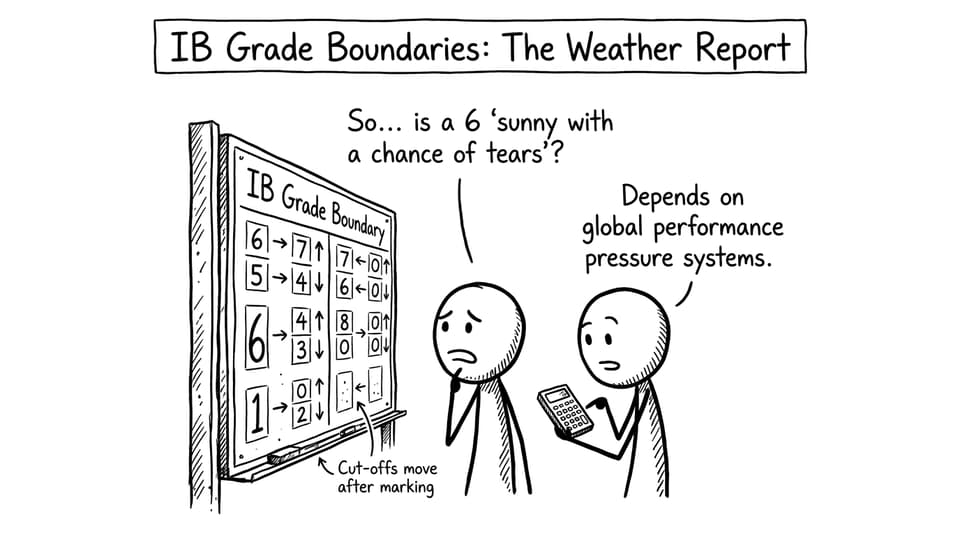
IB grade boundaries 2025 in one quick checklist
Use this mini-checklist to keep IB grade boundaries practical, not mysterious:
-
Boundaries are set after marking, not before exams.
-
They are session-specific (May 2025 has its own boundaries).
-
They differ by subject and level (HL vs SL).
-
They apply to your final weighted total, not just one paper.
-
They help you decide whether a remark (EUR) is worth it.
For fast reference, bookmark the IB Grade Boundaries tool.
What are IB grade boundaries (and what they are not)?
IB grade boundaries are the minimum total marks needed to earn each final grade (1 to 7) in a specific subject, for a specific exam session.
They are not a promise that “70% always equals a 6.” In fact, one reason the IB uses boundaries is to protect fairness across years. If a paper is unusually difficult, boundaries can be lower. If it’s more accessible, boundaries can rise.
If you want a deeper explanation of the mechanics, see IB Grade Boundaries: How They’re Actually Calculated.
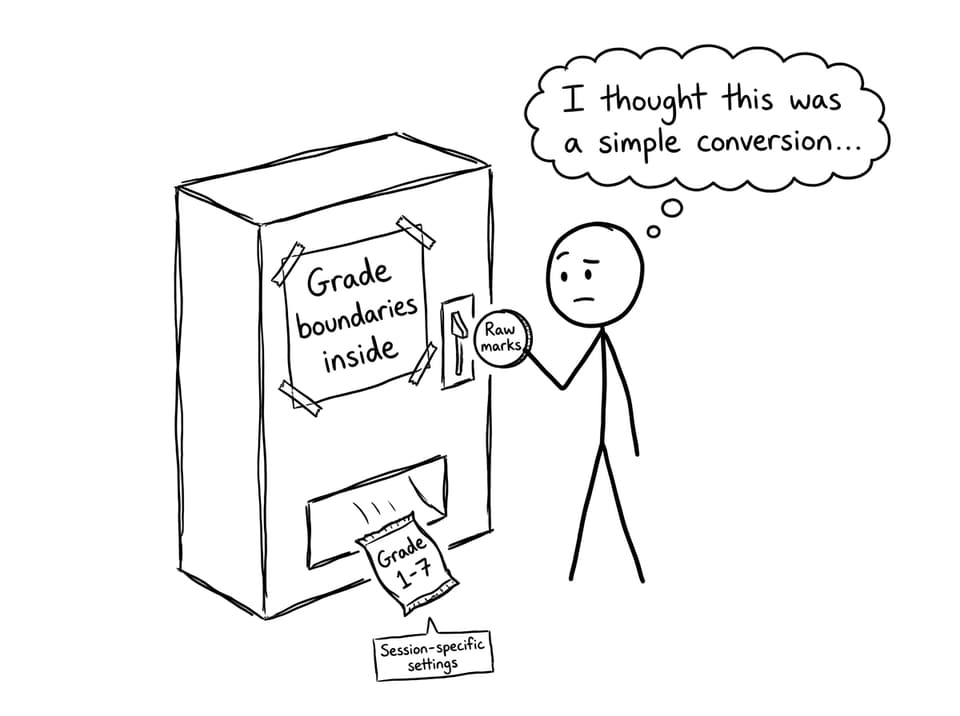
How IB grade boundaries 2025 are applied to your final grade
Think of your IB course like a weighted recipe. Your final subject score usually combines multiple components: exam papers plus internal assessment. The IB then compares that final total to the grade boundary table for your subject and level.
Two important implications for IB students:
-
Small mark differences near a boundary matter a lot. One extra method mark can shift your final grade.
-
Big improvements far from a boundary can feel “invisible.” If you move from comfortably mid-5 to comfortably mid-5, you improved, but your grade label may not change.
To understand your own situation quickly, plug in your component marks using the IB Grade Calculator.
Where to find reliable IB grade boundaries for 2025
After results release, schools receive official IB documentation. Some schools share it directly; others summarize it. If you’re unsure, ask your IB coordinator first.
For students who want a trustworthy place to compare boundaries over time, RevisionDojo keeps a clean, searchable hub at IB Grade Boundaries, plus subject pages such as IB Business Management Grade Boundaries.
You can also use targeted guides like the IB Grade Boundaries 2025 Guide to orient yourself quickly.
How to use IB grade boundaries 2025 to revise smarter
The healthiest way to “use” IB grade boundaries is not to predict them. It’s to build a buffer.
Here’s a simple IB approach:
Set a boundary buffer target
Pick the grade you want, then aim for a few marks above the typical boundary range, not exactly on it. A buffer protects you from nerves, tricky questions, and minor marking variance.
Train with feedback loops (not hopeful repetition)
This is where RevisionDojo becomes more than information. You can:
-
Drill weak topics using the Questionbank
-
Clarify gaps fast with Study Notes
-
Keep recall alive with Flashcards
-
Use AI Chat when you’re stuck mid-session
-
Practice realism with Mock Exams and Predicted Papers
-
Improve writing with Grading tools and the Coursework Library
-
Get human support via Tutors when a topic just won’t click
If you want a ready-made practice rhythm, read RevisionDojo App: The Smarter Way to Prep for IB Exams.
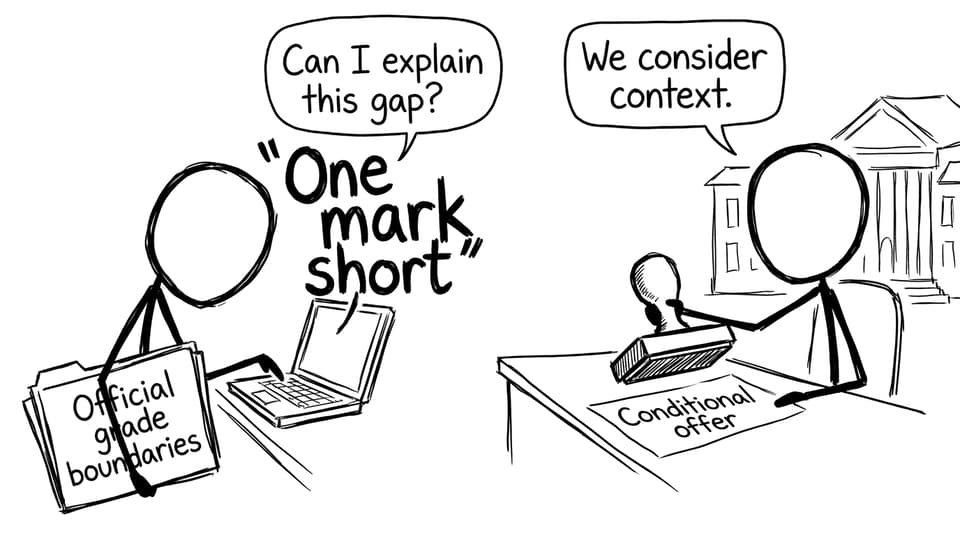
When being “one mark short” actually matters
If you missed the next IB grade boundary by a tiny margin, you may consider an Enquiry Upon Results (EUR). That decision should be calm, not emotional: remarks can increase marks, leave them unchanged, or decrease them.
Grade boundaries help you ask the right question: “Is the gap small enough that a remark is realistic?” If you’re far from the boundary, your energy may be better spent planning the next step (retake strategy, university communication, or strengthening a specific subject).
Closing thought: turn IB grade boundaries 2025 into a plan
IB grade boundaries 2025 are not a trick and not a rumor. They’re the rulebook that converts your hard-earned marks into the final grade universities see. When you treat boundaries as a planning tool, you stop chasing perfect predictions and start building a margin you can trust.
Start by checking your subjects on the IB Grade Boundaries tool, calculate your current standing with the IB Grade Calculator, then use RevisionDojo’s Questionbank, Study Notes, Flashcards, AI Chat, Grading tools, Predicted Papers, Mock Exams, Coursework Library, and Tutors to build the buffer that makes exam day feel calmer -- and more controllable.