



If you have ever stared at an IB mark and thought, “So…what does this actually mean?”, you are not alone. The week before exams, grade boundaries feel like a rumour that decides your future. But the calmer truth is simpler: IB grade boundaries are just translation tables. They turn your raw marks into the 1-7 grade universities see.
In this IB Grade Boundaries 2025 guide, you will learn what boundaries are, what they are not, and how to use them to set targets that feel realistic rather than fragile.
IB Grade Boundaries 2025: what they are (and why they move)
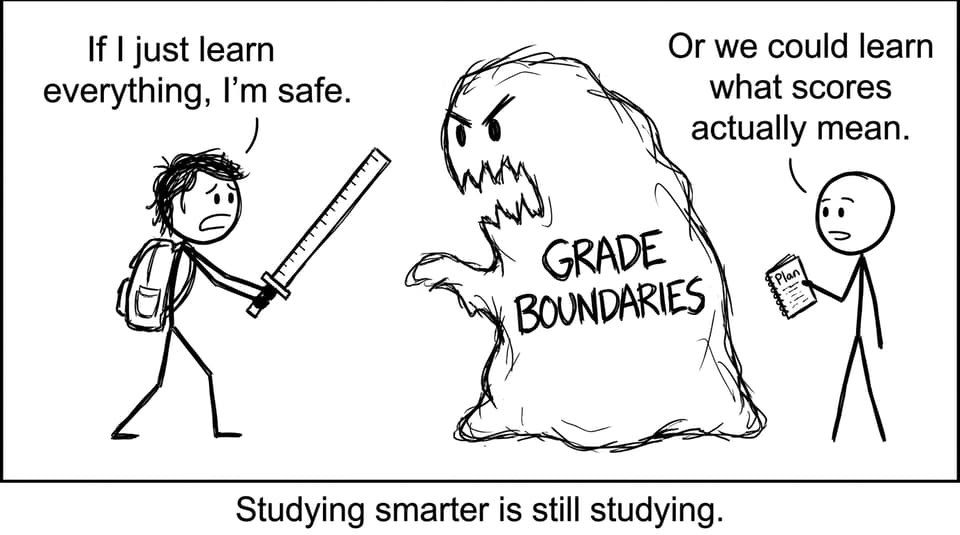
An IB grade boundary is the minimum mark needed to earn each final grade (1-7) in a specific subject, level (HL/SL), session, and sometimes timezone. Boundaries are set after marking, using evidence about paper difficulty and global performance.
That is why you should not “guess the boundary” as your strategy. A smarter IB strategy is to build margin: aim to score above the grade you want by a small buffer, so one tough question does not decide everything.
To check official boundary tables and trends quickly, bookmark: IB Grade Boundaries.
Quick checklist: how to use IB grade boundaries for revision
-
Convert your goal (like a 6) into a raw-mark target, not vibes.
-
Create a buffer of +3 to +6 marks above the boundary zone you want.
-
Train with timed practice so your scores reflect exam conditions.
-
Use feedback loops: fix one mistake pattern, then re-test within 48 hours.
For a deeper explanation of how boundaries are determined, read: IB Grade Boundaries: How They’re Actually Calculated.
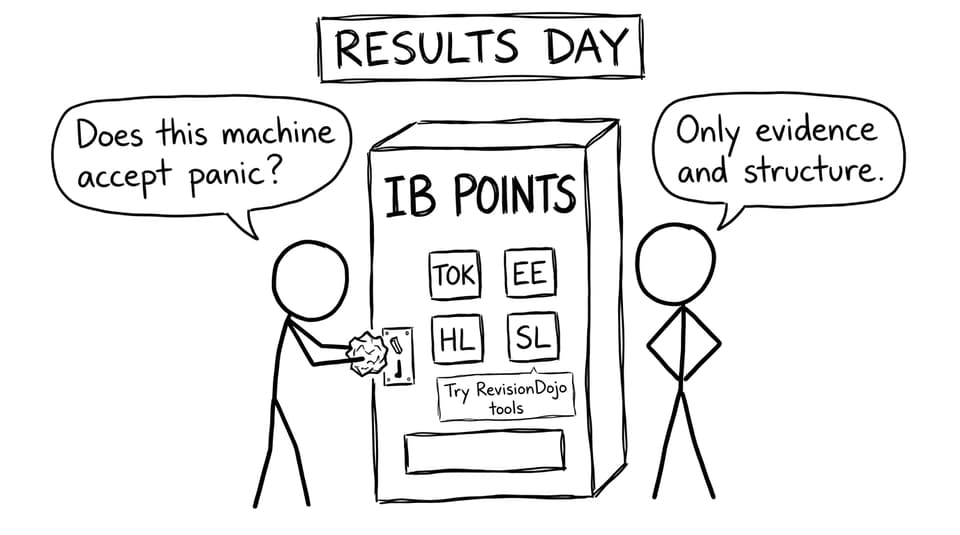
Core components in IB: TOK and EE boundaries (2025)
Your core matters because it can add up to 3 points. Here are the 2025 ranges from the guide:
Theory of Knowledge (TOK): out of 30
-
A: 22-30
-
B: 16-21
-
C: 10-15
-
D: 4-9
-
E: 0-3
Extended Essay (EE): out of 34
-
A: 27-34
-
B: 21-26
-
C: 14-20
-
D: 7-13
-
E: 0-6
If your TOK/EE process feels foggy, this is where RevisionDojo’s Coursework Library, Grading tools, and Tutors help you turn “I worked hard” into “I met the criteria.”
Subject examples from the IB Grade Boundaries 2025 guide
Grade boundaries vary by subject, but concrete examples help you set targets.
Language A examples (final out of 100)
Spanish A: Literature HL
-
7: 82-100
-
6: 69-81
-
5: 55-68
-
4: 42-54
Turkish A: Literature SL
-
7: 76-100
-
6: 65-75
-
5: 53-64
-
4: 42-52
Mathematics examples (final out of 100)
Mathematics Analysis HL
-
7: 79-100
-
6: 65-78
-
5: 52-64
-
4: 37-51
Mathematics Analysis SL
-
7: 80-100
-
6: 67-79
-
5: 53-66
-
4: 37-52
For a math-specific boundary breakdown, see: Applications and Interpretation HL Grade Boundaries 2025.
Science example (final out of 100)
Sports Exercise Science HL
-
7: 72-100
-
6: 60-71
-
5: 46-59
-
4: 34-45
If you want the full table format and more subjects, use: IB Grade Boundaries 2025 Guide.
Turn boundaries into points: the RevisionDojo loop
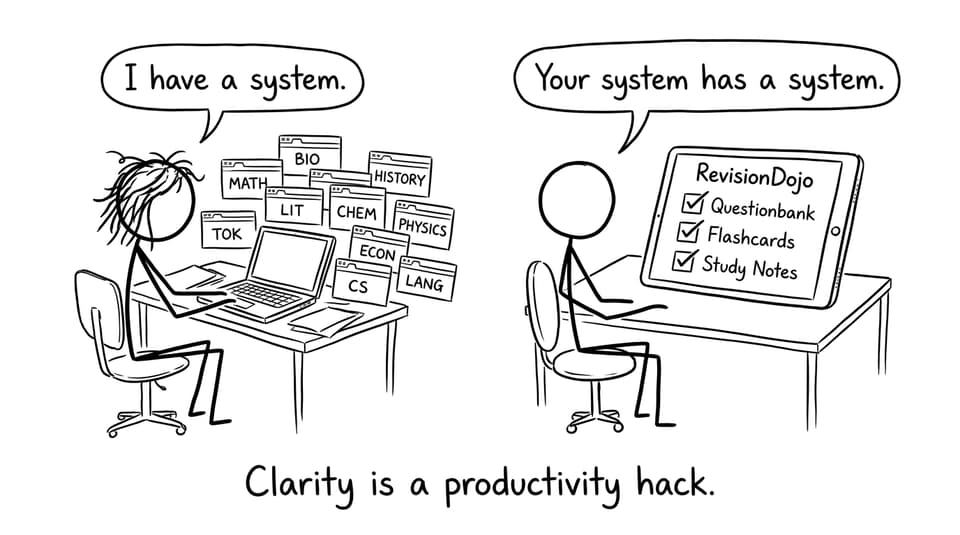
Boundaries are only useful when you pair them with practice that matches the IB.
A simple loop:
-
Check your target zone using the IB Grade Calculator.
-
Drill weak topics using RevisionDojo’s Questionbank (and keep it targeted): IB Math: Targeted Revision Using the Questionbank.
-
Reinforce with Study Notes and Flashcards so you stop re-learning the same thing.
-
Use AI Chat when you are stuck, so confusion does not steal an hour.
-
Pressure-test with Mock Exams and Predicted Papers: IB Predicted Papers and IB Predicted vs Specimen Papers: What They Mean.
FAQ: IB grade boundaries 2025
Are IB grade boundaries the same for every school?
IB grade boundaries are set centrally for an exam session, so they are not “your school’s decision.” However, the boundaries you should use depend on your session (May or November) and sometimes your exam timezone for particular subjects. That is why students can compare notes and still talk past each other. The most reliable approach is to look up your exact subject and session on a dedicated tool. RevisionDojo makes this easy because you can select the session and then compare boundary trends over time. Once you see the pattern, you stop chasing rumours and start building a buffer.
Should I aim exactly for the boundary I want?
In IB, aiming exactly for a boundary is like planning to arrive at the airport exactly when boarding closes. It can work, but it is stressful and fragile. A better approach is to aim a few marks above the boundary zone you want, creating a cushion for harder questions or minor mistakes. This is especially important in papers where method marks matter and a single slip costs more than you expect. The calm strategy is to treat boundaries as a minimum, not a destination. RevisionDojo’s timed practice tools (Questionbank sets, Mock Exams, and Predicted Papers) help you see whether your cushion holds under pressure.
How do I use grade boundaries to plan my revision week?
Start by converting your goal into a number: use the IB Grade Calculator to translate practice marks into a likely grade zone. Next, identify your fastest “repeatable marks”: definitions, standard methods, command-term structures, and common question types. Then spend most of your week on those, because they come back reliably in IB assessments. After that, add one timed session to train pacing and decision-making, not just content knowledge. Finally, use feedback: review errors with the markscheme mindset, then drill that exact weakness in the Questionbank. If you do this for two weeks, boundaries stop feeling mysterious because your scores become more stable.
Closing: use IB grade boundaries 2025 to study with margin
The best use of IB grade boundaries is not prediction. It is perspective. They tell you what “enough” looks like, so you can stop revising blindly and start training the marks you can actually control.
Open IB Grade Boundaries, set a buffer, and build a simple loop inside RevisionDojo using Study Notes, Flashcards, AI Chat, the Questionbank, Grading tools, Predicted Papers, Mock Exams, the Coursework Library, and Tutors. In IB, calm confidence is usually just a good system repeated long enough.