



The first surprise in IB Global Politics is rarely the amount of news you need to follow. It is discovering that knowing what happened is not the same as explaining why it matters politically.
That distinction sits behind many IB Global Politics first term struggles. New students may confidently describe elections, wars, protests, or climate negotiations. Then their first response comes back with questions such as: Where is the concept? Whose perspective is this? What does the evidence prove?
The biggest adjustment is moving from informed description to concept-led analysis. You must use political concepts to explain relationships, compare perspectives, and judge claims. This is a learnable method, not an instinct that some students simply possess.
The first-term adjustment checklist
Concentrate on five habits:
- Treat current events as evidence, not the argument itself.
- Learn power, sovereignty, legitimacy, and interdependence as analytical lenses.
- Record actors, interests, perspectives, and consequences for every case.
- Build paragraphs around claims rather than timelines.
- Practise analysis in small pieces before attempting complete essays.
The RevisionDojo IB Global Politics resource hub brings Study Notes, Flashcards, case studies, and practice tools together. The first term becomes easier when each resource supports one consistent method.
Why description feels deceptively safe
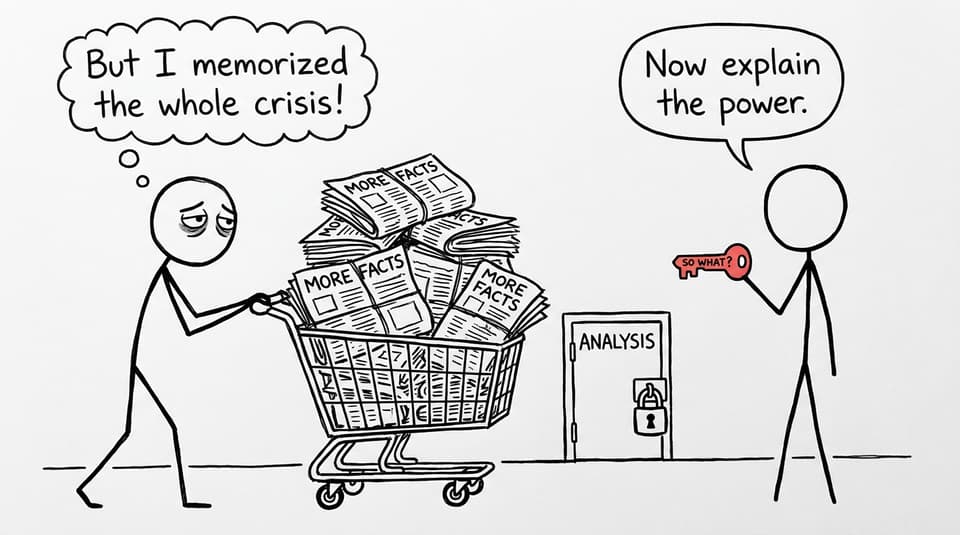
Description rewards visible effort. You read several articles, remember dates, and fill a page. The result looks substantial.
Analysis is more selective. A student may know ten facts about an international dispute, yet a stronger answer might use two facts to explain how interdependence limits state sovereignty. More information does not automatically create more insight.
The IB course integrates concepts, content, and real-world contexts through inquiry. Its four central concepts are power, sovereignty, legitimacy, and interdependence, while contemporary political issues are examined from multiple perspectives. A news summary therefore cannot complete the analytical work by itself.
Description: A government introduced a policy, protests followed, and an international organization responded.
Analysis: The policy shows how legal authority does not necessarily create legitimacy, particularly when affected groups reject the decision-making process.
The second version identifies a political relationship and explains its significance.
Use concepts as lenses, not labels
A common early correction is to insert the word power into an otherwise descriptive paragraph. Naming a concept is not the same as applying it.
Imagine that a multinational company influences environmental regulation. Writing that the company “has power” adds little. Better questions include:
- What resources or relationships create its influence?
- Can the state resist without economic costs?
- Do citizens consider the outcome legitimate?
- How does interdependence constrain each actor?
Concepts direct attention towards mechanisms. They help you see who shapes outcomes, why authority is accepted, and where political independence becomes constrained. RevisionDojo’s guide to the IB Global Politics analytical framework connects actors, levels of analysis, concepts, issues, and perspectives.
Create one page for each core concept. Include a concise definition, a contested interpretation, one suitable case, and one limitation. Use the Global Politics Study Notes to clarify the concept, then close the notes and explain it from memory. Flashcards can reinforce definitions, but application is the final test.
Turn case studies into evidence
Another early mistake is building case studies as long chronological files. This produces impressive notes that are difficult to use.
A useful case study should identify the political issue, important state and non-state actors, their interests, relevant concepts, contrasting interpretations, and the judgement the evidence supports.
For a protest movement, a descriptive file records every demonstration. An analytical file examines how protesters influenced the political agenda, why the government defended its authority, whether public acceptance shifted, and which groups experienced the dispute differently.
The guide to using case studies in IB Global Politics develops this distinction. RevisionDojo’s Global Politics case-study collection also demonstrates how evidence connects to actors, concepts, and consequences.
Do not try to collect the entire world during your first term. Build two or three flexible cases properly. One carefully organised case can support discussions of several concepts and themes.
Build analytical paragraphs before full essays
Students sometimes respond to a disappointing assignment by writing more complete essays. This can rehearse the same weakness at greater length.
Instead, practise one paragraph using this sequence:
- Claim: Answer part of the question directly.
- Concept: Identify the political idea explaining the claim.
- Evidence: Add a few precise details.
- Explanation: Show how the evidence supports the claim.
- Perspective: Introduce a credible alternative interpretation.
- Judgement: Decide which interpretation is stronger and under what conditions.
Do not stop after saying international cooperation failed because states disagreed. Explain how national interests shaped the disagreement, how sovereignty affected willingness to compromise, and whether interdependence still produced limited cooperation.
Choose a prompt from the IB Global Politics Questionbank, write one paragraph, and inspect every sentence. If it merely reports an event, ask what political mechanism it reveals. AI Chat can challenge a counterclaim, while Grading tools can indicate where explanation returns to description. Your teacher’s feedback and official assessment criteria should remain the final reference points.
A realistic first-term routine
The best response to adjustment shock is not a heroic weekend. It is a modest weekly system.
Spend 15 minutes retrieving one concept and applying it to a recent issue. Spend another 20 minutes updating one case, adding only evidence that changes or strengthens your interpretation. Record every source so facts retain their context.
Next, spend 20-30 minutes planning a response or writing one analytical paragraph. The guide to revising IB Global Politics effectively offers a broader routine for turning knowledge into exam performance.
Finally, identify one recurring weakness, such as vague evidence, missing counterclaims, or conclusions that repeat rather than judge. Correct it in the next task. Later, Predicted Papers and Mock Exams can develop timing, while the Coursework Library and Tutors can support calibration when your reasoning remains inconsistent.
What progress should look like
By the end of term, you should be able to take an unfamiliar issue and identify its principal actors, interests, forms of power, relevant scales, and competing perspectives. You should explain why a concept clarifies the issue and where its limits appear.
Your paragraphs may become shorter before they become longer. That can be progress. You are removing facts that occupy space and retaining evidence that performs analytical work.
RevisionDojo supports that journey from several directions: learn with Study Notes, retrieve ideas through Flashcards, apply them in the Questionbank, and refine reasoning with AI Chat and Grading tools. As the course develops, Predicted Papers, Mock Exams, the Coursework Library, and Tutors can extend the same method. The world will remain complicated. Your thinking does not have to remain disorganised.