

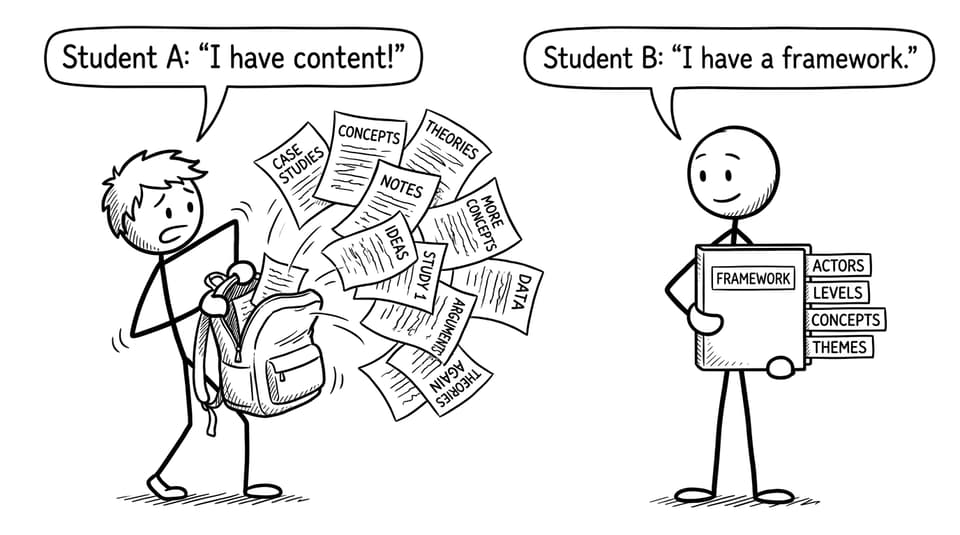
If you’ve ever read an IB Global Politics question and felt your brain sprint toward random case studies (and away from structure), you’re not alone. The best students don’t “know more news.” They see patterns. That’s what the IB Global Politics framework is for: a disciplined way to analyse messy events without turning your answer into a timeline.
In exams, the framework helps you do what examiners actually reward: explain how global politics works, not just what happened. You move between actors, concepts, and levels of analysis until your argument feels inevitable.
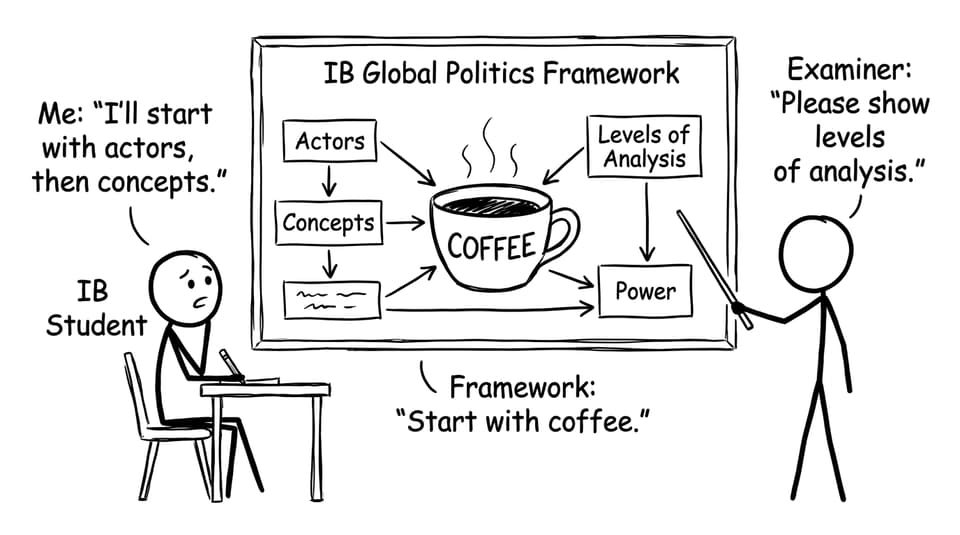
The IB Global Politics framework (quick checklist)
Use this as your planning grid for almost any IB Global Politics prompt:
-
Actors: Who has influence (state and non-state)?
-
Levels of analysis: Global, international, national, local, individual.
-
Core concepts: Power, sovereignty, legitimacy, interdependence, human rights (and more).
-
Issues/themes: Development, sustainability, peace and conflict, rights and justice.
-
Theories/perspectives: Realism, liberalism, constructivism (used selectively).
If you want a single hub where these parts connect, start with the IB Global Politics resources page.
Actors: who shapes outcomes in IB Global Politics?
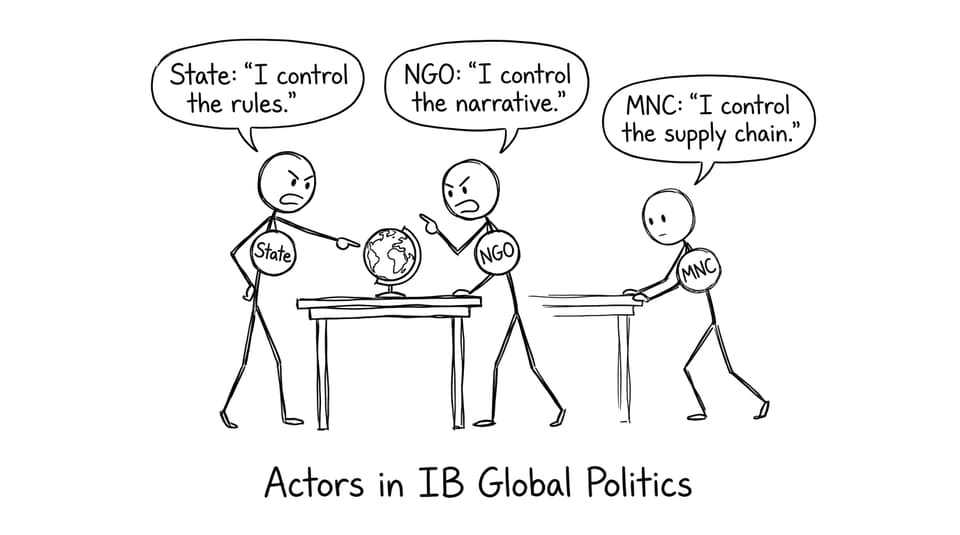
At the centre of IB Global Politics sits a simple truth: the world is run by more than governments. Yes, states still matter because they control borders, law, and coercive power. But many global outcomes are negotiated, pressured, funded, or exposed by non-state actors.
Common actor categories you can apply in exams:
-
States (including their militaries, courts, and bureaucracies)
-
Intergovernmental organizations (UN, WTO, regional bodies)
-
NGOs and civil society (advocacy, monitoring, service delivery)
-
Multinational corporations (trade, investment, tech infrastructure)
-
Media and platforms (agenda-setting, framing, information power)
-
Individuals (leaders, whistleblowers, activists)
For topic-specific practice, RevisionDojo’s concept pages help you build precise examples, like Power in IB Global Politics.
Levels of analysis: the shortcut to “depth”
The fastest way to upgrade an IB Global Politics answer is to stop treating causes as single-layered. Most global issues happen at multiple scales at once.
A strong paragraph often moves like this:
-
Global/international: norms, institutions, alliances, economic systems.
-
National: domestic interests, regime type, public opinion, policy trade-offs.
-
Local/individual: community impacts, identity, leadership choices.
Examiners reward this because it avoids one-dimensional explanations. If you want exam-focused guidance on how that thinking shows up in the actual papers, use the IB Global Politics Paper 1 guide notes and the IB Global Politics Paper 2 guide notes.
Core concepts: the “tools” that turn events into arguments
In IB Global Politics, concepts are not vocabulary to memorise. They are lenses that transform a case study into analysis.
A few high-utility examples:
-
Power: Who gets what, when, how (and through which type of power)?
-
Sovereignty: Who has authority, and where are the limits?
-
Legitimacy: Why do people accept (or reject) authority?
-
Interdependence: How do connections create vulnerability and influence?
-
Human rights: Who defines rights, and how are they enforced or contested?
When you revise legitimacy with real exam wording, use the Legitimacy questionbank and, for clearer conceptual notes, see External challenges to state legitimacy notes.
Themes and issues: where concepts get tested
Themes are the “arena” where concepts collide in IB Global Politics. A concept like sovereignty looks different when applied to humanitarian intervention than it does in trade policy.
RevisionDojo’s topic pages make this concrete:
When you practise, try building each paragraph as: claim → concept → evidence → counterclaim → judgement. For a clear structure model, use Top-scoring IB Global Politics essay structure.
Theories: use them like seasoning, not the whole meal
Theories help you explain behaviour in IB Global Politics, but only when they clarify the question.
-
Realism can strengthen arguments about security competition, state interest, or power balancing.
-
Liberalism often helps with cooperation, institutions, and interdependence.
-
Constructivism clarifies identity, norms, legitimacy, and changing ideas.
If you want targeted practice that mirrors the exam style, use the Theoretical perspectives questionbank.
How to practise the framework (fast, exam-friendly)
-
Pick one case study and write three mini-claims about it.
-
For each claim, add one concept and two levels of analysis.
-
Write a two-sentence evaluation: what would someone disagree with, and why?
Then train under pressure using RevisionDojo’s Questionbank and Mock Exams, tighten memory with Flashcards, and use AI Chat to test counterclaims. When you draft longer responses, RevisionDojo’s Grading tools help you see exactly what your argument is missing (usually evaluation). If you’re aiming for extra realism, Predicted Papers give you timed practice with examiner-style marking.
Closing: turn IB Global Politics into something you can control
Global politics will always feel bigger than you. That’s the point. But IB Global Politics isn’t testing whether you can predict the next crisis; it’s testing whether you can analyse one with discipline.
If you want your framework to become second nature, build your routine inside RevisionDojo: start with the IB Global Politics revision notes, drill with the Questionbank, sharpen timing with Mock Exams and Predicted Papers, and use AI Chat plus the Grading tools to turn feedback into points on the markscheme. That’s how the IB Global Politics framework stops being theory and starts becoming your advantage.