



The minute you leave an IB exam room, the story begins.
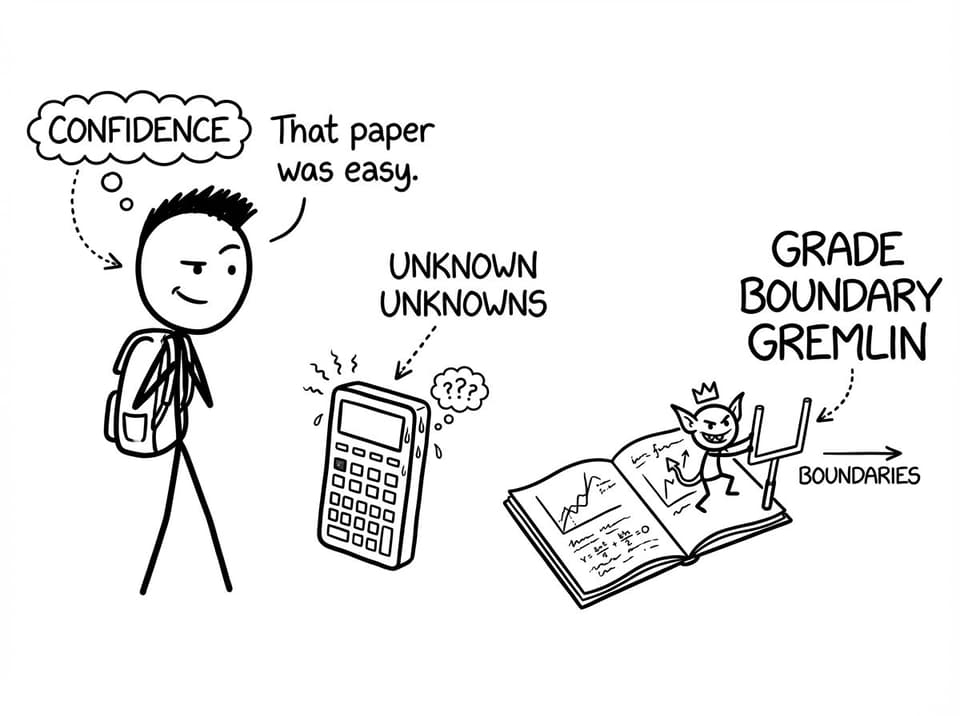
Someone says, "That was easy."
Someone else says, "Boundaries are going to be insane."
And suddenly, you're no longer thinking about what you wrote. You're thinking about a number you don't control.
This is the truth about the "easy paper = higher boundaries" idea: it's not completely wrong, but it's also not the useful prediction students think it is. In IB, boundaries move for reasons that are bigger than your post-exam mood, and smaller than the panic in your group chat.
What matters is learning how boundaries actually work, why "easy" can be misleading, and what you can do so the boundary conversation stops hijacking your revision.
The quick IB checklist (save this before you spiral)
If you want a simple, calm way to think about IB boundaries without getting trapped in rumors, use this checklist:
- Check actual boundary history (not vibes) on the IB Grade Boundaries page.
- Remember boundaries are set after marking, not right after the exam.
- Treat "easy" as a warning to be precise, not as a reason to panic.
- Focus on what you can control: accuracy, method marks, structure, and command terms.
- Train with feedback loops: Questionbank + Study Notes + timed practice.
That's the real IB edge: not guessing the boundary, but raising your consistency.
Why "easy paper" is a terrible measurement in IB
"Easy" in IB often means one of three things:
It matched what you revised
If the questions landed on topics you drilled, your brain reads it as easy. Someone else, who revised different topics, experiences the same paper as a trap.
That's why post-exam surveys are noisy. They measure preparation alignment, not objective difficulty.
It was straightforward but strict
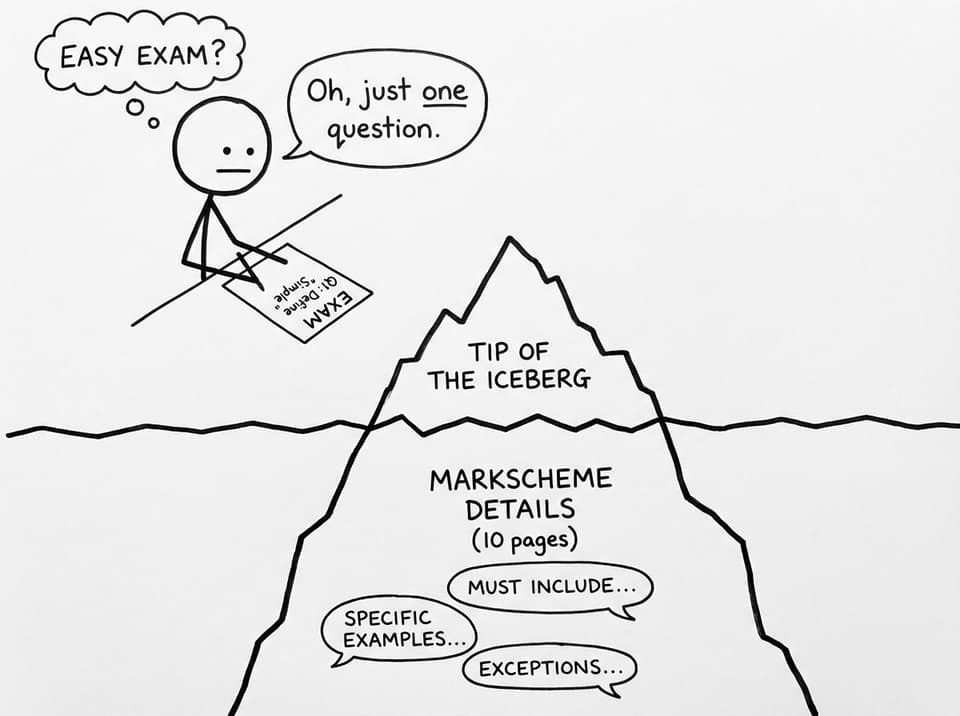
Some IB papers feel accessible because the questions are familiar. But the markscheme can be sharp.
In essay subjects, "easy" prompts can lead to generic responses. In sciences and math, "easy" questions can still punish skipped steps. In both cases, lots of students score in a tight band, which can push boundaries upward.
But notice what caused the movement: not the paper being easy, but the distribution of marks.
You don't know what you missed yet
The most dangerous kind of easy is the kind that comes from not noticing the small requirements.
IB rewards precision. A definition missing one phrase. A diagram without labels. A History essay that narrates but doesn't argue. A TOK paragraph that sounds deep but doesn't answer the knowledge question.
"Easy" is often a delayed reaction. You only find out later which marks quietly walked away.
What grade boundaries actually respond to (and what they don't)
IB grade boundaries respond to how students perform in that session on that paper, across time zones and cohorts. They don't respond to your school's reaction, your teacher's guess, or a trending TikTok breakdown.
A practical way to understand it:
- If a paper leads to higher raw scores across the global cohort, boundaries often rise.
- If a paper leads to lower raw scores, boundaries often fall.
- If performance clusters tightly, small differences can change boundaries more noticeably.
That's why boundaries shift from year to year, even for the same subject.
If you want a fuller explanation, RevisionDojo breaks it down in What Are the Grade Boundaries for IB Subjects? and adds extra context in Insights on IB Grade Boundaries and Result Trends.
The truth: easy papers can raise boundaries, but not in the way you think
Here's the cleanest way to say it for IB students:
An "easy" paper can raise boundaries if it makes many students score high marks.
But three things complicate that:
Boundaries are not a punishment
Students talk like IB "raises boundaries" to humble you. That's not how standard setting is supposed to work. The goal is comparability across sessions. If performance is higher, boundaries shift to keep grade meaning stable.
"Easy" is not evenly distributed
A paper can be easy for strong students and still messy for mid-range students, which changes the shape of results. Sometimes that shape moves boundaries less than people expect.
Your grade is built from multiple components
Even if one component feels easy, your final subject grade often combines different papers and coursework. So the "easy paper" story is rarely the whole story.
This is why obsessing over boundary predictions rarely improves your outcome in IB. It burns energy you could invest into accuracy.
A better IB strategy: prepare for tight marking, not boundary rumors
If there's one habit that consistently separates top IB results from anxious mid-results, it's this:
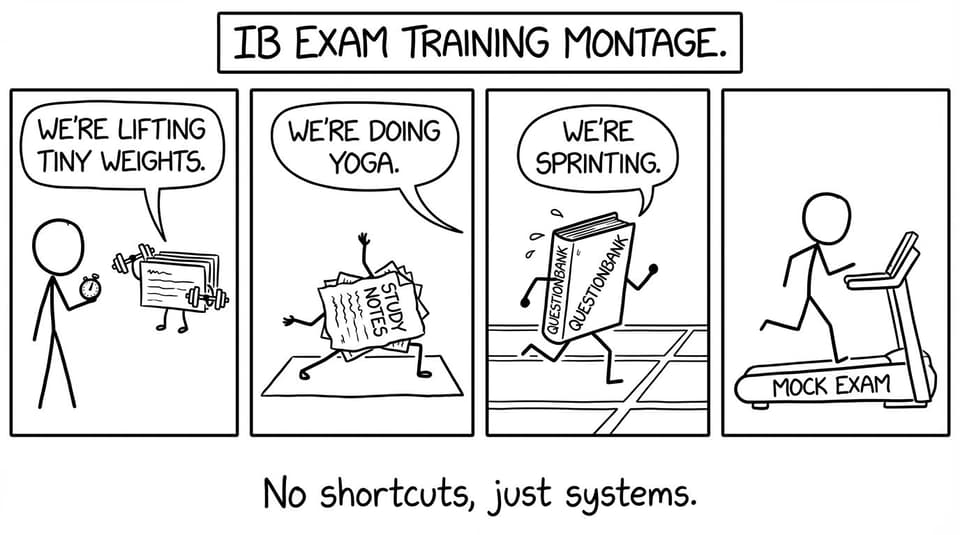
Top students train for the markscheme.
They don't just revise content. They rehearse the exact way marks are awarded.
That's also why RevisionDojo is structured as a system, not a folder of PDFs.
- Study Notes clarify what matters and reduce the "rewrite everything" trap. Start with Digital IB Study Notes: Access Anywhere, Anytime.
- Flashcards turn knowledge into daily recall (the kind that holds under time pressure).
- Questionbank teaches you how marks are won and lost with high-volume, topic-filtered practice. See Comprehensive IB Question Bank: Thousands of Practice Questions.
- AI Chat (Jojo) helps you get unstuck fast, then pushes you back into practice.
- Grading tools make feedback immediate, especially for coursework drafts where waiting a week costs momentum.
- Mock Exams and Predicted Papers build stamina and timing so the exam stops feeling mythical.
- Coursework Library and Tutors give you exemplars and human guidance when you need it most.
If you want the full workflow, use RevisionDojo App: The Smarter Way to Prep for IB Exams.
The hidden reason "easy paper" causes panic: it threatens your margin
Most IB students aren't aiming for perfection. They're aiming for margin.
Margin is what lets you:
- misread a sub-question and still survive
- blank for 20 seconds and recover
- make one silly arithmetic error without it becoming a cascade
An "easy" paper story scares you because it suggests your margin disappears. Suddenly, you imagine a world where you needed 2 more marks to cross a boundary.
Here's the honest fix: build margin in advance.
Build margin with targeted practice loops
Instead of doing "more revision," do tighter cycles:
- One weak topic from Study Notes
- 20-30 items in Questionbank
- Turn repeated mistakes into Flashcards
- Ask AI Chat one clarifying question, then reattempt
This is how you become boundary-proof in IB. Not invincible. Just consistently above the noise.
Build margin with timed realism
Many students know content but lose marks to pacing. Fix it with weekly realism:
- one timed session using Online IB Mock Exams: Practice Anywhere, Anytime
- review your errors like an analyst
- rebuild the same weak area immediately
If your biggest stress is timing and structure, IB Questions: Official Exam Practice pairs well with this approach.
How to talk about boundaries without losing your head (a short script)
In IB season, boundaries come up like weather. Everyone has an opinion, no one can change it.
Try this response:
- "Maybe. I'm focusing on what I can control."
- "I'll check actual trends later on RevisionDojo, but I'm revising technique now."
- "If it was easy, the markscheme will be picky. I'm drilling accuracy."
This isn't fake positivity. It's disciplined attention.
Closing: the IB boundary you can control is your consistency
The "easy paper = higher boundaries" story survives because it contains a small truth: sometimes easier papers produce higher marks.
But the bigger truth for IB students is calmer: boundaries are a result, not a strategy.
Your strategy is building consistency so your score doesn't depend on rumors, or on one lucky question, or on a paper that happened to fit your revision.
That's what RevisionDojo is built for: a full IB system that turns effort into feedback and feedback into results. Use Study Notes to cut noise, Flashcards to make memory compound, Questionbank to learn the markscheme, AI Chat to stay unblocked, Mock Exams and Predicted Papers to rehearse reality, and Grading tools, Coursework Library, and Tutors when coursework pressure peaks.
If you want one next step, make it simple: open RevisionDojo, pick one weak topic, and prove you can improve it today. In IB, that is how confidence is actually built.