

A parent can look at an IB score and feel as though it should answer a simple question: Where will this be accepted? Unfortunately, university admissions rarely offer simple arithmetic.
The reassuring answer is that the IB Diploma is widely recognized across major university destinations. The less satisfying but important answer is that reliable IB acceptance rates by country are not published centrally. Countries do not admit students; individual universities and degree programmes do. Each applies its own academic thresholds, subject prerequisites, language rules, and selection process.
The International Baccalaureate reports that more than 4,500 universities in over 110 countries and territories receive IB applications and transcripts each year. Recognition, however, does not guarantee admission. It means the qualification can be considered.
For IB diploma parents, the useful question is therefore not, "What percentage of IB students does this country accept?" It is, "How will this university assess my child's diploma, subjects, and wider application?"
The answer at a glance
Before comparing countries, keep these distinctions clear:
- There is no authoritative global database of IB applicant acceptance rates by country.
- Diploma recognition means a university accepts the qualification as valid, not that every applicant receives an offer.
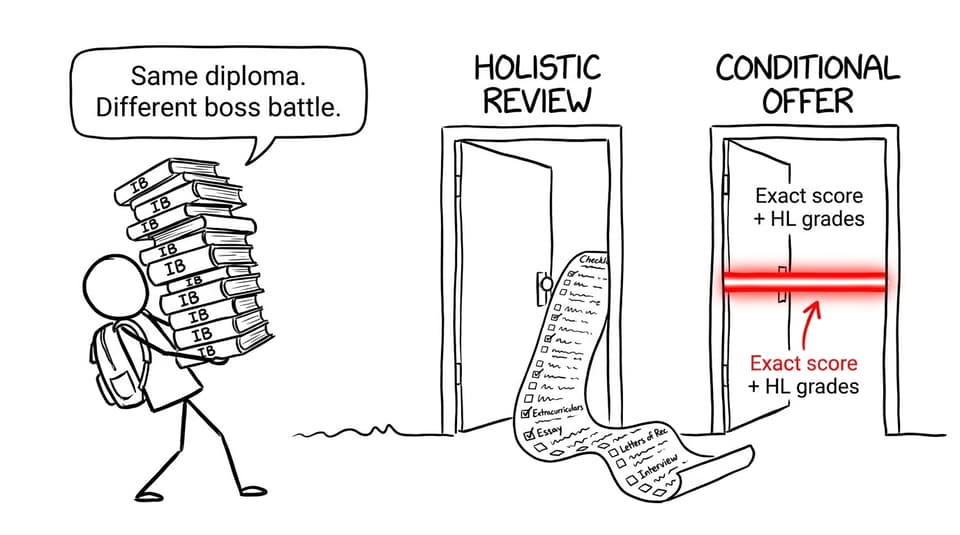
- Some systems emphasize a total IB score and Higher Level grades.
- Others review the transcript, course rigor, essays, activities, recommendations, or contextual information together.
- Subject selection can matter as much as the final total, especially for medicine, engineering, mathematics, and science.
- University, programme, and annual admissions pages are more useful than broad country averages.
Parents new to the programme can begin with a clear explanation of how the IB Diploma works. Understanding the six subjects, HL and SL structure, Theory of Knowledge, Extended Essay, and CAS makes university requirements much easier to interpret.
Why IB acceptance rates by country can mislead parents
An acceptance rate needs a defined numerator and denominator: admitted IB applicants divided by all IB applicants. Most national authorities do not collect or publish that combination consistently. Universities may publish their overall admission rate without separating IB candidates, while others disclose entry standards but not applicant outcomes by qualification.
Even transcript data cannot solve the problem. The IB itself cautions that the number of transcripts sent to a university does not show how many students were admitted. A student may send results after receiving an offer, apply through a different process, or choose another institution.
Older surveys comparing IB applicants with wider applicant populations are still circulated online. They should not be treated as current country rates. Admissions selectivity, applicant pools, policies, and sample quality change over time.
There is another source of confusion: diploma pass rate and university acceptance rate are different measurements. The latest finalized May 2025 IB statistical bulletin available during this article's research reported a global Diploma Programme pass rate of 81.9% and an average score of 30.6 among diploma recipients. Those figures describe IB assessment outcomes. They do not reveal the percentage entering university in any country.
How major countries and regions assess the IB Diploma
The following comparison describes the dominant admissions model rather than inventing a percentage that official sources do not provide.
| Country or region | How the IB is generally treated | What families should verify |
|---|---|---|
| United States | Recognized within decentralized, often holistic admissions | Transcript, course rigor, essays, recommendations, testing policy, and university-specific IB credit |
| United Kingdom | Usually assessed through course-specific academic offers | Total points, HL grade pattern, prerequisite subjects, admissions tests, and interviews |
| Canada | Widely recognized, with policies set by each university and faculty | Required subjects, competitive score range, English requirements, and transfer credit |
| Australia | Full Diploma results are converted to a nationally coordinated admissions rank | Current conversion schedule, course rank threshold, prerequisites, and state admissions process |
| Netherlands | The full Diploma can provide access to higher education, subject to institutional requirements | Required subjects, programme selection, language rules, and whether the course has limited places |
| Germany | Recognized when detailed national conditions concerning subjects and study pattern are met | Diploma composition, HL choices, languages, mathematics, sciences, and official documentation |
| Singapore | Accepted by leading universities, but admission is highly competitive and programme-specific | Actual or predicted result rules, subject prerequisites, language requirements, and submission dates |
| Hong Kong | Accepted as an international entrance qualification | Competitive programme score, HL subjects, language requirements, interviews, and supporting materials |
United States
The United States has no national IB cutoff or unified admissions formula. A university may consider school grades, the difficulty of the student's programme, HL and SL choices, essays, recommendations, activities, and personal context. The Diploma demonstrates academic rigor, but it is not an automatic admissions advantage detached from the rest of the application.
Credit is a separate decision. Some institutions award credit or advanced placement for qualifying HL results, while policies for SL subjects and the full Diploma vary. Families should read the admissions policy and the academic credit policy independently. RevisionDojo's guide to using the IB in US college applications explains how to report courses, predictions, and final results accurately.
United Kingdom
UK offers are often more visibly score-based. A course may require a particular total alongside an HL combination, such as three specified grades. Competitive courses may add an admissions test, written work, an interview, or strict subject prerequisites.
This makes the published requirement unusually useful, but it remains a threshold rather than an acceptance probability. Meeting it may make a student eligible or satisfy an offer; it does not guarantee selection. Families comparing options can use the global guide to minimum IB university scores as a starting point, then confirm every figure on the current course page.
Canada
Canadian universities commonly accept the IB Diploma, but admission and transfer-credit policies differ by institution and faculty. For example, official policies at major universities show that credit may depend on the subject, level, and final grade. A science faculty may also apply different rules from an arts faculty at the same institution.
Parents should distinguish three questions: Is the Diploma recognized? Is the student's score competitive for the chosen programme? Will particular subjects earn credit? These answers often appear on separate pages.
Australia
Australia offers one of the clearest structural pathways. Awarded Diploma results are converted through an admissions framework into an ATAR-equivalent rank used for comparison with domestic applicants. The conversion schedule can change by selection year, so an old table should never guide a current application.
Even a strong converted rank does not remove programme prerequisites or competitive selection. Families need the current conversion, the course threshold, and required subjects. A published rank is better understood as a position within the selection system, not a national acceptance rate.
The Netherlands and Germany
Both countries recognize the IB, but recognition rules deserve careful attention.
In the Netherlands, the full Diploma can support access to research universities, while institutions may impose programme-specific subject and language requirements. Selective or capacity-limited programmes can add further steps.
Germany is more prescriptive about Diploma composition. Official recognition depends on conditions involving the six subjects, languages, mathematics, science, HL choices, continuous study, and documentation. Rules applying from the 2025 examination year changed part of the required HL configuration. A family considering Germany should check eligibility early, preferably before final subject choices are fixed.
Singapore and Hong Kong
Leading universities in Singapore and Hong Kong accept the full IB Diploma, but popular programmes can be exceptionally competitive. Published figures are often minimum, indicative, or previously competitive scores rather than an acceptance rate. Programme prerequisites, language requirements, interviews, and application timing can all influence the outcome.
The practical lesson is simple: do not turn a previous competitive score into a promise. Treat it as one piece of planning evidence.
What matters more than a country-level percentage
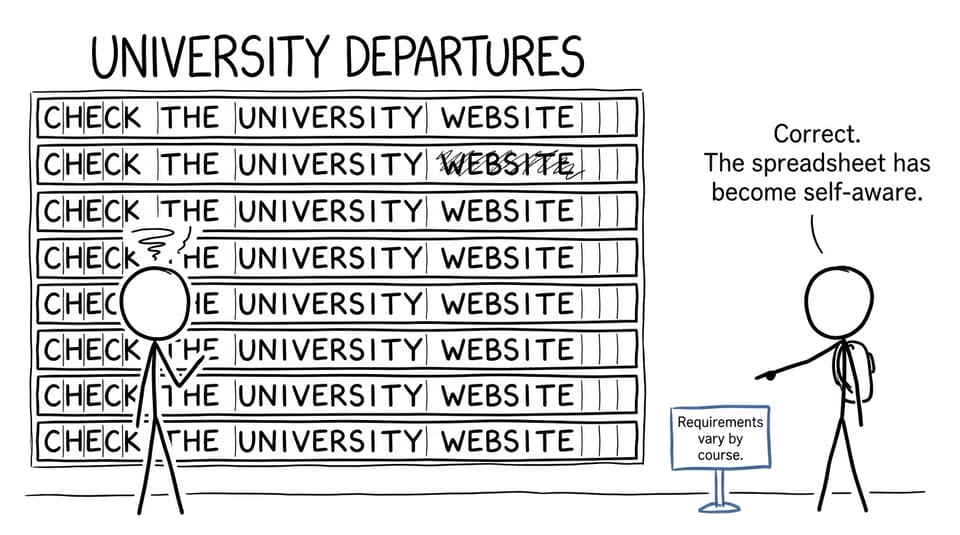
A useful university spreadsheet should track details that can actually change an application:
| Application factor | Question to record |
|---|---|
| Qualification recognition | Is the full IB Diploma accepted for this route? |
| Total score | Is there a minimum, typical, or competitive range? |
| HL profile | Are particular HL grades specified? |
| Subject prerequisites | Does the programme require mathematics, a laboratory science, or another subject? |
| Admissions model | Is selection score-led, holistic, ranked, or conditional? |
| Additional assessment | Is there a test, interview, portfolio, or written submission? |
| Language requirement | Does the student's IB language study satisfy it? |
| Credit policy | Can qualifying subjects earn placement or university credit? |
| Evidence date | When was the requirement last confirmed? |
Build a balanced shortlist rather than searching for one supposedly safe country. Include options at different levels of selectivity, and compare the student's predicted profile with programme requirements. The step-by-step guide to global IB university applications can help families organize that process without turning every conversation into a negotiation over points.
Predicted results also need context. They are estimates used in many application systems, not final awards. Students and parents who are uncertain about how schools form them can read how IB predicted grades are developed.
How parents can support exam preparation without adding pressure
Admissions research eventually reaches a limit. Once the shortlist is sensible and requirements are recorded, the highest-value work returns to the student: understanding content, retrieving it reliably, applying it to exam-style questions, and reviewing errors.
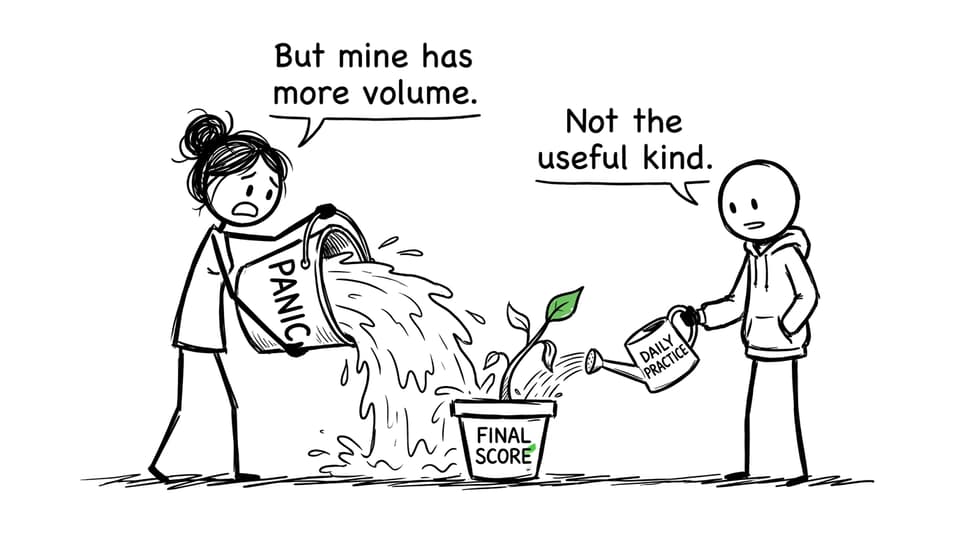
Consistency is less dramatic than panic, which is precisely why it works better as a study system. A repeatable week might include short recall sessions, targeted question practice, one timed section, and a careful error review. Parents can help protect the time and environment without taking ownership away from the student.
RevisionDojo brings that routine into one place. Its complete collection of IB resources includes Study Notes for clarification, Flashcards for active recall, a Questionbank for targeted application, AI Chat for difficult concepts, and Grading tools for feedback. Predicted Papers and Mock Exams support timed rehearsal, while the Coursework Library and Tutors provide help when independent work reaches its limit.
The aim is not to promise a particular score or admission outcome. It is to make consistent, evidence-led preparation easier. Students who need a practical routine can also explore how to combine flashcards and practice questions or review the RevisionDojo guide to effective IB exam resources.
A clearer way to think about IB university acceptance
The absence of dependable country-level percentages is not bad news. It simply means families should avoid judging a student's prospects through a statistic too broad to be useful.
The IB Diploma travels well, but every destination reads it through a different admissions system. In the US, the whole application may dominate. In the UK, total points and HL conditions often sit at the center. Australia uses rank conversion. Germany scrutinizes Diploma composition. Other destinations combine recognition with programme-level competition.
So begin with the course, not the country. Verify the current requirements, build a balanced list, and turn the student's target into a calm revision plan. RevisionDojo can support the final part of that journey by helping students practise consistently, understand their mistakes, and walk into examinations knowing what they have prepared for.