



Water doesn’t look like a hero. It’s quiet, everywhere, and usually taken for granted until your teacher asks a 3-mark question about it.
But in IB Biology, water is the reason your enzymes don’t experience mood swings every time the sun goes behind a cloud. Its ability to stabilize temperature is one of those syllabus ideas that seems small at first, then keeps showing up in ecosystems, physiology, and even climate.
This post breaks down how water stabilizes temperature (and how to explain it clearly in exams), with links to RevisionDojo resources you can use to practise and lock in marks.
The 20-second IB Biology checklist
If you need an exam-ready explanation for IB Biology, aim for this chain:
-
Define specific heat capacity (energy needed to raise temperature of 1 g by 1°C)
-
Water has a high specific heat capacity
-
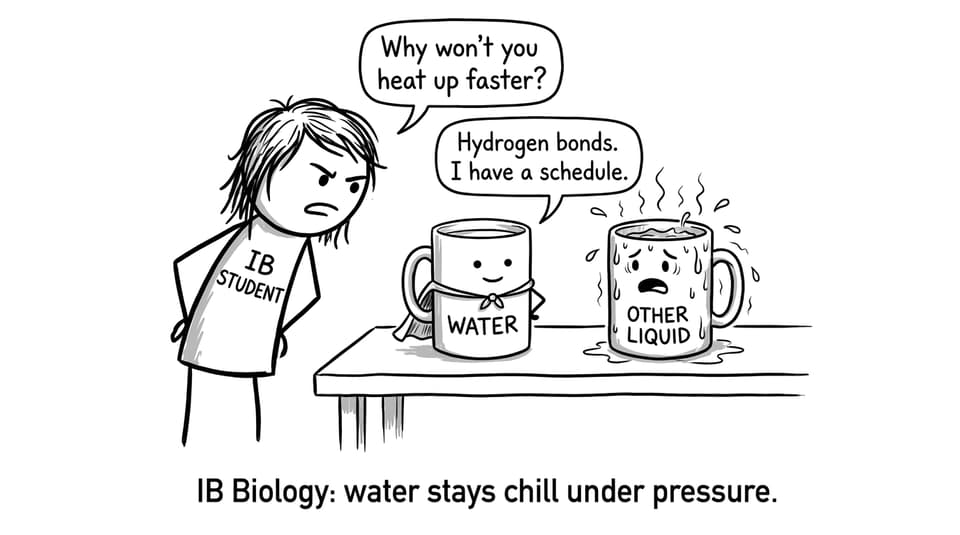
Reason: hydrogen bonds absorb energy when disrupted
-
So water warms and cools slowly
-
Outcome: stable aquatic habitats, moderated coastal climates, and steadier conditions for enzyme activity
For a syllabus-aligned version of this exact content, keep these open while revising:
What “high specific heat capacity” really means in IB Biology
Specific heat capacity is basically a substance’s resistance to temperature change. In IB Biology, you don’t need the full physics treatment, but you do need the meaning:
Water requires a lot of energy to increase in temperature. So when heat enters a lake, an ocean, or even cytoplasm, the temperature rises slowly compared to many other liquids.
That slow change is the point. Life depends on a narrow window of temperatures where proteins hold their shape and enzymes keep their active sites functioning.
To reinforce the definition and exam-style phrasing, practise with:
Hydrogen bonding: the microscopic reason water stabilizes temperature
In IB Biology, “because of hydrogen bonds” is not the whole answer. It’s the start of the answer.
Here’s the clearer mechanism:
Water molecules form a constantly shifting network of hydrogen bonds due to polarity. When heat energy is added, a large portion of that energy is used to disrupt hydrogen bonds before it significantly increases molecular kinetic energy. So temperature rises more slowly.
When the environment cools, hydrogen bonds reform and release energy, slowing the cooling process too. Water becomes a thermal buffer in both directions.
If you want the best supporting explanation for this (and the polarity step that often earns extra credit clarity), use:
From molecule to planet: where IB Biology expects you to apply it
A good IB Biology answer connects the molecular cause to a biological consequence. Here are the high-yield applications.
Stable aquatic environments
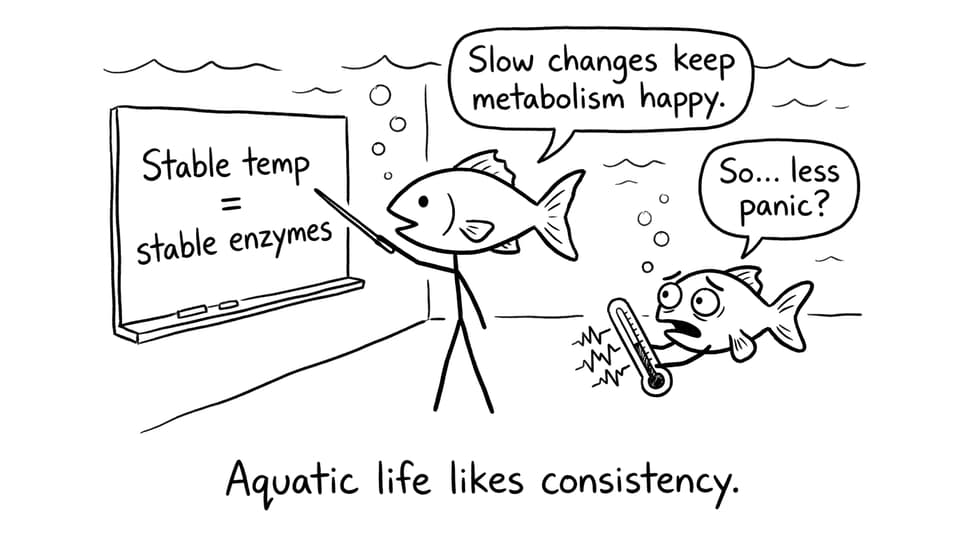
Aquatic habitats change temperature slowly. That matters because many aquatic organisms tolerate only small shifts before metabolism and behaviour are affected.
RevisionDojo often frames this as a comparison: water vs air. Water’s high specific heat capacity leads to less daily temperature variation, which stabilizes ecosystems.
Climate moderation near large bodies of water
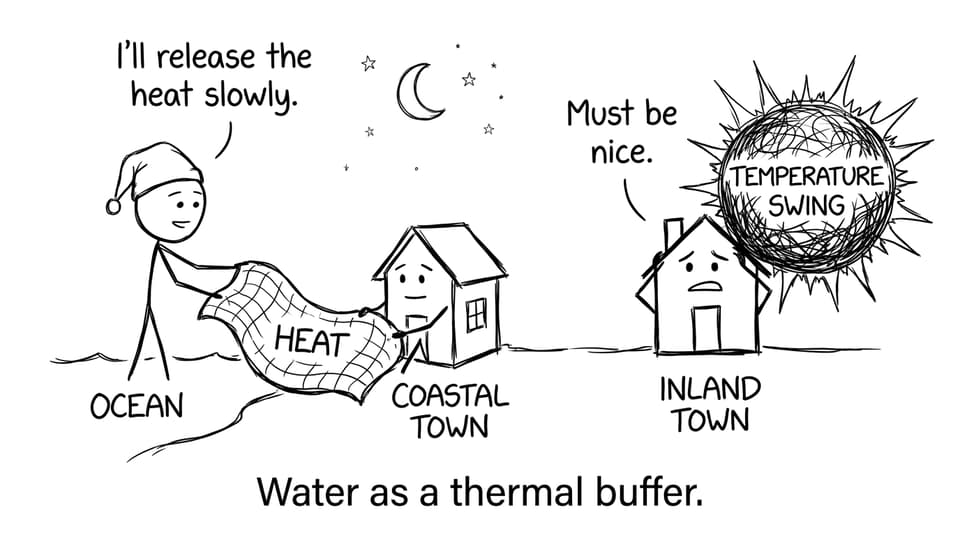
Oceans and lakes act as thermal reservoirs. They absorb heat during warmer periods and release it gradually during cooler periods. Coastal regions therefore experience smaller temperature swings than inland regions.
Enzymes and homeostasis
Temperature stability helps enzymes maintain function and reduces the risk of denaturation. This idea links naturally to homeostasis, where the goal is maintaining internal conditions within safe limits.
To connect these dots with exam-style language, see:
Quick exam tip: how to write the 3-mark version
A strong 3-mark IB Biology response usually has:
-
A correct definition (specific heat capacity)
-
A mechanism (hydrogen bonds absorb energy when disrupted)
-
A consequence (slow temperature changes stabilise habitats and enzyme activity)
Avoid vague endings like “so it helps organisms.” Name something concrete: stable aquatic temperature, reduced enzyme denaturation risk, moderated coastal climate.
Bring it home with RevisionDojo
In IB Biology, water stabilizes temperature is the kind of topic that rewards clear chains of logic: hydrogen bonding leads to high specific heat capacity, which leads to slow temperature change, which leads to stable life processes.
To turn understanding into marks, use RevisionDojo as your full revision system: the Study Notes for clean explanations, Flashcards to lock in definitions, the Questionbank for exam-style practice, and AI Chat when your wording feels almost-right but not quite. Add Grading tools to sharpen responses, and finish with Predicted Papers and Mock Exams to build calm under timed pressure. If you want more targeted support, the Tutors and Coursework Library round out everything you need in one place.
Start with IB Biology Topic A1.1 Water Notes & Questions (SL/HL) and practise until the explanation feels automatic.