




The first term IB Biology experience is less about memorizing an enormous textbook and more about learning a new way to think. You will encounter unfamiliar terminology, practical work, graphs, experimental uncertainty, and questions that ask you to apply knowledge rather than simply repeat it.
The exact topic order varies by school. The current IB Biology course is organized around four themes: unity and diversity, form and function, interaction and interdependence, and continuity and change. Teachers explore these themes across molecules, cells, organisms, and ecosystems, often in a sequence designed around the school's timetable.
The opening weeks may feel manageable. By the middle of term, however, you begin to see how much precision the subject demands. The final weeks reveal whether your study system can keep earlier material alive while new content arrives.
Your First Term at a Glance
A realistic first term will probably include:
- Several connected syllabus topics
- Regular practical activities or demonstrations
- Graphing, data analysis, and evaluation of methods
- Tests containing unfamiliar applications
- Precise biological vocabulary and labelled diagrams
- A growing need for cumulative review
The central lesson is simple: Biology rewards consistency earlier than many students expect.
Weeks 1-3: The Course Feels Deceptively Familiar
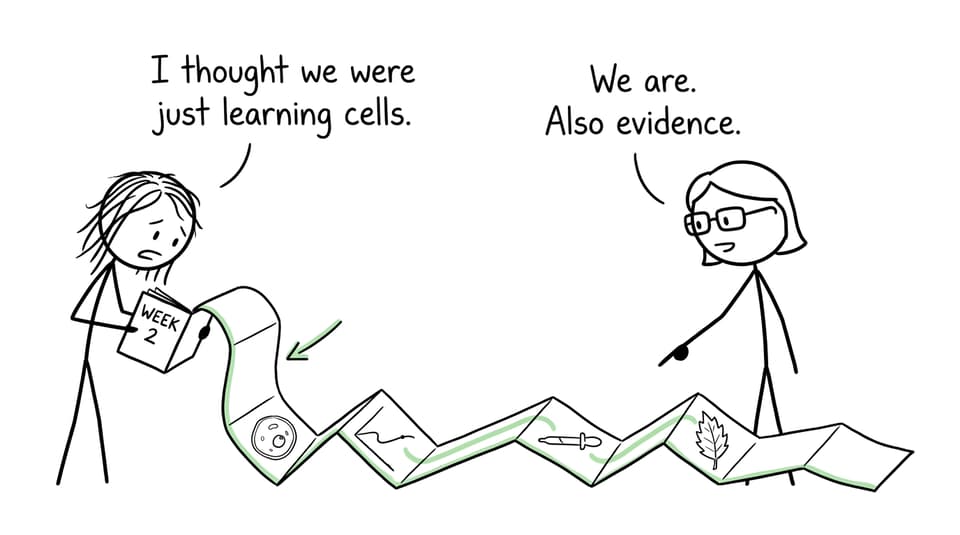
The opening lessons often contain recognizable ideas about cells, water, proteins, or ecosystems. This familiarity can create the impression that IB Biology is simply an expanded version of earlier science. Then the required level of explanation changes.
Knowing that water is a solvent is no longer enough. You may need to connect molecular polarity and hydrogen bonding to transport, thermal properties, or biological reactions. Recognizing a cell diagram is different from explaining how compartmentalization enables particular functions. A definition becomes the beginning of an answer, not the end.
Establish a light study rhythm now. Use the IB Biology Study Notes after each lesson to resolve gaps, then write a short explanation from memory. Ten focused minutes can prevent an hour of reconstruction before a test.
You may also complete an early practical. The procedure might be simple, but the deeper lesson lies in recording units, identifying variables, presenting data, and noticing uncertainty. These are habits you will use throughout the course.
Weeks 4-7: Biology Becomes a Language
By the middle of term, the pace usually increases. New terms arrive while earlier concepts continue to appear in questions. You might understand a process in conversation yet lose marks because your answer lacks the required sequence, relationship, or biological term.
This is one of the most important IB Biology first term expectations: familiarity is not mastery. A page can look obvious when it is open and disappear when you must reconstruct it unaided.
IB Biology Flashcards are useful for definitions, process steps, comparisons, and structures. Biology also requires causal reasoning, so follow every recalled fact by asking what it causes, why it happens, and what evidence could support it.
Your first substantial test may include a graph or experiment you have never seen. That does not necessarily mean it contains untaught content. It means you are expected to transfer familiar biology into an unfamiliar context.
The IB Biology Question Bank helps develop this skill. Learn one narrow concept, retrieve it without notes, answer several related questions, and record why any marks were lost.
Weeks 8-12: The Workload Starts to Compound
Late in the term, the difficulty is rarely one impossible topic. Pressure comes from accumulation. You are learning today's content while trying not to forget material from several weeks earlier, alongside your other IB subjects.
SL and HL students share substantial foundations, but HL adds greater breadth and depth. The IB recommends 150 teaching hours for SL Biology and 240 for HL across the full course. That difference eventually appears as more content, denser connections, and greater independent study demands, although every HL lesson will not feel dramatically harder.
Outside class, you might need two or three short review sessions, assigned work, and additional test preparation. The exact amount depends on your school, prior knowledge, and efficiency. Hours spent rewriting attractive notes are not automatically productive.
A better weekly pattern is:
- Summarize the week's content briefly
- Complete two active-recall sessions
- Answer a small set of topic questions
- Revisit one older topic
- Record specific corrections in an error log
RevisionDojo's guide to using IB Biology revision notes effectively shows how to turn notes into retrieval and application rather than passive rereading.
What Surprises New IB Biology Students Most
There Is More Data Than Expected
Many students expect Biology to be dominated by memorization. In practice, you will interpret graphs, compare results, identify patterns, evaluate methods, and use evidence in explanations. Knowing every definition develops only part of the required skill set.
Practical Work Is About Decisions
The difficult part of an experiment is not always handling equipment. It is deciding what should be measured, controlled, repeated, calculated, and questioned. A result can look convincing until uncertainty or an uncontrolled variable changes how much confidence it deserves.
The formal scientific investigation may not begin during your first term. Even so, ordinary practicals prepare you for it. The IB Biology Internal Assessment Guide explains why teachers emphasize reproducibility and data quality, without requiring you to choose a research question immediately.
Precise Writing Matters
Long answers do not necessarily earn more marks. Strong responses address the command term, use accurate vocabulary, and build a clear chain of reasoning. Knowing the biology and communicating it are separate skills.
RevisionDojo's guide to earning a 7 in IB Biology connects knowledge, data handling, and exam technique.
Forgetting Happens Faster Than Expected
The first topic may feel secure while you study it. Six weeks later, it may be difficult to explain without prompts. That is normal, but it should change your routine. Cumulative review must begin before the course feels cumulative.
A Sustainable First-Term Study System
Keep your system small enough to repeat during a busy week. After each topic, use Study Notes to clarify the concept, Flashcards to retrieve essential language, and the Questionbank to apply it. When an explanation remains unclear, AI Chat can break it into smaller steps, while Grading tools can identify where a response lacks precision.
Predicted Papers and Mock Exams become useful when you have enough coverage for mixed timed work. The Coursework Library and Tutors can provide models, investigation support, or individual guidance. You do not need every feature immediately. Choose the tool that matches the problem in front of you.
For a broader map, see RevisionDojo's IB Biology SL, HL, and IA coverage.
Most importantly, maintain an error log. Record whether each mistake came from missing knowledge, vague terminology, weak data interpretation, or misunderstanding a command term. Different errors require different repairs.
By the End of Term, Aim for Control Rather Than Perfection
A successful first term does not mean remembering every detail or writing flawless responses. It means understanding the course's rhythm. You can learn a concept, retrieve it, apply it, inspect your mistakes, and return to it later.
That rhythm makes the subject manageable. RevisionDojo brings the cycle together through its Questionbank, Study Notes, Flashcards, AI Chat, Grading tools, Predicted Papers, Mock Exams, Coursework Library, and Tutors. Used selectively and consistently, those resources turn a rush of biological detail into a coherent system.