


The moment a “non-living” thing starts controlling everything
In IB Biology, there’s a quiet plot twist hiding in almost every ecology question: the most powerful forces in an ecosystem often aren’t alive.
A sudden temperature drop. A lake with low dissolved oxygen. Soil pH that locks nutrients away. None of these “do” anything in the way a predator hunts or a plant grows. And yet, they decide who survives, where species can live, and why your data-based exam question has three confusing axes.
So, what is an abiotic factor in IB Biology? Let’s make it simple, memorable, and easy to use in exam responses.
What is an abiotic factor in IB Biology?
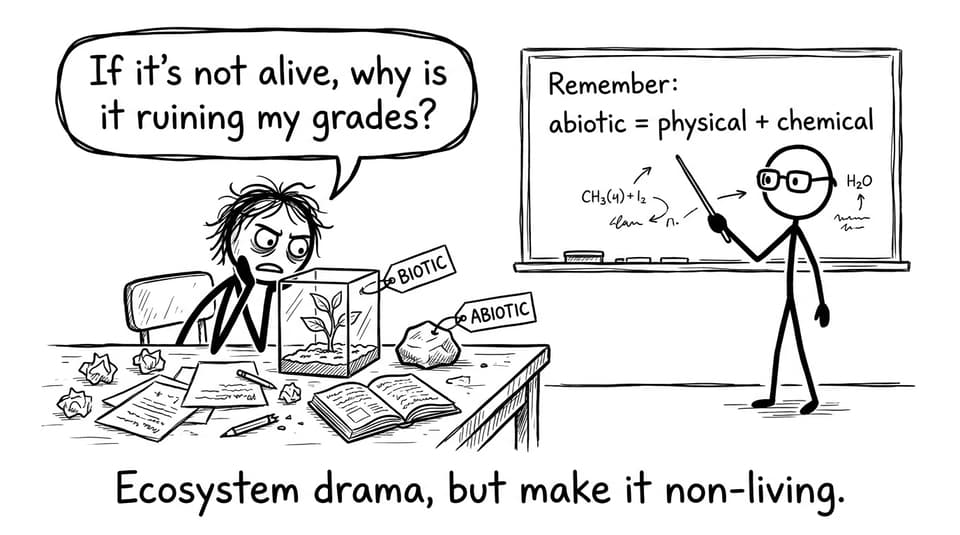
In IB Biology, an abiotic factor is a non-living physical or chemical part of the environment that affects organisms’ survival, growth, and reproduction.
Abiotic factors are different from biotic factors, which involve living interactions like competition, predation, disease, and symbiosis.
Common abiotic factors you’re expected to know
-
Temperature (controls enzyme activity and metabolism)
-
Light intensity (limits photosynthesis and influences behaviour)
-
Water availability (affects transport, reproduction, and plant turgor)
-
pH (affects nutrient availability and protein function)
-
Salinity (affects osmosis and water balance)
-
Oxygen availability (especially important in aquatic ecosystems)
-
Soil composition/mineral content (affects plant growth and productivity)
For syllabus-aligned explanations, start with RevisionDojo’s ecology hub for IB Biology: Ecology (SL/HL) topic page.
Quick checklist: how to answer abiotic factor questions in IB Biology
When you see an abiotic-factor prompt in IB Biology, run this quick mental checklist:
-
Define the abiotic factor clearly (name it and state it’s non-living).
-
Link it to a biological mechanism (enzymes, photosynthesis, osmosis, respiration).
-
Use the language of tolerance range and limiting factor.
-
If there’s a graph, describe the trend before explaining the reason.
A great supporting page for the “tolerance” idea is B4.1.4 Range of tolerance of a limiting factor.

How abiotic factors shape ecosystems (and your marks)
Abiotic factors in IB Biology are rarely “background info.” They often explain the entire pattern in the question.
Abiotic factors and species distribution
Species don’t live everywhere they could in theory. They live where abiotic conditions sit inside their tolerance range. That’s why you see zonation on rocky shores, plant gradients along mountains, and different communities across biomes.
RevisionDojo’s notes on this are especially exam-useful: B4.1.3 Abiotic variables affecting species distribution.
Abiotic factors and adaptation
If an environment is consistently hot, dry, salty, or acidic, selection pressures build. Over time, populations shift toward traits that cope better with those abiotic constraints.
To connect abiotic factors to adaptations (a common IB Biology move), see: B4.1.2 Adaptations of organisms to the abiotic environment.
Abiotic factors as selection pressures
A key exam phrasing is that many abiotic factors act as density-independent pressures. A frost, heatwave, or pollution event doesn’t care how crowded the population is; it still hits.
This is covered clearly here: D4.1.4 Abiotic factors as selection pressures.
A fast way to revise abiotic factors with RevisionDojo
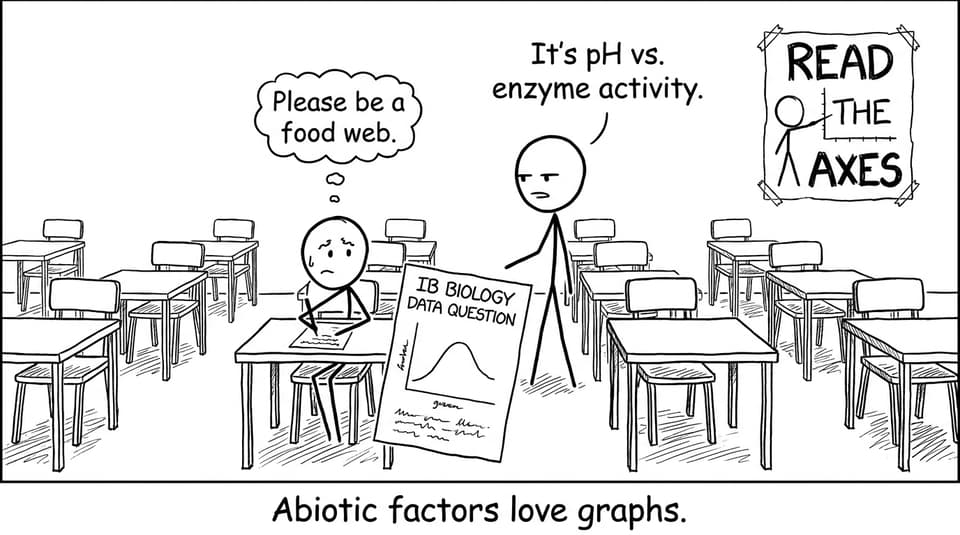
Most students don’t lose marks because they “don’t know” abiotic factors. They lose marks because they can’t apply them to data.
RevisionDojo is built for that application layer:
-
Use the Study Notes to lock in definitions and mechanisms: IB Biology revision notes
-
Use Flashcards for rapid recall of variables and definitions: B4.1.3 Flashcards deck
-
Use the Questionbank to practise exam-style graphs and explanations with feedback: IB Biology resources hub
That combination (Notes + Flashcards + Questionbank) turns “abiotic factor” from a vocabulary word into an exam skill in IB Biology.
Conclusion: abiotic factors are the “silent rules” of IB Biology ecology
An abiotic factor in IB Biology is simply a non-living condition, but it behaves like the rulebook of an ecosystem: it sets the limits, shapes adaptations, and explains the graphs.
If you want to turn this topic into easy marks, revise the definitions quickly, then practise applying them to real questions. Use RevisionDojo’s Study Notes, Flashcards, AI Chat, Questionbank, Mock Exams, Grading tools, Predicted Papers, Coursework Library, and Tutors to build exam-ready explanations that feel natural under time pressure. Start with the ecology hub and keep IB Biology practice consistent until abiotic factors stop feeling like surprises and start feeling like shortcuts to the right answer.