The night you finally open the document, it feels almost unfair: you’ve survived IB deadlines, timed essays, and the quiet pressure of predicted grades, but this blank page still wins the staring contest.
A personal statement is strange that way. Exams measure what you know. A personal statement measures whether you can explain why it matters.
For IB (and AP) students preparing for exams, the temptation is to treat the statement like another assessment: list achievements, sound impressive, keep it formal. But admissions readers aren’t looking for an “ideal applicant.” They’re looking for a real person with evidence of curiosity, direction, and growth.
Quick checklist for a standout IB personal statement
Use this as your one-page plan before you draft:
-
One clear academic “why” (your subject motivation in plain language)
-
Two or three proof moments from your IB journey (EE, IA, TOK, class discussions, readings)
-
One extracurricular thread that connects to the subject (not a random list)
-
Reflection after every example: “So what changed in how I think?”
-
A clean structure (hook, evidence, reflection, future direction)
-
Two rounds of edits: meaning first, wording second
If you want help keeping your writing focused while exam prep is intense, build your week around short, repeatable blocks (not marathon sessions). The study workflow in the RevisionDojo app for IB exam prep is a good model: small loops, fast feedback, calm momentum.
What universities are actually scanning for
Most readers are moving quickly. They’re asking:
-
Do you know what you’re applying for, and why?
-
Can you communicate clearly?
-
Have you done anything that proves academic engagement beyond “I like the subject”?
-
Are you reflective (not just accomplished)?
For an IB student, you already have unusually strong raw material. The Extended Essay shows independence. TOK shows critical thinking. IAs show research and method. The statement becomes the bridge between those experiences and your future course.
To sharpen your academic evidence, it helps to revisit how you actually learned during IB revision: targeted practice, feedback, then improvement. That’s the same rhythm you want on the page.
Choose proof moments from your IB experience (and make them specific)
A proof moment is a scene where something changed: your question got sharper, your method improved, your assumptions broke.
Strong IB proof moments often come from:
-
Extended Essay: a question that evolved when your evidence didn’t behave
-
Internal Assessment: a design choice you defended (and what you learned when it failed)
-
TOK: a moment you realized certainty has limits
-
Class essays/presentations: feedback you applied, not just received
If you’re unsure which moment is “good enough,” pick the one you can explain with the most honest detail. Admissions readers trust clarity more than sparkle.
If your EE is your best academic story, you can also borrow the framing from How Do I Use My EE Topic in College Applications? to connect research to motivation.
A structure that feels human (not like a checklist)
A memorable IB personal statement usually reads like one thought unfolding, not a résumé in sentences.
Start with a hook that reveals a question
A hook isn’t a dramatic life event. It’s a precise moment of curiosity.
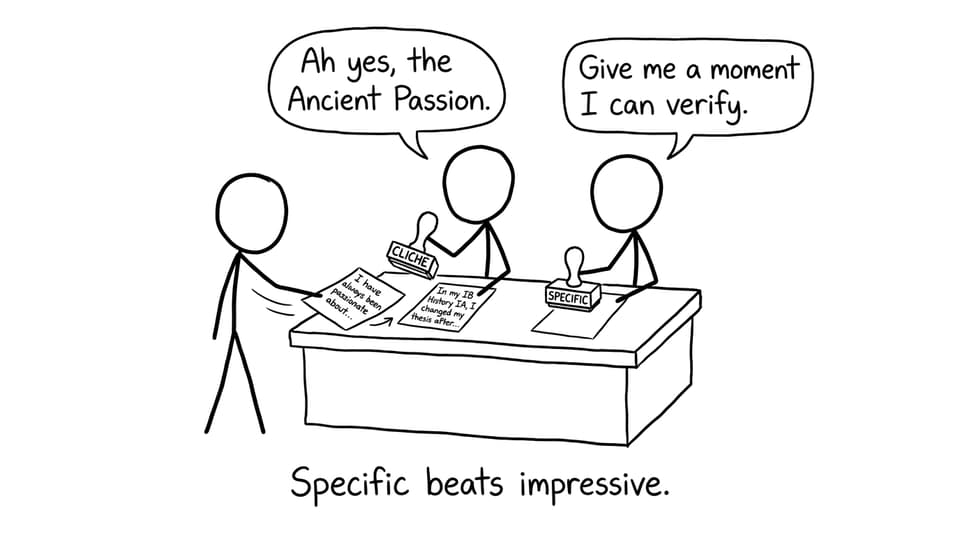
Instead of: “I’ve always been passionate about economics.”
Try: “While comparing two policy responses in my IB Economics coursework, I noticed how the same data could justify opposite conclusions, depending on the assumptions you choose.”
Build the middle around evidence and reflection
For each example, use this mini-format:
-
What you did (one sentence)
-
What you learned (two sentences)
-
How it changed your direction (one sentence)
This prevents the most common trap: listing achievements without meaning.
For more traps (and how to fix them), keep Common Personal Statement Mistakes to Avoid open while you edit.
End with forward motion, not a slogan
Your ending should answer: “What do you want to study next, and what kind of student will you be?”
Not: “This university is my dream.”
Yes: “I want a course that rewards careful argument, experimentation, and revision, the same habits my IB work forced me to practice.”
Show transferable skills the IB already trained into you
You don’t need to announce “I have leadership.” You show it through decisions and outcomes.
Here are transferable skills IB students can prove quickly:
-
Critical thinking (TOK-style evaluation of claims)
-
Research and synthesis (EE, IAs, Capstone-style work)
-
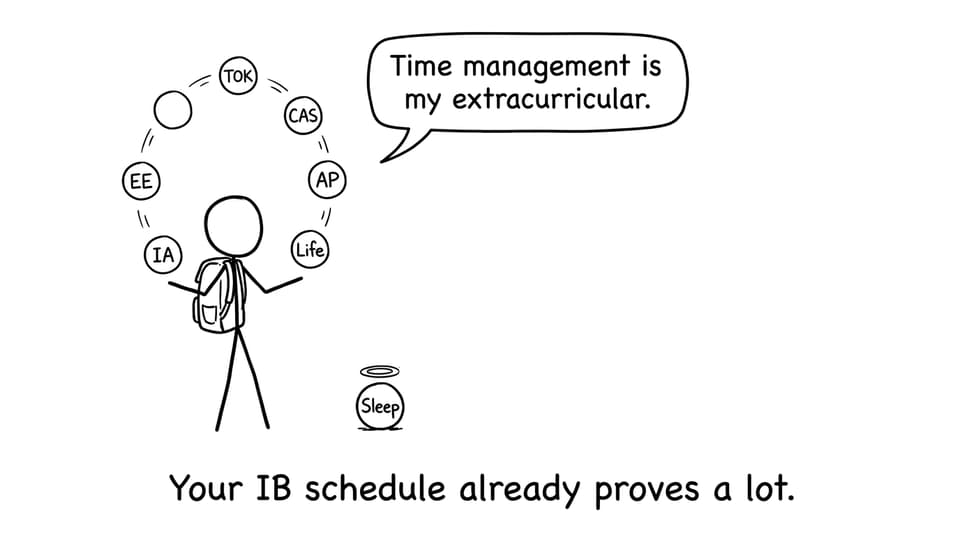
Time management under pressure (balancing multiple deadlines)
-
Communication (explaining complex ideas simply)
A useful trick: write one sentence that connects skill to evidence.
Example: “Planning my IB Biology IA taught me how to design a method, anticipate confounding variables, and revise when results contradicted my hypothesis.”
That sentence sounds like university work because it is university work in miniature.
Edit like an IB student: feedback, then refinement
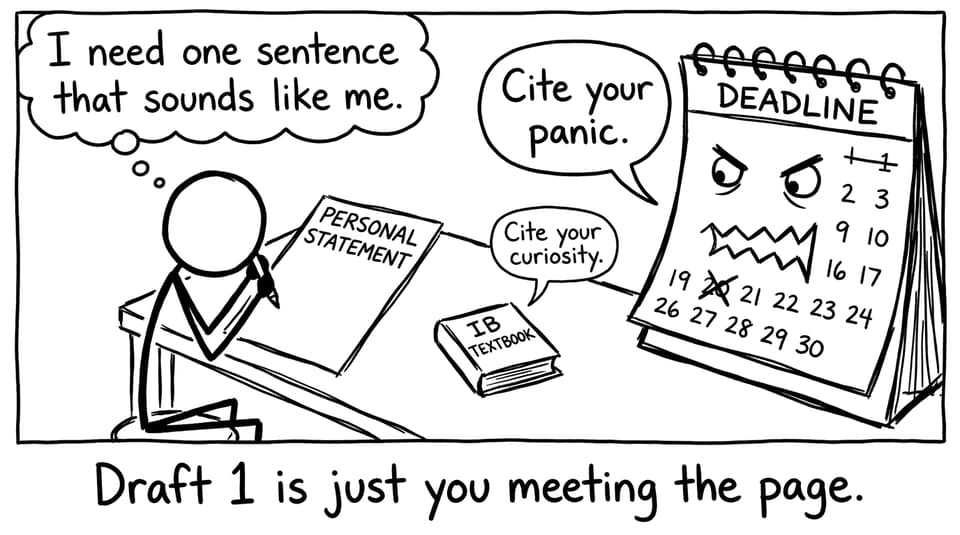
Your first draft is allowed to be messy. Treat it like a practice paper: it exists so you can improve it.
A reliable edit sequence:
-
Cut anything a stranger could write about themselves
-
Replace vague adjectives (“fascinating,” “passionate”) with specific actions
-
Check that every paragraph returns to the subject you’re applying for
-
Read aloud for rhythm and clarity
If you need external structure, UCAS-focused students can cross-check requirements in UCAS Application Structure Explained, then compare effective patterns in UCAS Personal Statement Examples That Work.
And if you’re juggling exam prep while writing, it helps to reduce friction elsewhere: use Study Notes to clarify topics fast, then drill confidence with the Questionbank. Your statement improves when your mind isn’t carrying unnecessary academic stress.
Conclusion: make your IB story feel inevitable
A standout IB personal statement isn’t louder than everyone else’s. It’s calmer. It shows a reader exactly how you think, what you’ve done to test that thinking, and what you want to explore next.
If you want that same calm momentum in exam season, RevisionDojo is built for the full IB loop: Study Notes for clarity, Flashcards for recall, AI Chat when you’re stuck, the Questionbank for targeted practice, plus Mock Exams, Predicted Papers, and Grading tools to tighten technique. When coursework is part of your story, the Coursework Library and Tutors can help you turn hard work into clear evidence.
Write the statement like you revise: one honest draft, one focused improvement, then the version that finally sounds like you, and proves you’re ready.