

The real job of an IB Math IA conclusion
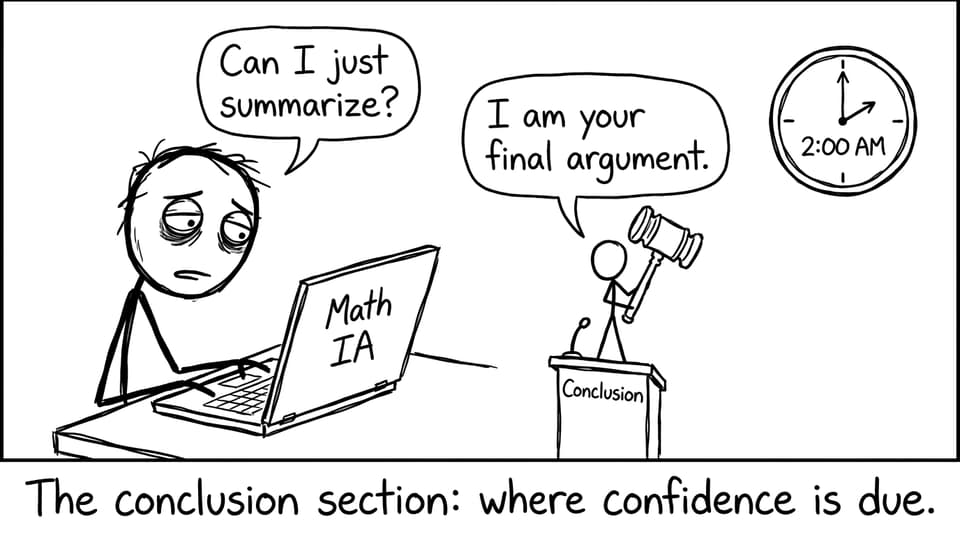
At some point in every IB Math IA, you reach the last page and feel a tempting thought: “I’ll just summarize and be done.”
But the IB examiner isn’t looking for a recap. They’re looking for a final piece of thinking: a short, calm argument that shows you understand what your mathematics revealed, how trustworthy it was, and what a sensible next step would be.
A strong IB conclusion feels like closing a book with purpose. The reader shouldn’t wonder, “So what?” They should feel, “Okay, this student knows what their exploration means.” If you want your ending to sound sharp and mature, it helps to build it with the same structure every time.
If you’re still shaping the whole write-up, it’s worth skimming How to Structure Your IB Math IA Logically first; a clear structure makes the conclusion almost write itself.
A quick checklist for a clear IB conclusion
Before you write a single sentence, check you can answer these six prompts in plain English:
-
What was my original aim (and did I meet it)?
-
What are the 2-3 key findings that directly answer the aim?
-
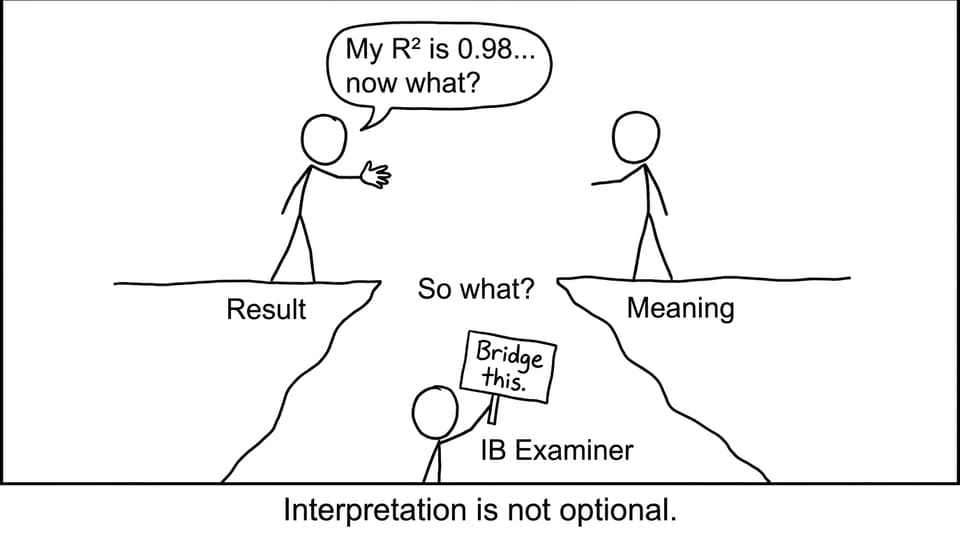
What do those findings mean (in context or compared to theory)?
-
How reliable is the model/method (and why)?
-
What are the main limitations/assumptions (specific, not generic)?
-
What improvement or extension would genuinely deepen the math?
RevisionDojo helps you prepare this quickly: use the IA guides to confirm what examiners want in the final section, and use AI Chat to pressure-test whether your conclusion actually answers your aim.
Start your IB Math IA conclusion by returning to the aim
Your first 1-2 sentences should bring the reader back to the destination.
Not a dramatic restatement. Not a new introduction. Just a clean reminder of the investigation’s purpose.
Example starter you can adapt:
“This exploration aimed to model ___ using ___ in order to determine ___.”
If your aim is still fuzzy, fix that before polishing the ending. RevisionDojo’s IB Mathematics Analysis and Approaches (AA) IA Guide and IB Mathematics Applications & Interpretation (AI) IA Guide are excellent for aligning your aim with what the IB actually rewards.
Summarize findings, but only the ones that earn marks
In an IB conclusion, your results section already did the heavy lifting. The conclusion should only carry the most important numbers and relationships, the ones that answer the aim.
A practical rule: choose at most three results, and write each as a sentence with interpretation built in.
Instead of:
- “I calculated the regression and found the parameters.”
Try:
- “The regression model predicted an optimal value of __, which was within __% of the theoretical expectation, suggesting the model captured the main relationship.”
If your write-up is turning into a results dump, revisit how you narrate your work. 10 Essential Tips to Write a Strong IB Math IA Commentary is a useful reset.
Add insight: explain what the results mean in context
This is where many IB students accidentally stop too early. They have results, but they don’t translate them into meaning.
Ask yourself:
-
Does this confirm or challenge what you expected?
-
What does it suggest about the real-world situation (if applicable)?
-
How does it connect back to the math idea you chose (calculus, probability, modeling, etc.)?
This “meaning” paragraph is also a great place to show personal engagement without sounding emotional. If you’re unsure what counts as reflection vs conclusion, read How to Write a Perfect IB Math IA Reflection and How to Use Reflection to Strengthen Your IB Math IA Grade.
Evaluate reliability like an IB student, not like an apology
An examiner trusts students who can be specific.
If you used a model, discuss fit and weakness precisely (for example, where it performs well and where it breaks). If you used measurement, name the likely error sources and how they affect results. If you used technology, note any setting choices that matter.
A strong IB conclusion doesn’t say “My model wasn’t perfect.” It says:
-
what was reliable,
-
what was less reliable,
-
and why.
For the official expectations, the “Conclusion” and “Critical reflection” parts in Essentials of the Internal Assessment are worth scanning.
Limitations and extensions: keep them realistic and mathematical
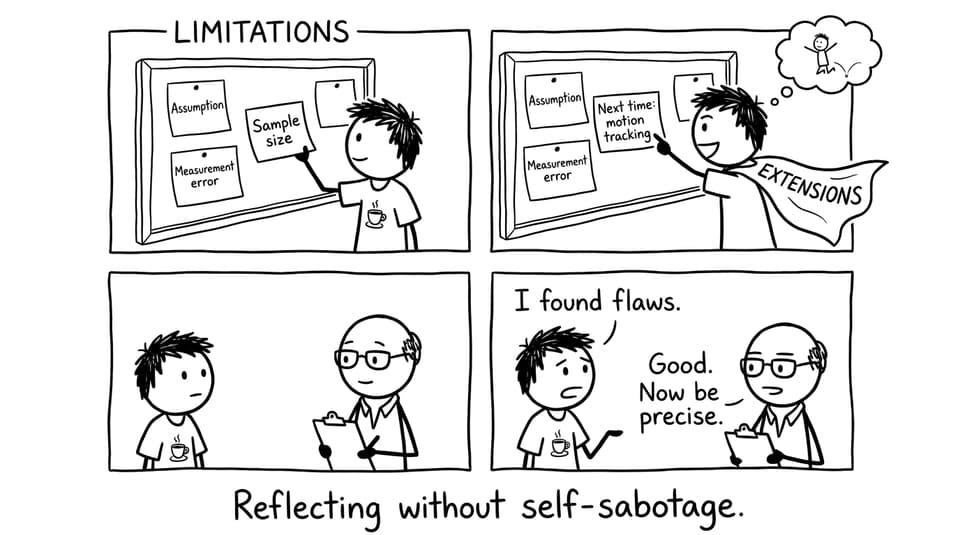
Limitations are not self-criticism. They’re boundary lines.
Pick two limitations that truly matter. Then suggest one extension that would deepen the exploration.
Good extensions usually do one of these:
-
improve the data quality (better measurement, larger sample)
-
refine the model (piecewise, additional parameter, better assumptions)
-
test sensitivity (how much conclusions change when inputs change)
RevisionDojo’s Coursework Library and IA/EE Exemplars make this easier because you can see how high-scoring students phrase limitations without sounding unsure: Using IA/EE Exemplars to Improve Your IB Math IA.
The last line: close with control
Your final sentence should feel inevitable: a confident landing that answers the aim in one clean thought.
Template:
“Overall, the investigation shows that ___, within the limits of ___, and suggests ___ as the most meaningful improvement.”
That’s the tone the IB likes: clear, reflective, finished.
If you’re also preparing for exams while polishing coursework, build a balanced routine using RevisionDojo’s Study Notes, Flashcards, and Questionbank. For example, this Ultimate IB Math Study Routine pairs well with short IA editing sessions, and the Questionbank keeps your core skills sharp.
A final reminder for IB students
A great IB Math IA conclusion is short, but it isn’t small. It’s where your work becomes a clear claim: this is what the math showed, this is how much we can trust it, and this is what comes next.
If you want to finish with confidence, use RevisionDojo as your last-mile toolkit: check the IA Guides, compare against Coursework Library exemplars, polish clarity with AI Chat, and keep your exam skills strong with Study Notes, Flashcards, Questionbank, Predicted Papers, and Mock Exams. Your ending should feel like a door closing, quietly, firmly, and on purpose.