
You can study math for weeks and still freeze when the clock starts.
It’s rarely because you “don’t know” the content. In IB Math, the gap usually lives in a quieter place: you haven’t practiced performing the content under exam pressure. The brain you use to read notes is not the same brain you use when you’re 18 minutes deep into a question, your working is messy, and you’re trying to remember whether you’re allowed to use a calculator.
That’s why the fastest way to improve your IB results is to stop revising in a vague way and start revising in a paper-shaped way. RevisionDojo’s Exam Builder (also called the Test Builder) is built for exactly this: generating IB-style math exams you can run timed, review like an examiner, then rebuild smarter the next day.
Along the way, you can connect everything: Questionbank practice for precision, Study Notes for clarity, Flashcards for recall, AI Chat for quick unblocking, Grading tools for method marks, plus Predicted Papers, Mock Exams, the Coursework Library, and Tutors when you want a human diagnosis.
A quick IB checklist before you build your first exam
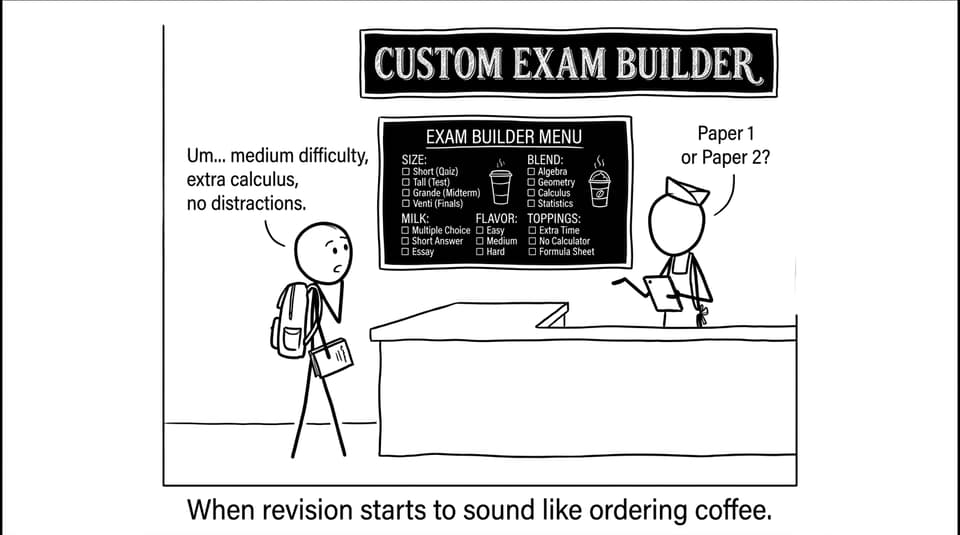
Use this short checklist to make the Exam Builder work efficiently, not just intensely.
-
Choose your course: IB Math AA or AI, and SL or HL
-
Decide your goal for this session: accuracy, speed, or endurance
-
Pick the paper style you need to simulate (Paper 1 vs Paper 2)
-
Choose 1-3 topics (narrow beats broad when time is limited)
-
Set a realistic time limit and remove distractions
-
Keep a one-page “error log” for patterns you repeat
Helpful starting points:
-
Explore the broader International Baccalaureate (IB) hub
-
Jump into IB Mathematics Analysis and Approaches Resources if you’re on AA
What the Exam Builder is (and why it feels different)
The Exam Builder is RevisionDojo’s tool for creating custom IB-style math papers from the platform’s syllabus-aligned Questionbank. You pick the structure, topics, and difficulty, then generate a paper you can complete online (with feedback) or export as a printable pack with mark schemes.
That matters because IB success is partly a reading skill. The wording, command terms, layout, and mark allocation all train your attention. The more your revision looks like the real assessment, the fewer surprises your brain has to process on exam day.
If you want the official feature overview, start here: Test Builder (Exam Builder). For a longer walkthrough, this guide is also useful: IB Test Builder: Create Custom Exams for Targeted Practice.
Set one purpose per IB practice exam
A trap IB students fall into is “doing a paper” as if the act alone guarantees growth. But practice only becomes revision when you can name what you’re training.
Before you click generate, choose one purpose:
Accuracy session
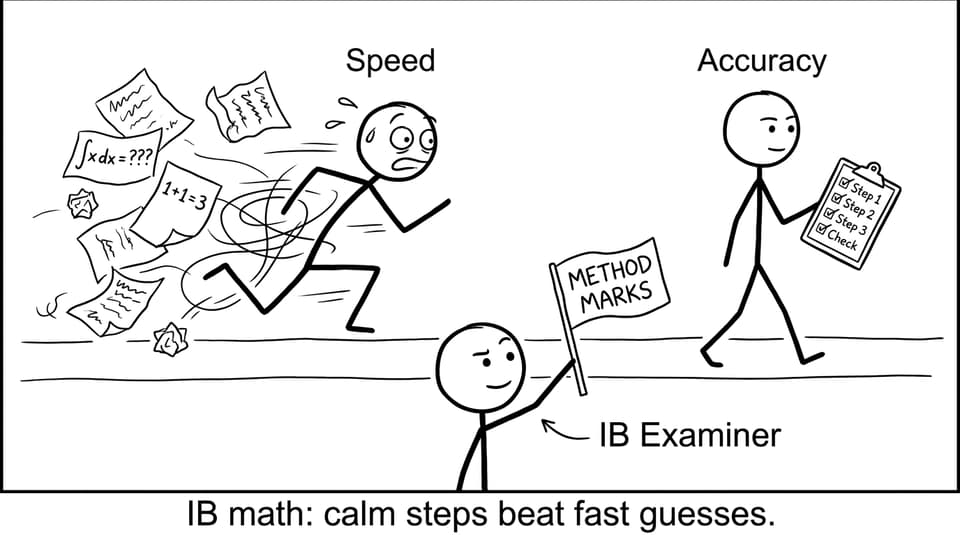
You’re training clean method and fewer unforced errors. Use fewer questions, allow enough time, and focus on showing steps that earn marks.
Speed session
You’re training pacing and decision-making. Use timed mode, mixed difficulty, and strict movement: if you’re stuck, park it and continue.
Endurance session
You’re training stamina and focus. Build a longer, mixed-topic paper that mirrors the mental fatigue curve of an IB sitting.
That single intention turns the Exam Builder from a random worksheet printer into a feedback machine.
How to build an IB-style math exam in under 3 minutes
When students say revision is “overwhelming,” they often mean they don’t know what to do next. The Exam Builder helps because the decision tree is short.
Choose your course and paper style
Start with your exact IB route (AA/AI, SL/HL). Then select a paper type that matches what you’re preparing for.
Select topics like a strategist
Efficient IB revision is not “cover everything every time.” It’s pinpoint, pressure test, rebuild.
A smart pattern is:
-
70% weak topics
-
30% maintenance topics
If calculus is a priority, drill with a focused bank like IB Math AA Calculus Questionbank. If you’re stuck on specific subskills, narrow further using pages like Chain, Product and Quotient Rules Questionbank (SL/HL).
Set difficulty on purpose
A good IB sequence is:
-
Start Standard (clean methods)
-
Add Challenge (transfer and problem-solving)
-
Mix them (realistic distribution)
Decide: online feedback or printable pack
If you’re prone to repeating the same mistake, online completion with feedback can shorten the loop. If you want a quiet, exam-like desk setup, printing can be better. Alternate both.
Use timed mode to train calm execution
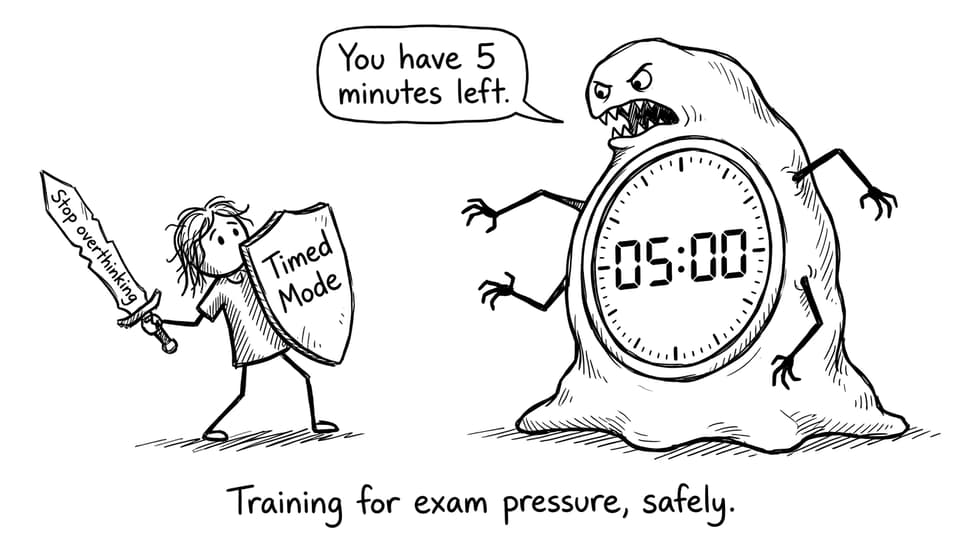
Timed mode is where the Exam Builder becomes more than “more questions.” It recreates the feeling of scarcity that changes how you think. And that feeling is exactly what you want to practice.
When you run timed sessions, you learn three IB skills that notes can’t teach:
-
When to move on
-
How to capture method marks quickly
-
How to keep accuracy when your brain is tired
A useful rule: if you can’t make progress in 90 seconds, write a “next step” (what you would try) and move. That tiny habit protects your grade.
Review like an IB examiner (not like a disappointed student)
Most students review by checking the answer and feeling bad. Efficient IB review is colder than that, and kinder too. You’re not judging yourself. You’re diagnosing a system.
After each Exam Builder session, sort every lost mark into one of these buckets:
Concept gap
You didn’t know what to do. Fix it with Study Notes and one targeted question set.
Process gap
You knew what to do, but your method was incomplete. This is where RevisionDojo’s Grading tools and mark-scheme allocation matter: you’re learning which steps earn marks.
Precision gap
Algebra slips, sign errors, rounding, calculator setup. Fix it with short daily drills and Flashcards for definitions and conditions.
Time gap
You could do it, but not fast enough. Fix it by rebuilding smaller timed sets, then scaling.
If you want a flashcard-based routine that supports this review style, use: How to Use RevisionDojo Flashcards for Formula Mastery.
Build an IB revision ladder (so your confidence compounds)
A powerful way to use the Exam Builder is to stop thinking in isolated attempts and start thinking in progressive exposure.
Week 1: narrow and frequent
-
25-35 minute topic sets
-
Heavy review
-
One-page error log
Week 2-3: mixed-topic pressure
-
45-60 minute mixed sets
-
Timed mode on
-
Start tracking topic-level performance
Week 4+: full simulations
-
Full-paper sessions for endurance
-
Review in two passes: quick triage, then deep correction
When you’re closer to the exams, you can complement Exam Builder work with full-structure practice using IB Predicted Papers by IB Examiners (Free) and structured guidance like IB Predicted vs Specimen Papers: What They Mean.
Pair the Exam Builder with the rest of RevisionDojo
The Exam Builder is the engine. But efficiency comes from the whole loop:
-
Questionbank for targeted repetition and pattern recognition
-
Study Notes for fast clarification right before you rebuild a set
-
Flashcards for daily recall of formulas, definitions, and conditions
-
AI Chat for unblocking one stuck step without losing an hour
-
Grading tools to train method marks and solution structure
-
Mock Exams to rehearse longer sittings
-
Predicted Papers to experience realistic coverage and pacing
-
Coursework Library to reduce background stress from IA deadlines
-
Tutors when you need a human to spot the root cause quickly
If you’re building a sustainable schedule around all of this, this article helps: The Ultimate IB Math Study Routine for Busy Students.
Conclusion: make IB revision feel predictable
The most comforting feeling in the IB isn’t “I studied a lot.” It’s “I know what happens when the timer starts.”
RevisionDojo’s Exam Builder gives you that predictability: you build IB-style math exams that match your course, your weak spots, and your timeline. Then you review like an examiner, rebuild smarter, and watch the same topics stop being scary.
If you’re ready to make your next session count, open the Test Builder (Exam Builder), generate one focused timed set, and commit to one honest review pass. That’s how efficient IB math revision becomes a habit, not a hope.