
When you lose marks in IB Math, it’s rarely because you “didn’t know math.”
It’s because, in the most important moments, you couldn’t say math.
A definition you half-remember becomes a sentence you half-write. An examiner reads it once, finds it imprecise, and the mark quietly disappears. That’s why How to Use Flashcards to Learn IB Math Definitions isn’t a cute study hack; it’s a practical way to turn mathematical language into something you can produce on command.
RevisionDojo’s Flashcards (plus Key Definitions) are built for exactly this: small, daily retrieval practice that makes definitions feel automatic, not fragile. And when you combine them with Study Notes, AI Chat, and the Questionbank, you get a loop that doesn’t just memorize words; it trains exam performance.
Quick checklist: a definition-flashcard system that actually sticks
Use this as your simple setup for How to Use Flashcards to Learn IB Math Definitions without overthinking it:
-
Pick the right deck: start with RevisionDojo Flashcards and a Key Definitions-style deck.
-
Study in short bursts: 7-12 minutes daily beats a 60-minute weekend session.
-
Always answer before you flip: say it, write it, or whisper it.
-
Add one “exam line”: a common condition or phrase examiners expect.
-
Test in context: follow flashcards with 3-5 targeted Questionbank items.
If you need the tool itself, start here: RevisionDojo Flashcards and the feature overview: Flashcards Feature.
Why definitions are a hidden scoring lever in IB Math
In IB Math AA and AI, you’re rewarded for precise communication. Definitions are where that precision is easiest to measure. “Function,” “conditional probability,” “correlation,” “variance,” “domain,” “range.” These aren’t just vocabulary. They’re mark scheme triggers.
A strong definition is typically:
-
Precise: it uses correct mathematical language.
-
Complete: it includes the necessary conditions.
-
Compact: it doesn’t wander into a story.
Flashcards help because they force you to produce the definition from scratch, which is what the exam asks you to do under time pressure.
For course context and topic organization, these hubs are helpful:
How to Use Flashcards to Learn IB Math Definitions (the method)
This is the core routine for How to Use Flashcards to Learn IB Math Definitions: you’re not collecting definitions, you’re training retrieval.
Build cards that match examiner expectations
If you create your own cards, avoid the classic mistake: “term on the front, paragraph on the back.” Definitions should be tight.
A great structure:
-
Front: the term + a prompt like “Define precisely.”
-
Back: the model definition + one key condition.
Example idea (don’t copy blindly, learn the pattern):
-
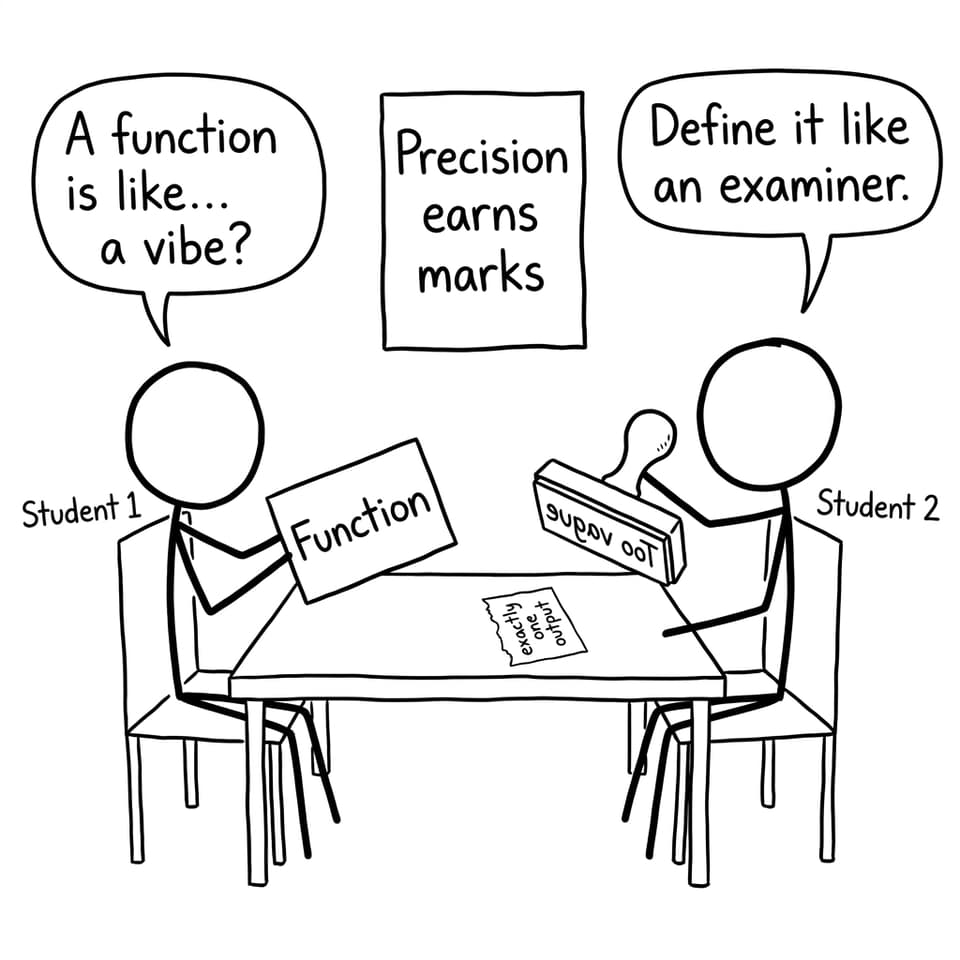
Front: Function (define precisely)
-
Back: A relation that assigns each element of the domain exactly one output in the range.
To strengthen understanding, pair definitions with topic explanations in Notes. For example:
Use active recall the hard way (because it works)
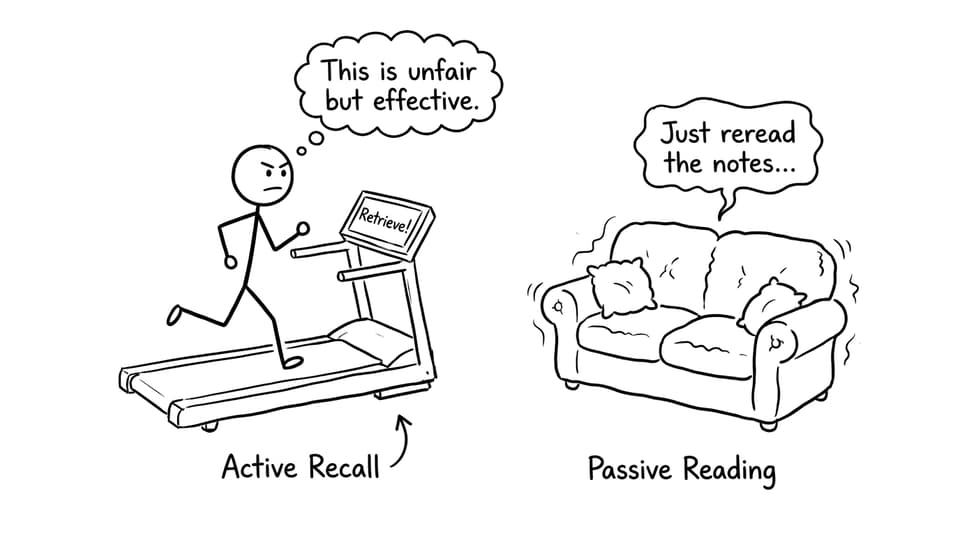
Reading definitions feels productive. It’s also the fastest path to false confidence.
Instead, do this every time:
-
Look at the front.
-
Close your eyes.
-
Say the full definition.
-
Write it in one clean line.
-
Flip and compare.
That discomfort is the point. It’s your brain practicing retrieval.
If you want a broader strategy for modern flashcard study, see: How to Use Flashcards Effectively in the Digital Age.
Prioritize “high-frequency” definitions first
When time is short, start with definitions that appear everywhere:
-
Function, relation, domain, range
-
Gradient and rate of change
-
Correlation and correlation coefficient interpretation
-
Mean, variance, standard deviation
-
Derivative and integral (conceptual meaning)
-
Conditional probability
Then use RevisionDojo Notes to attach meaning, not just wording. For example:
Add one example to stop definitions from floating away
Definitions become memorable when they touch something concrete.
After you recall a definition, add a 10-second example:
-
“Derivative” means rate of change; in (f(x)=x^2), derivative (2x) is slope at (x).
-
“Conditional probability” refers to (P(A|B)), the probability of A given B has happened.
You can even make a second card type:
-
Front: “Derivative: interpretation example?”
-
Back: “Slope of tangent / instantaneous rate of change.”
Make spaced repetition do the scheduling for you
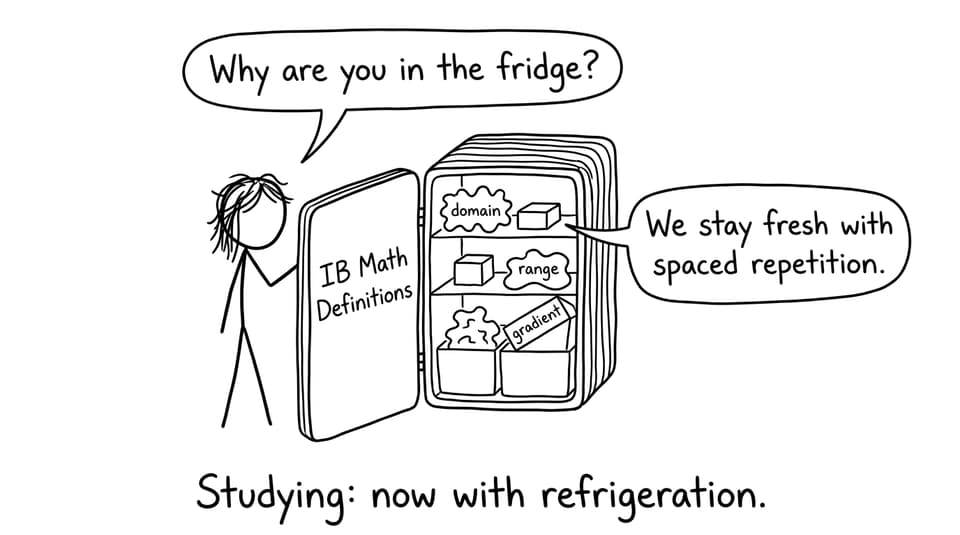
The secret advantage in How to Use Flashcards to Learn IB Math Definitions is not intensity. It’s timing.
Spaced repetition works because it brings a card back right when you’re about to forget it. That’s where long-term memory is built.
If you want to extend the routine beyond definitions into formulas, this pairs nicely: How to Use RevisionDojo Flashcards for Formula Mastery.
Apply definitions immediately in the Questionbank
Definitions are rarely isolated on an exam. They’re usually embedded in “explain,” “interpret,” “justify,” or “show that” tasks.
Right after a flashcard session, open practice questions:
-
Choose a topic (e.g., calculus, functions, statistics).
-
Do 3-5 questions.
-
When you miss one, convert the missing language into a new flashcard.
Start here for practice:
And if your overall routine feels messy, this helps: The Ultimate IB Math Study Routine for Busy Students.
Common definition mistakes (and how flashcards prevent them)
Most definition errors fall into three buckets:
-
Too vague: “A function is an equation with x and y.”
-
Missing a condition: forgetting “exactly one output,” or forgetting the “given” in conditional probability.
-
Not exam-ready phrasing: the idea is right, but the language is not precise enough to earn the mark.
Flashcards prevent these because they force you to practice the exact sentence you’ll need when the pressure is real.
Closing: turn definitions into a daily advantage
The students who score highest in IB Math often look calm, but it’s not because they’re naturally calm. It’s because they’ve practiced the same small things so many times that the exam can’t surprise them.
That’s the real promise of How to Use Flashcards to Learn IB Math Definitions: you stop hoping you’ll remember the right words, and you start training yourself to produce them.
Open RevisionDojo Flashcards, commit to 10 minutes a day, and pair it with Study Notes, AI Chat, the Questionbank, and timed practice through Mock Exams. If you’re pushing for the top bands, add Predicted Papers for structured exam rehearsal, and use Grading tools to see what your wording is costing you. For coursework alignment, the Coursework Library and Tutors can help you keep mathematical communication consistent across IA work too.
If you do one thing today, do this: start a definitions deck, review it daily, and let those small reps compound into marks.