
When people talk about the IB, they usually talk about endurance. Late nights. Timers. Color-coded calendars.
But the Mathematics: Applications and Interpretation Internal Assessment (Math AI IA) is different. It’s the rare part of the IB where the clock slows down and your choices matter more than your speed.
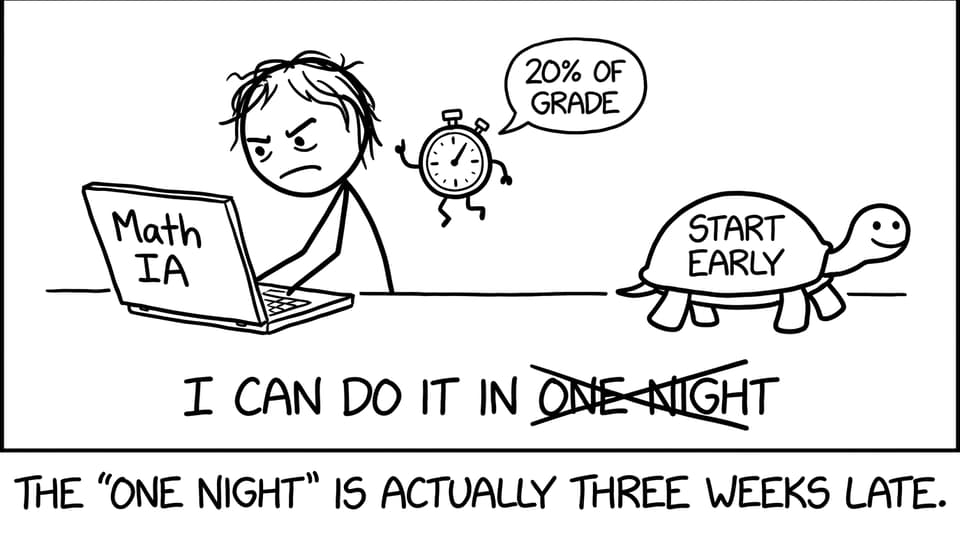
It’s also worth 20% of your final grade. That’s not a small side quest. It’s a fifth of the story.
This guidebook is built for one goal: helping you score a 7 on your Math AI IA by making examiner-friendly choices in topic, structure, mathematics, and writing style, without losing your own voice.
IB Math AI IA: a quick checklist before you write
Use this as your “am I on track?” filter. In the IB, clarity beats chaos.
-
Your research question is specific enough to answer in 12-20 pages.
-
You can access (or collect) reliable data.
-
The mathematics is clearly relevant to the question (not decorative).
-
You have at least two mathematical processes (for example, regression + residual analysis; or probability model + simulation).
-
You plan reflection points throughout, not just at the end.
-
You’re writing for an examiner who’s read hundreds of IAs this week.
If you want a rubric-aligned roadmap, start with RevisionDojo’s IB Mathematics Applications & Interpretation (AI) IA Guide and keep it open as you draft.
What the IB Math AI IA actually is (and what it isn’t)
The Math AI IA is a self-directed mathematical exploration. In the IB, that means you’re assessed not just on getting results, but on how you frame the problem, justify methods, communicate mathematics, and evaluate limitations.
It is not:
-
a data dump with a trendline,
-
a wordy essay with a few formulas sprinkled in,
-
or a “look what my calculator can do” screenshot parade.
It is a structured argument: a question, a method, a chain of reasoning, and a conclusion that admits what the math can and can’t prove.
For a step-by-step walkthrough aligned to AI expectations, see IB Math AI Internal Assessment: Step-by-Step Guide.
Choosing a topic that can earn a 7 (without being impossible)
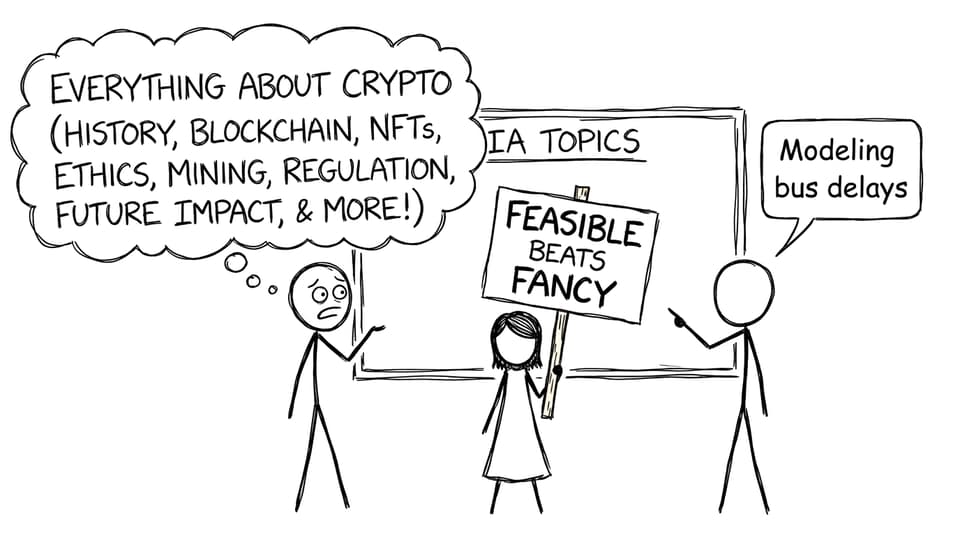
A common IB trap is thinking a high score requires an impressive topic. Examiners don’t grade ambition. They grade execution.
A 7-friendly IA topic usually has three traits:
It has personal pull, not fake drama
“Personal engagement” isn’t about telling your life story. It’s about showing authentic ownership: why you picked the context, how you made decisions, what you changed when the math pushed back.
It’s mathematically “alive”
Good Math AI IA topics invite multiple moves: modeling, checking fit, discussing assumptions, testing alternatives, interpreting results.
It’s small enough to finish well
If your topic feels like it could be a podcast series, it’s too broad.
If you need inspiration that fits AI-style exploration, browse The Best IB Math IA Topics for 2025 and the broader idea list at IB Math IA Ideas (Analysis and Approaches & Applications and Interpretation).
A 7-scoring IB Math AI IA structure you can actually follow
The IB doesn’t require one rigid template, but high-scoring work is almost always easy to navigate. Your examiner should never be hunting for your aim, your method, or your conclusion.
A reliable structure looks like this:
Introduction: rationale, aim, and what “success” means
-
A hook that places the math in context.
-
A short rationale (why this context matters to you).
-
A clear research question that is measurable.
-
A sentence defining what you’ll treat as evidence (R²? residuals? error? comparison of models?).
For structure guidance, use How to Structure Your IB Math IA Logically or How To Structure An IB Math IA Effectively.
Body: the math, explained like you’re teaching it
A 7-level body section does two things at once:
-
it performs mathematics accurately, and
-
it narrates mathematical thinking.
That means:
-
Define variables and units early.
-
Introduce a method, explain why it fits, then apply it.
-
Interpret results immediately after calculations.
-
Use technology, but don’t outsource reasoning to it.
If you’re using a regression model, don’t stop at the equation. Discuss residuals, outliers, and what assumptions might be violated. That’s where IB reflection lives.
Conclusion: answer the question, then zoom out carefully
-
State your final answer in plain language.
-
Tie it directly back to the aim.
-
Don’t overclaim (examiners notice).
Evaluation/Reflection: limitations, improvements, extensions
This is where many IB students lose easy marks by being vague.
Strong evaluation includes:
-
specific limitations (sample size, measurement error, model assumptions),
-
realistic improvements (better data collection, alternative model, different interval),
-
and one meaningful extension (not ten shallow ones).
To avoid academic integrity issues while using tools and data, read IB Mathematics Internal Assessment: Avoiding Common Integrity Pitfalls.
Understanding the IB criteria (and how to aim for top bands)
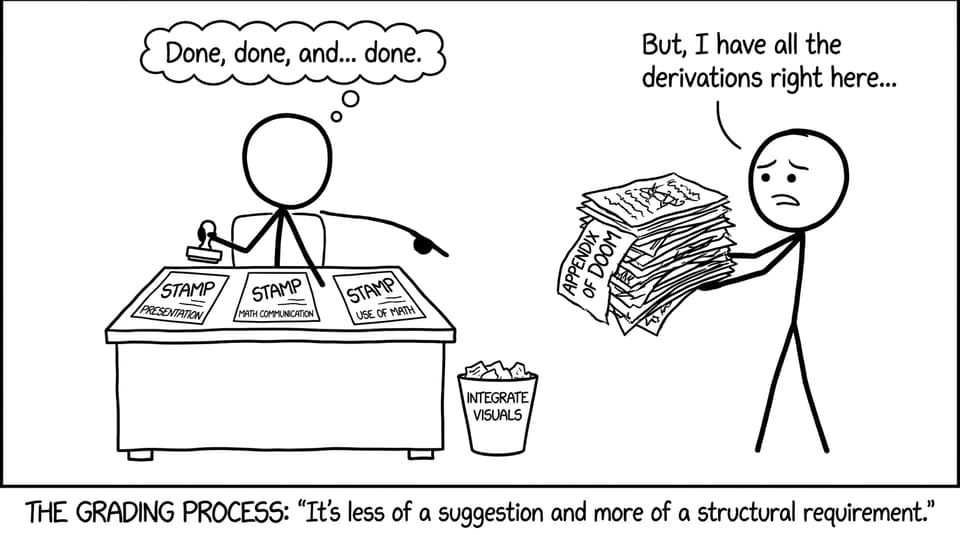
Your Math AI IA is marked using five criteria. If you want a 7, you don’t “write generally well”, you target marks.
Presentation (4)
Examiners reward readability.
-
Use clear headings and a logical flow.
-
Put graphs and tables inside the argument, not dumped at the end.
-
Label everything and reference it in text.
Formatting guidance that examiners consistently like is summarized in How to Format and Present Your IB Math IA Professionally.
Mathematical Communication (4)
This is your mathematical language.
-
Use correct notation consistently.
-
Define symbols before you use them.
-
Write sentences that explain what each line of math is doing.
A simple upgrade: replace “plugging in” with “substituting,” and replace “I got” with “this implies.” Small shifts signal IB maturity.
Personal Engagement (3)
High engagement is visible in choices.
-
You justify why you selected a model.
-
You tweak the approach when results are odd.
-
You explain why your variables matter in your real-world context.
If you’re stuck, reviewing strong examples can help you see what “authentic” looks like. Use IB Maths AI IA Examples and the wider Mathematics Applications & Interpretation (AI) Exemplars.
Reflection (3)
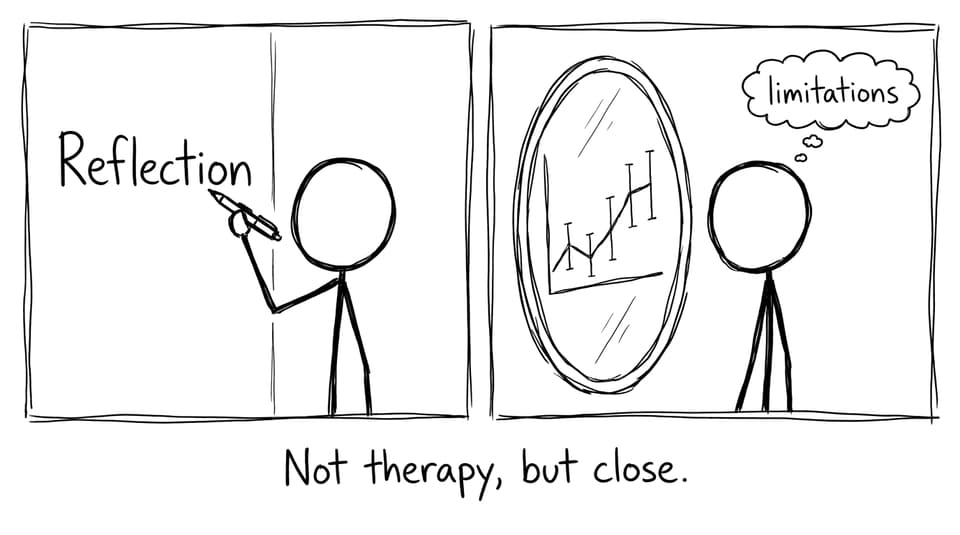
Reflection is not a diary. In the IB, reflection is analysis of decisions.
-
Why did this method work here?
-
What does this result suggest, and what does it not prove?
-
What would change if an assumption failed?
Add reflection moments throughout the body, not just in the final evaluation.
Use of Mathematics (6)
This is the biggest slice. You score by using mathematics that is:
-
relevant to the research question,
-
accurate and correctly applied,
-
appropriately sophisticated for your course,
-
and connected to interpretation.
The quickest way to lose marks is to include math “because it looks advanced.” If it doesn’t help answer the question, it’s noise.
How RevisionDojo helps you build a 7-level IB Math AI IA
At some point, every IB student hits the same wall: you can’t tell if your IA is “good” or merely “done.” That’s where systems help.
Here’s a practical way to use RevisionDojo while drafting:
-
Start with the rubric framing inside the IB Mathematics Applications & Interpretation (AI) IA Guide.
-
Compare your tone and structure against real samples in Maths AI IA coursework exemplars.
-
Use the IB Maths AI IA Grader to self-check criterion by criterion before teacher feedback.
-
Build weak-topic confidence by revising core skills in the IB Mathematics Applications & Interpretation Resources: Study Notes, Flashcards, and targeted practice.
-
Train exam-style problem solving alongside IA work using the Questionbank, and pressure-test topics like modeling or statistics so your IA math stays accurate.
RevisionDojo’s ecosystem matters because the IA isn’t isolated from exams. The same habits, clear method, correct notation, justified reasoning, show up everywhere in the IB.
Closing: your IB Math AI IA is leverage
The IB can feel like a long marathon where every grade is decided on one day. The Math AI IA quietly disagrees.
It’s 20% of your result, yes. But more than that, it’s leverage: a place where planning beats panic, and where a well-chosen topic plus disciplined writing can lift your whole final grade.
If you want the fastest path to a 7, treat your IA like a project with checkpoints. Use RevisionDojo’s IB Mathematics Applications & Interpretation (AI) IA Guide, review Maths AI IA examples, and run a final self-audit with the IB Maths AI IA Grader. Then reinforce the math behind your model using RevisionDojo Study Notes, Flashcards, AI Chat, and the Questionbank.
Build it slowly. Explain it clearly. Reflect like an examiner is listening.
That’s how a 7 happens in the IB.