If you have ever rehearsed your Solo Theatre Piece and thought, “I’m doing the acting… but where is the theorist?” you are not alone.
In IB Theatre, that gap is usually the difference between a performance that feels sincere and a performance that is examiner-ready. The Solo Theatre Piece (HL) is not asking you to decorate your work with theory. It is asking you to let theory change what your body does, what your voice does, how you place the audience, and what meaning you make them build.
Practitioner conventions are the bridge. They are not trivia. They are the tools that turn research into stage language.
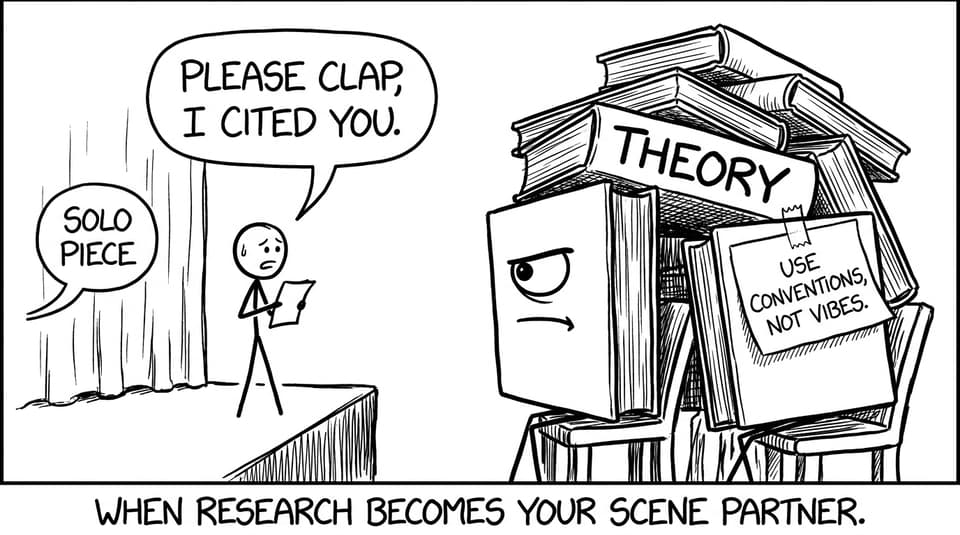
A student rehearses while THEORY judges
A quick checklist before you rehearse again
Use this as your pre-flight routine for IB Theatre:
Choose 2--3 practitioner conventions you can show clearly in a solo format.
Write one sentence: “This convention should make the audience feel/think…”
Run a 30-second experiment for each convention (record it).
Keep what communicates meaning. Cut what is only decorative.
Build reflection notes immediately after rehearsal, not later.
A convention is effective when an examiner can watch your piece and say: the practitioner is visible in the choices. Not because you mention their name, but because the performance behaves like their thinking.
In IB Theatre, effectiveness usually comes down to three tests:
Clarity: Could a stranger identify what is happening and why it is staged that way?
Consistency: Do the conventions repeat as a deliberate pattern rather than a one-off trick?
Purpose: Does each convention create meaning (theme, tension, audience response), not just style?
Choosing practitioner conventions without overloading the piece
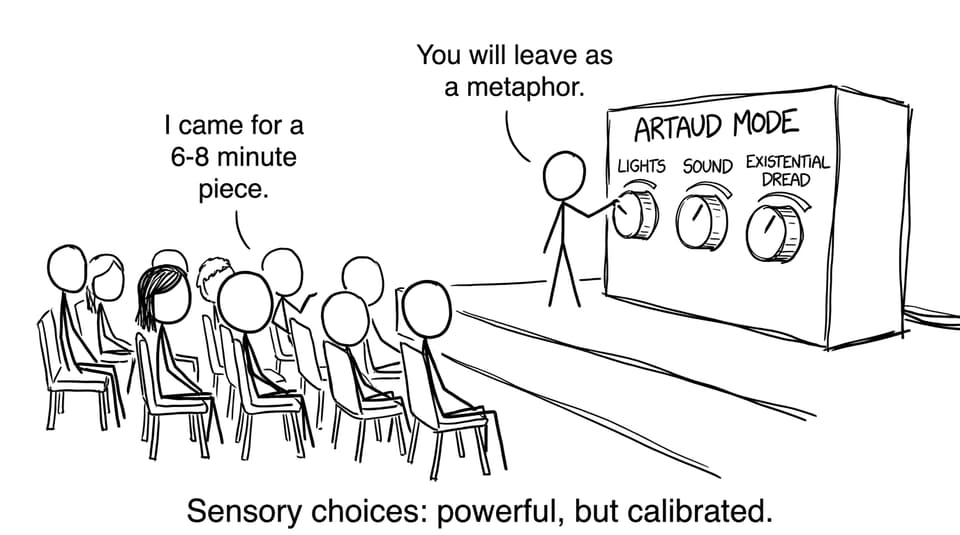
Most students lose marks in IB Theatre by trying to include too much. A Solo Theatre Piece is only 6--8 minutes. That time limit is a gift because it forces taste.
Pick conventions that survive the solo format
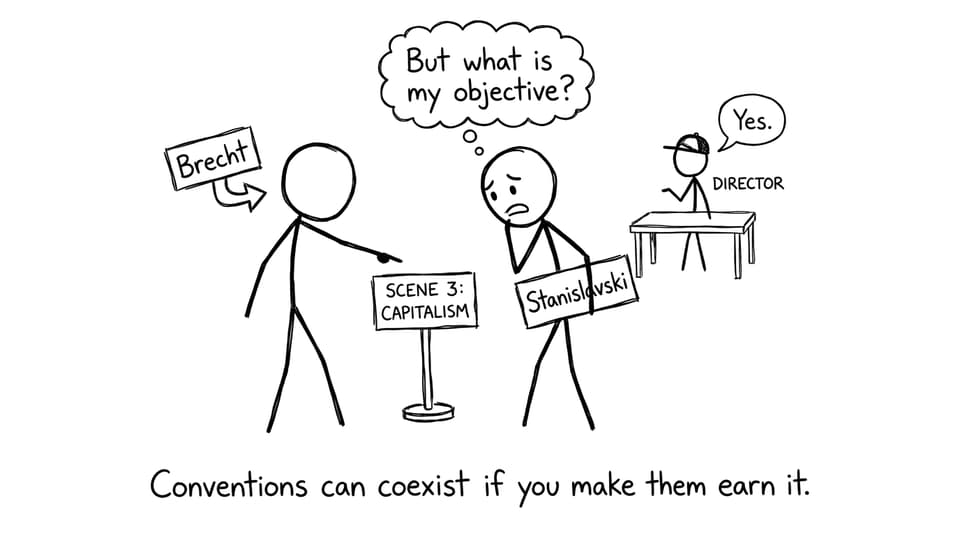
Some conventions were born for ensembles. Your job is to protect the principle while adapting the method.
If a practitioner relies on group energy, translate it into contrast (you vs. imagined others), spatial relationships (distance, levels), or rhythm shifts.
If a convention depends on design elements, scale it down into one strong prop, one repeatable sound cue, or one lighting idea you can explain and justify.
The best Solo Theatre Pieces in IB Theatre feel like a quiet argument: here is the world, here is the practitioner lens, and here is what the audience must notice. Practitioner conventions are how you make that argument visible.
If you want a system that supports both rehearsal and reflection, RevisionDojo is built for this moment: use the Study Notes to tighten theory, the Flashcards to lock in key terminology, the Questionbank to test your understanding, and the AI Chat when you need to pressure-test an idea. Then sharpen your portfolio with the Grading tools, and boost confidence with Mock Exams, Predicted Papers, the Coursework Library, and targeted Tutors.
Do fewer things. Do them deliberately. Let IB Theatre reward you for craft, not clutter.