

If you’ve ever walked out of an IB Math paper thinking, “That came out of nowhere,” you’re not alone.
But here’s the quiet truth most top scorers eventually learn: the IB is rarely chaotic. It’s consistent in the way a tide is consistent. Waves look random up close, yet the patterns return if you track them long enough.
That’s the real skill behind using past questions: not fortune-telling, but pattern literacy. When you combine that habit with the right tools (especially a well-tagged questionbank and strong analytics), you stop revising like you’re chasing shadows. You start revising like you’re following evidence.
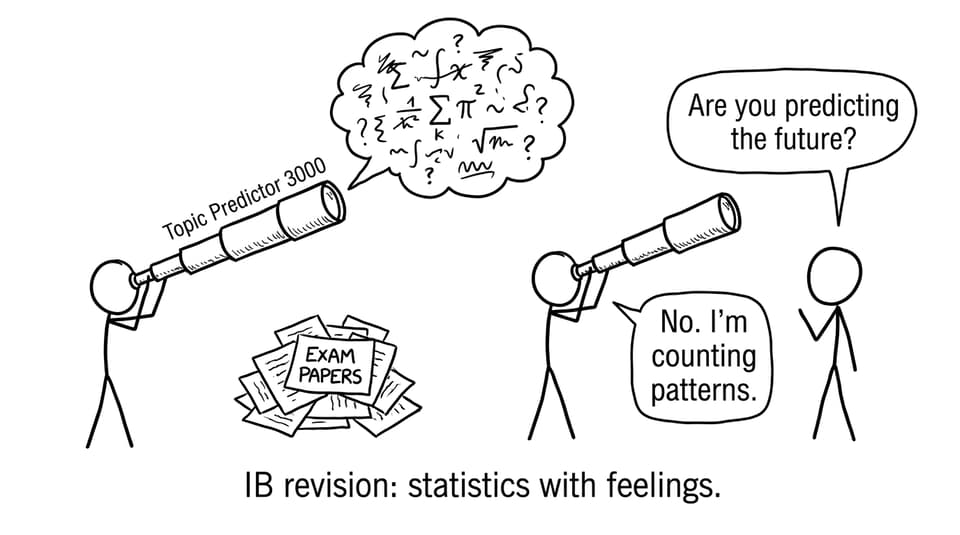
The fast IB checklist: predicting topics without guessing
Use this checklist before you do any “prediction” work. It keeps your IB revision grounded and stops you from overfitting patterns.
-
Choose your exact course: Math AA or Math AI, SL or HL (IB details matter).
-
Split your tracking by paper (Paper 1 vs Paper 2, and Paper 3 if HL).
-
Look at recent sessions first, then widen the sample.
-
Track topic frequency, but also track question type (proof, modeling, interpretation).
-
Convert insights into practice: a prediction that isn’t trained becomes anxiety.
A good starting point is to browse your course hub and then work topic-by-topic: IB Mathematics Analysis and Approaches Resources or IB Mathematics Applications & Interpretation Resources.
Why IB Math feels unpredictable (and why it isn’t)
The IB doesn’t sit down and try to surprise you. It sits down and tries to assess you.
Assessment creates repetition. Syllabus weightings create repetition. Markschemes create repetition. Even examiner habits create repetition.
So when IB students say “anything can come up,” what they usually mean is: “I didn’t see the structure.” Once you start sorting past questions by topic and paper, the structure becomes visible. Not perfectly, not mechanically, but enough to make your revision plan calmer and more efficient.
RevisionDojo is built for this exact IB workflow: you can move from Study Notes to Questionbank practice to Flashcards, then ask AI Chat to diagnose errors, then run Mock Exams and Predicted Papers to pressure-test your progress. It’s one loop, not ten disconnected resources.
If you want the tool-based workflow, this guide pairs well with the approach here: How to Use the Questionbank for Targeted Math Revision.
Step one: anchor your predictions in IB topic weighting
Prediction starts with humility. Before you chase “what’s due,” start with what’s always present.
In IB Math, certain syllabus areas consistently take up a large share of marks over time. That doesn’t mean every session is identical, but it does mean you’ll routinely see the big pillars return.
Practical move for IB students:
-
Pick 4–6 macro-topics (for your course).
-
For each paper, estimate how often each macro-topic appears.
-
Use that as your baseline revision allocation.
When you’re learning or revising the core content quickly, you can keep your foundation tight with syllabus-aligned notes such as IB Mathematics Analysis and Approaches Calculus Notes and the IB Mathematics Analysis and Approaches Data Booklet.
Step two: use past questions to find “always,” “often,” and “rare”
Here’s a simple way to avoid the biggest IB prediction trap (obsessing over one neglected topic): create three buckets.
The “always” bucket
Topics that appear so regularly that predicting them is basically just acknowledging reality.
Example action: Build daily sets from a dedicated topic questionbank page like Functions - IB Questionbank.
The “often” bucket
Topics that rotate in emphasis but show up reliably across sessions.
Example action: Track subtopics, not just the big chapter name. In calculus, for instance, you can drill specific techniques with pages like Chain, Product and Quotient Rules Questionbank or broader practice such as IB Mathematics AA Calculus Questionbank.
The “rare” bucket
Topics that appear less frequently or appear as smaller mark allocations.
These still matter in IB, because a small mark allocation can still be the difference between a 6 and a 7. But they shouldn’t dominate your limited revision time.
Step three: track question types (not just topics)
Two IB questions can share a topic and still feel like different sports.
“Functions” might mean:
-
graph transformations and interpretation,
-
solving equations with composite functions,
-
sketching with asymptotes and constraints.
So instead of only tracking topics, track formats:
-
“show that” algebraic structure
-
multi-step modeling with interpretations
-
use of technology vs clean algebra
-
proof-style reasoning
This is also where RevisionDojo’s AI Chat becomes more than explanation. Use it like a diagnostic coach: paste your solution, ask where marks would be lost, then generate a mini-quiz targeting that exact error pattern.
For proof fundamentals, a focused refresher like Notes for SL 1.6--Simple proof can save you hours of vague practice.
Step four: separate Paper 1 and Paper 2 patterns
A lot of IB prediction mistakes come from mixing papers together.
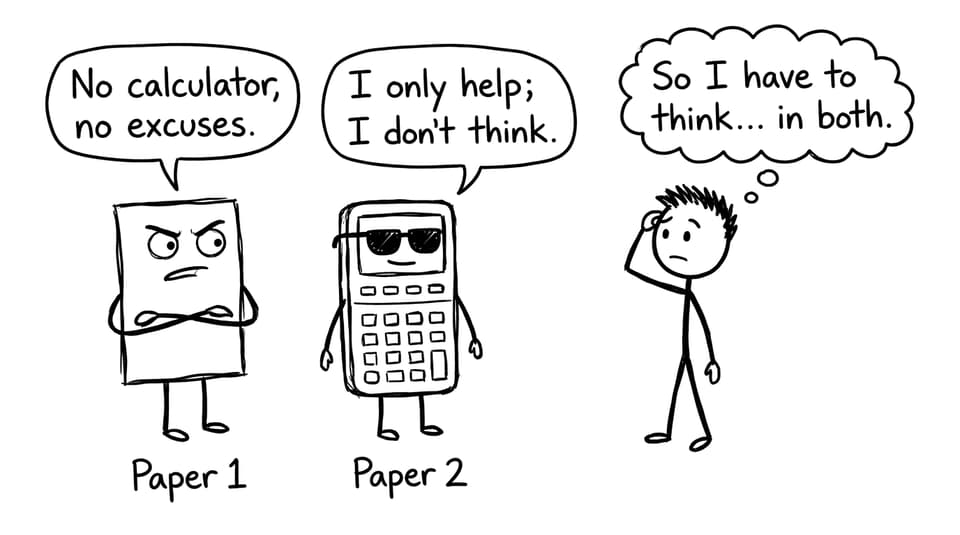
Paper 1 trains clean thinking: structure, algebra, methods, reasoning.
Paper 2 adds calculator fluency: interpretation, efficiency, and knowing what to trust.
So your “likely topics” list should be two lists: one per paper.
To build your Paper 1 foundation, this is a useful companion: How to Prepare for IB Math AA SL Paper 1.
Step five: turn prediction into training (the only part that matters)
A prediction is only valuable if it changes what you do tonight.
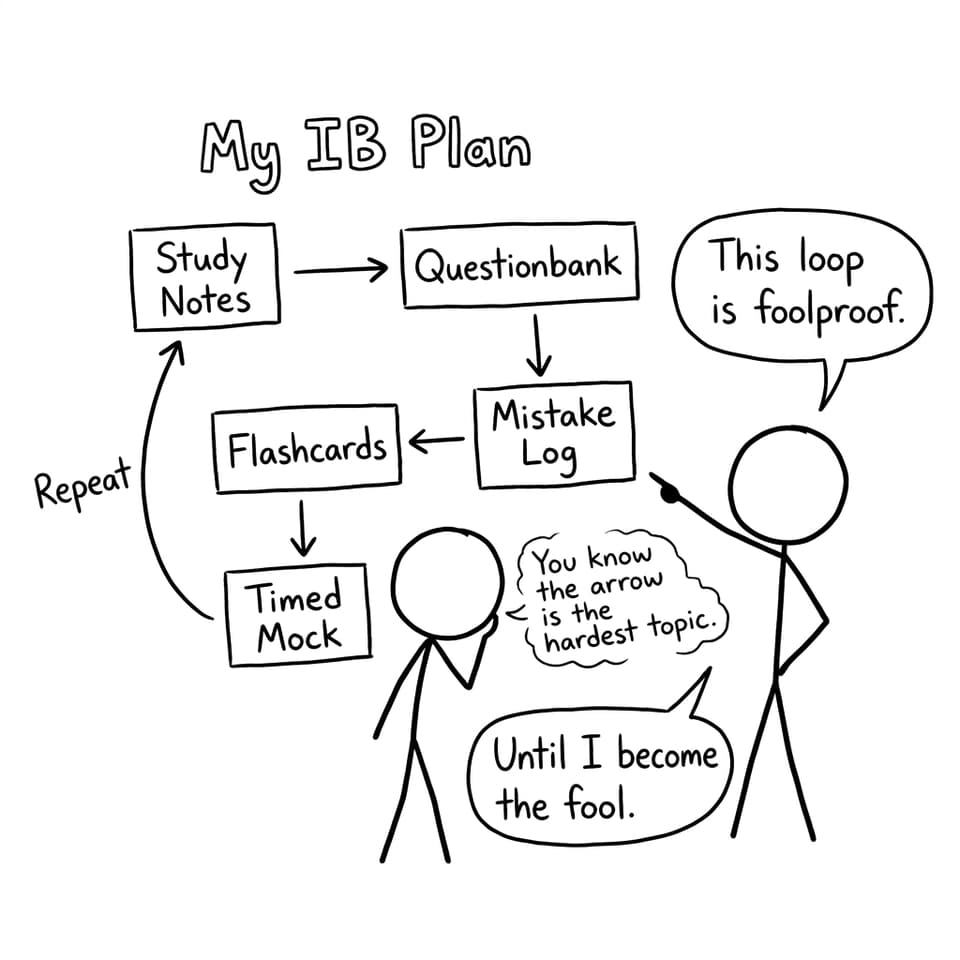
Here’s a clean IB workflow that turns “past questions” into measurable improvement:
-
Study Notes (10–20 min): refresh the method and key ideas.
-
Questionbank set (25–45 min): do a focused block on one subtopic.
-
Grading tools (10 min): mark strictly, identify where marks leaked.
-
Flashcards (5–10 min): convert 2–5 mistakes into retrieval prompts.
-
Retest (48 hours later): same subtopic, new questions, faster and cleaner.
For AI students, topic practice pages like Statistics and Probability Questionbank - IB keep your revision aligned with what IB Math AI actually rewards.
Step six: pressure-test your predictions with timed rehearsal
The IB doesn’t just test knowledge. It tests performance under time.
So once you’ve identified your “high-likelihood” topics from past questions, rehearse them under realistic conditions:
-
Build a short timed set (20–30 minutes) around those topics.
-
Review mistakes immediately.
-
Repeat weekly, increasing difficulty.
RevisionDojo supports this with Mock Exams and Predicted Papers, which are designed to mirror IB structure and mark allocation patterns.
Start here: IB Predicted Papers by IB Examiners (Free) and, for context on how to use them well, IB Predicted vs Specimen Papers: What They Mean.
Closing: make IB prediction calm, not superstitious
Using past questions to predict IB Math topics isn’t about getting lucky. It’s about building a system that notices what the IB repeats, then trains you to perform those skills cleanly under time.
If you want one home base for that system, RevisionDojo is built for it: Questionbank filtering by topic and difficulty, Study Notes for fast clarity, Flashcards for daily recall, AI Chat for targeted diagnosis, Grading tools to stop guessing, plus Predicted Papers and Mock Exams to rehearse the real IB pressure.
Pick one topic tonight. Use past questions to find its patterns. Then practise until the pattern feels boring. That’s usually when IB scores start rising.