
In the last five minutes of an exam, your brain doesn’t crave “better ideas.” It craves a better path.
That’s what connectors give you: a path your reader can follow without getting lost.
In IB Languages, especially IB Chinese B Paper 1, the difference between “I can write Chinese” and “I can communicate clearly under pressure” is often invisible. It’s the small words that guide logic: 首先, 因此, 然而, 总之. When they’re missing, your writing reads like a list. When they’re used well, your writing becomes a conversation that makes sense.
This guide shows how to use connectors effectively in IB Chinese B Paper 1, without forcing them or repeating the same ones until they lose meaning.
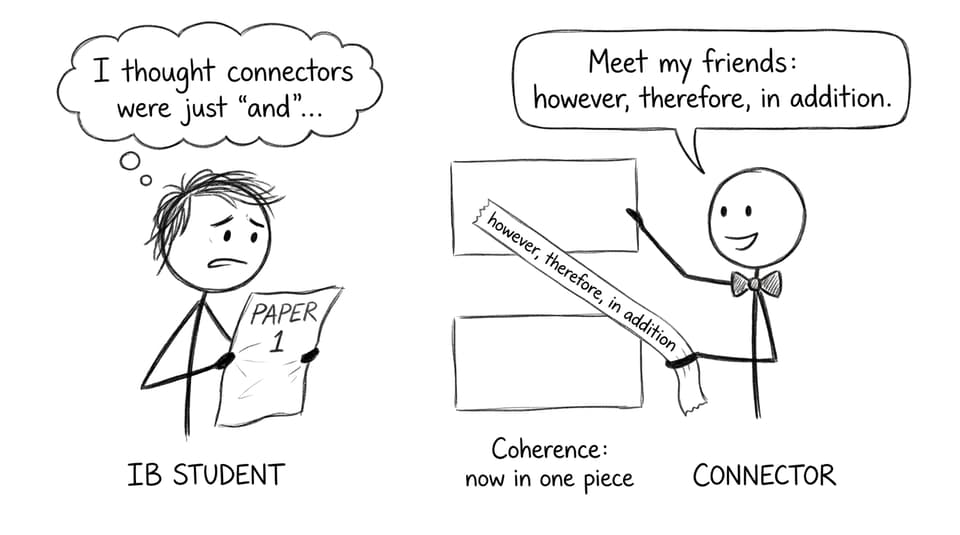
Quick checklist for using connectors in IB Chinese B Paper 1
-
Plan 3-4 connector “slots” before you write (not 20).
-
Use at least three different connector types (sequence, contrast, cause-effect, examples, conclusion).
-
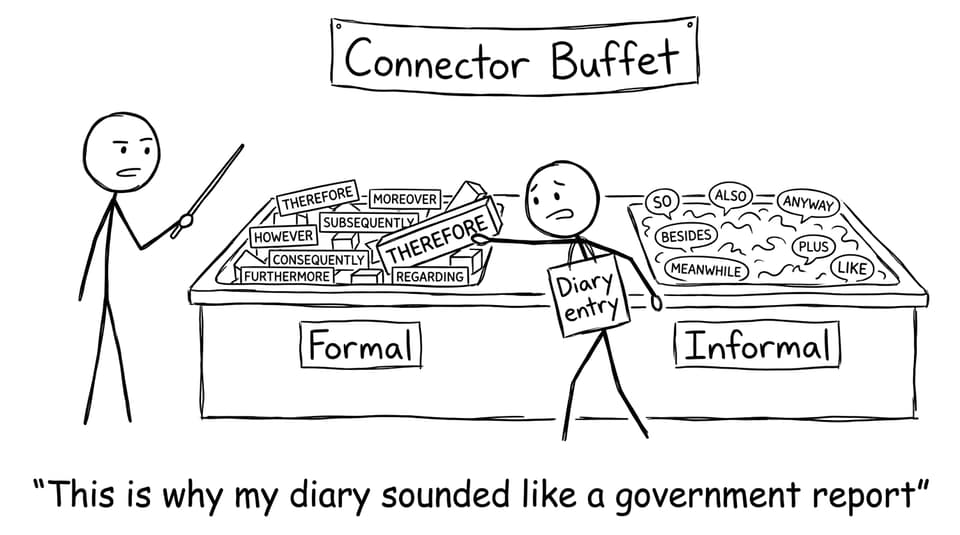
Match connector formality to text type (diary vs article vs speech).
-
Avoid using 所以 or 但是 repeatedly.
-
Proofread specifically for logic: “Does each paragraph turn clearly?”
If you want a bigger Paper 1 game plan alongside connectors, use How to Prepare for IB Chinese B Paper 1 (Writing Exam Guide) as your backbone.
Why connectors matter for IB Languages (and why examiners notice)
Paper 1 isn’t graded like a casual journal entry. In IB Languages, examiners reward writing that develops a message with structure and intention.
Connectors help you:
-
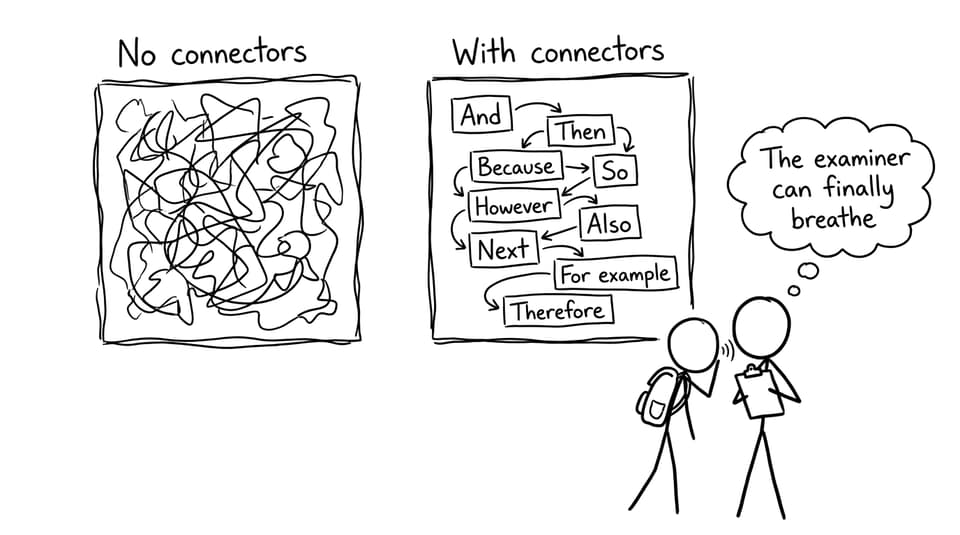
Signal coherence: your reader understands the relationship between ideas.
-
Show range: varied connectors suggest control of language, not memorised chunks.
-
Expand naturally: reasons, examples, consequences, and concessions become easier to add.
-
Keep your tone consistent: the right connector can make writing sound formal, friendly, persuasive, or reflective.
To align this with marking expectations, pair connector practice with the rubric language in Notes for Paper 1 (writing) criteria 写作评分标准.
The connector categories that actually lift your Paper 1 score
You don’t need a 200-word connector list. You need a compact set you can use accurately, across prompts and text types.
Sequencing connectors (structure on the page)
Use these when your writing has steps, stages, or a clear progression.
-
首先 / 第一
-
其次
-
然后
-
最后
Mini-example:
首先,我想谈谈手机对学习的影响;其次,我们也要考虑它对社交的改变;最后,我会提出一个可行的建议。
Cause-and-effect connectors (reason and result)
Use these to turn opinions into arguments.
-
因为…所以…
-
由于…因此…
-
因此
-
结果
Mini-example:
由于时间管理不当,因此很多同学在考试前会感到焦虑。
Contrast connectors (mature thinking, not just “but”)
In IB Languages writing, contrast is often where sophistication shows up: you recognise complexity.
-
但是 / 不过
-
然而
-
虽然…可是…
-
相反
Mini-example:
虽然复习很辛苦,可是当我看到自己的进步时,我又觉得这一切值得。
Addition connectors (developing ideas smoothly)
These help you add depth without sounding like you’re starting over.
-
而且
-
另外
-
同时
-
不仅…而且…
Mini-example:
这个方法不仅能提高效率,而且能让复习更有计划。
Example connectors (proof, not vibes)
Examples are how you “cash in” your point.
-
比如
-
例如
-
就像
-
特别是
Mini-example:
很多城市都在推动绿色出行,比如建设更多的自行车道。
Conclusion connectors (landing the plane)
Endings matter in IB Chinese B Paper 1. A clear close signals control.
-
总的来说
-
总之
-
简而言之
-
因此
Mini-example:
总的来说,只要我们从小事做起,环保就不会只是口号。
How to use connectors effectively (without sounding robotic)
Place connectors where the reader’s brain would ask “how?”
A good connector answers the reader’s silent question:
-
“What comes next?”: sequencing
-
“Why is that true?”: cause-effect
-
“Is there another side?”: contrast
-
“Can you show me?”: example
-
“So what?”: conclusion
Before you write, draft a 10-second outline with connector placeholders:
-
Paragraph 1: hook + position (我认为…)
-
Paragraph 2: reason (因为…所以…) + example (例如…)
-
Paragraph 3: contrast (然而…) + solution (因此…)
-
Ending: summary (总的来说…)
This fits naturally into broader Paper 1 structuring advice from Building a strong response 打造清晰有力的回答 Notes.
Match connector formality to the text type
Connectors carry “voice.” If your text type is informal, overly formal connectors can feel like costume jewellery.
Use this alongside your text type prep from IB Languages: Master Chinese B Paper 1 Text Types and IB Chinese B Writing: Mastering Different Text Types.
Practical rule:
-
Diary/blog: 然后, 所以, 不过, 另外
-
Article/speech/report: 然而, 因此, 总的来说, 由于…因此…
Aim for variety, not volume
In IB Languages, overusing connectors can make writing feel mechanical. A useful target is 1-2 connectors per paragraph that genuinely change the direction or clarity of the message.
Proofread for repetition patterns
In your final check, circle connectors. If you see 所以 three times in a row, replace one with:
-
因此
-
结果
-
这样一来
If you want fast, targeted feedback, run a practice draft through the IB Chinese B Paper 1 30 Marker Grader and focus only on coherence and development first.
A simple 15-minute connector practice routine
-
5 minutes: Pick one theme from How IB Chinese B Connects to the Five Prescribed Themes and write 3 topic sentences.
-
5 minutes: Add one cause-effect and one contrast connector to each sentence.
-
5 minutes: Add one example connector and write one concrete example.
Then store your best sentences as reusable “building blocks.” RevisionDojo makes this easier with Study Notes for structure, Flashcards for connector recall, AI Chat for quick rewriting options, and Tutors when you want line-by-line correction.
For connector-friendly vocabulary drilling, use Flashcards for Paper 1 - IB.
Closing: Make your logic easy to follow
Exams reward the student who makes the examiner’s job easier. Connectors do exactly that. They turn scattered sentences into a guided argument, and they help your IB Chinese B Paper 1 writing sound like it belongs in the world of IB Languages: clear, coherent, and purposeful.
If you want one place to practise this skill properly, RevisionDojo gives you the full loop: Questionbank prompts to write from, Study Notes and Coursework Library to build ideas, Flashcards to lock in connectors, AI Chat to refine phrasing, and Grading tools, Mock Exams, and Predicted Papers to pressure-test your writing before exam day. Start with one timed response this week, and let connectors be the “quiet upgrade” that lifts everything else.