


If you’re in the IB, you already know the cruel math of the calendar: deadlines multiply, energy divides, and somehow the exam date stays fixed. The panic isn’t just “I haven’t studied enough.” It’s the quieter fear that even if you start, you won’t know where to aim.
Here’s the reality most IB students discover too late: strong math results don’t come from long sessions. They come from tight loops you can repeat when life is busy. When you’re short on time, your job is to build a system that turns small blocks into marks.
RevisionDojo is built for that kind of system: Study Notes for fast clarity, a Questionbank for exam-style practice, Flashcards for daily recall, AI Chat for quick diagnosis, Grading tools for feedback, Mock Exams for timing, Predicted Papers for rehearsal, a Coursework Library to reduce background stress, and Tutors when you need a human reset.
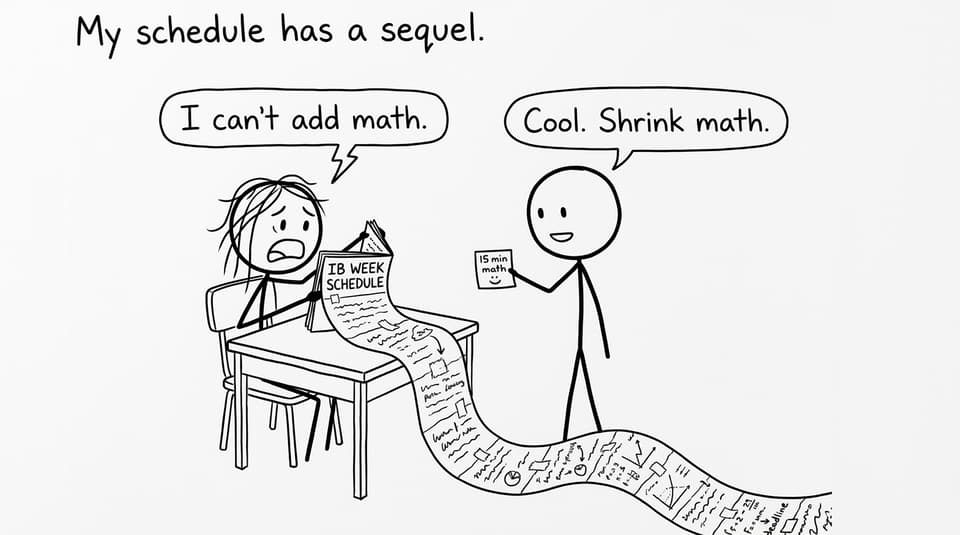
The short-on-time IB Math checklist
When you have limited time, don’t negotiate with your schedule. Use a repeatable checklist:
-
Pick two weak topics (maximum) for the week.
-
Read one short section of Study Notes to remove confusion.
-
Do 3-6 targeted questions immediately after (same topic).
-
Mark fast, write a one-line mistake pattern.
-
Finish with Flashcards for formulas and triggers.
-
Once per week, run a short timed set to train pace.
If you want a single home base for this, start at RevisionDojo for IB. It’s designed to keep the loop in one place so you don’t waste time switching tabs.
Why “more hours” fails in IB (and what to do instead)
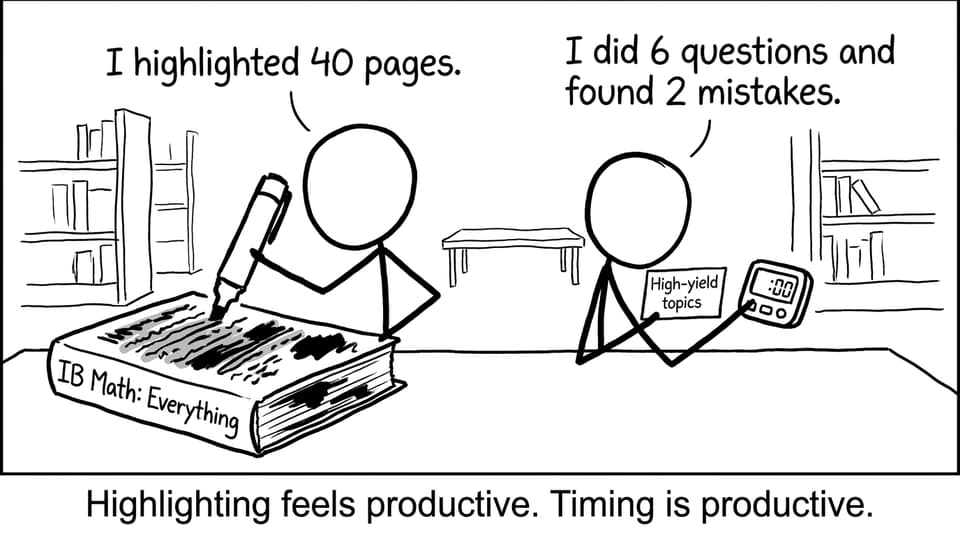
In the IB, time pressure does something sneaky: it pushes you toward comforting tasks. Re-reading notes. Highlighting. Organizing folders. They feel like progress because they’re quiet and controllable.
But math scores come from retrieval and application. The fastest learners aren’t calmer or smarter. They simply spend more minutes doing the uncomfortable thing: attempting questions, checking solutions, and noticing exactly where their thinking breaks.
That’s why a good IB math plan looks less like a marathon and more like short sprints with honest feedback.
Choose high-yield topics first (not your favorite ones)
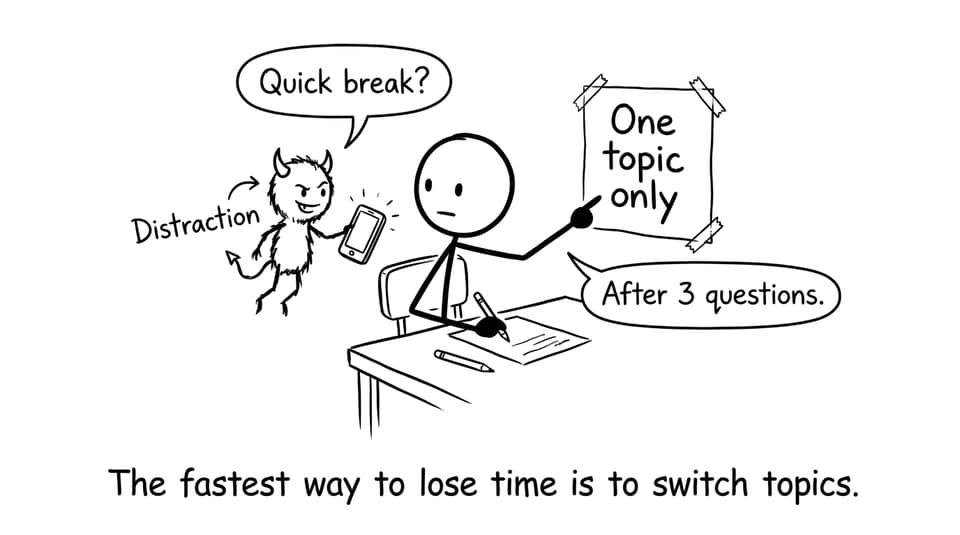
When you’re short on time, breadth becomes expensive. A smarter move is to focus on topics that:
-
appear often across assessments,
-
connect to other skills,
-
and produce predictable mark gains once the method is stable.
For many IB students, that often means prioritizing core areas such as:
-
functions and graphs
-
calculus foundations (especially differentiation patterns)
-
probability and statistics basics
-
geometry and trigonometry essentials
If you study AA, start with the hub for IB Mathematics Analysis and Approaches. If you study AI, your practice will lean more heavily toward modeling and statistics, but the same “high-yield first” principle applies.
Use Study Notes to get unstuck fast (clarity saves time)
When time is tight, confusion is the most expensive emotion. One unclear idea can turn a 25-minute session into two hours of spiraling.
So your first step isn’t to grind more questions. It’s to get clean clarity quickly, then practice immediately.
RevisionDojo’s Study Notes are made for this. They compress a topic into what matters for IB marking: definitions, method steps, worked examples, and the common traps students fall into.
A good micro-session looks like this:
-
10 minutes: Study Notes on one sub-skill (example: chain rule triggers)
-
15 minutes: 3-5 questions on that exact sub-skill
-
5 minutes: write the mistake pattern and the fix
If you’re in Math AI and want a structured approach to using notes efficiently, this guide helps: How to Use RevisionDojo Notes to Simplify IB Math AI Concepts.
The fastest loop: Learn, then Apply, then Check
The most effective short-time strategy for IB math is a tight feedback loop:
Learn (briefly)
Get the minimum explanation you need to start.
Apply (immediately)
Attempt questions while the idea is still warm.
Check (honestly)
Don’t just look at the answer. Compare steps, find the decision point where you went wrong, and name the error.
This is exactly what a topic-filtered question system is built for. Use the How to Use the Questionbank for Targeted Math Revision guide to set up a routine that stays focused under pressure.
And when you want direct practice, go straight to a topic bank like IB Math AA Calculus Questionbank or, if you need trig foundations, IB Math AA Geometry and Trigonometry Questionbank.
Use Flashcards to protect formulas from stress
In IB math, many “I knew this” moments are actually memory failures under stress: wrong sign, forgotten identity, mis-remembered condition.
That’s why flashcards work so well when you’re short on time. They turn dead minutes (commute, lunch line, pre-sleep) into retrieval practice.
Use IB Flashcards with Spaced Repetition (SRS) for daily review, and read the strategy behind it here: IB Flashcard System: Active Recall for Better Memory.
A simple rule that fits a busy IB schedule:
-
10 minutes daily beats 60 minutes weekly.
-
Keep cards short: formula + when to use it + one common trap.
The “Power 45” session for IB Math (when you have one slot)
If you only have one solid block today, make it structured:
-
10 min: Study Notes on one weak subtopic
-
25 min: Questionbank set (same subtopic, increasing difficulty)
-
5 min: Flashcards for related formulas
-
5 min: error log (pattern + fix + next action)
When you repeat this 4-5 times in a week, your brain starts to recognize question types faster. That speed is what people call “confidence” on exam day.
To build the routine around real life, this pairs well with: The Ultimate IB Math Study Routine for Busy Students.
Train timing with mock exams (without waiting for perfection)
Many IB students delay timed work because it feels discouraging. But timing isn’t a reward for mastery. It’s a skill you practice while learning.
Use short timed sets first, then build toward fuller simulations.
RevisionDojo supports this with Mock Exams and structured exam rehearsal. If you want a clear setup, use: IB Test Templates: Pre-Made Exams for Quick Practice and then step up with How to Use RevisionDojo's Mock Exam Builder to Simulate IB Conditions.
And when you want calm, precise help mid-session, use AI Chat like a diagnostic tool: paste your working and ask where the method diverges. If your issue is bigger than a single question, that’s where Tutors can save weeks.
Closing: make IB math smaller, then repeat it
When you’re short on time, the winning move in IB math is to shrink the task until it’s doable, then repeat it until it’s dependable. One topic. A short note. A handful of questions. Fast feedback. Tiny flashcard review.
If you want the cleanest setup for that loop, make RevisionDojo your base: Questionbank, Study Notes, Flashcards, AI Chat, Grading tools, Predicted Papers, Mock Exams, Coursework Library, and Tutors working together so your limited time turns into real exam performance.
Open one weak topic today, do 3 questions, and write one mistake pattern. That’s not “too little.” That’s how momentum starts in the IB.