

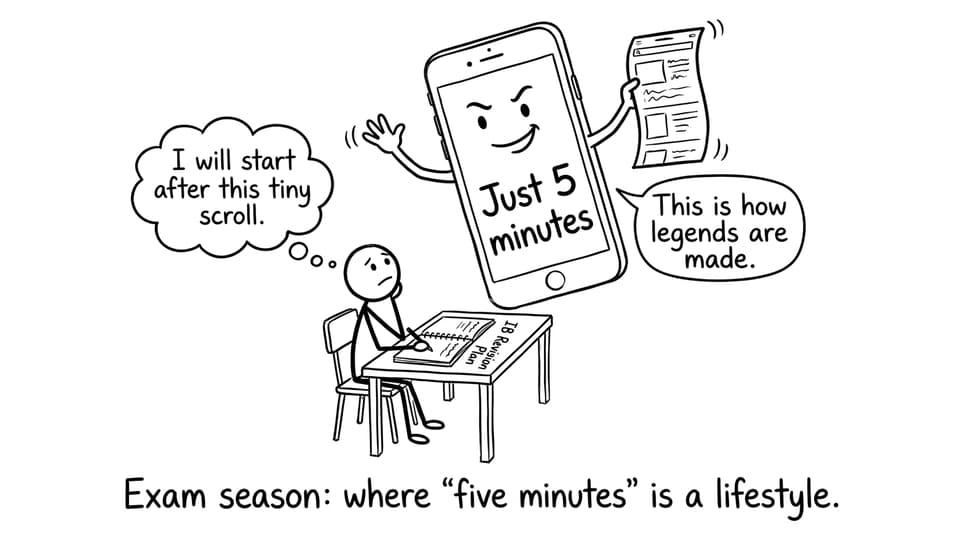
Procrastination has a special talent: it shows up exactly when you finally care.
One minute you are calm, telling yourself you will “start after dinner.” The next minute it is midnight, you have reorganised your stationery, and your brain is negotiating with you like a lawyer. During IB exam season, that pattern is common, and it is rarely about laziness. It is usually about fear, overload, and not knowing what “starting” actually looks like.
This guide shares Exam Tips that make starting small enough to be inevitable, then builds momentum you can keep.
Quick checklist (save this)
-
Name your procrastination trigger (fear, perfectionism, overwhelm, confusion).
-
Turn “revise” into a 10-minute, measurable task.
-
Time-block one short sprint and protect it.
-
Remove the biggest distraction before you sit down.
-
Reward consistency, not intensity.
If you want more planning structure, pair this with Best Time Management Hacks for IB Students.
Why you procrastinate (and why that matters)
Most procrastination is a protection strategy. Your brain avoids discomfort first, and long-term goals second.
Common triggers in IB exam season:
-
Fear of failure: if you do not start, you cannot “prove” you are not good enough.
-
Perfectionism: you wait for the perfect mood, resource, or plan.
-
Overwhelm: “Study Biology” is too big to begin.
-
Low clarity: you are unsure what the markscheme actually wants.
A practical set of Exam Tips begins here: do not fight the feeling head-on. Change the task shape until it feels safe enough to start.
For the anxiety side of this loop, read The IB Anxiety Loop (And How to Break It Before Exams).
Exam Tips that shrink the task until you start
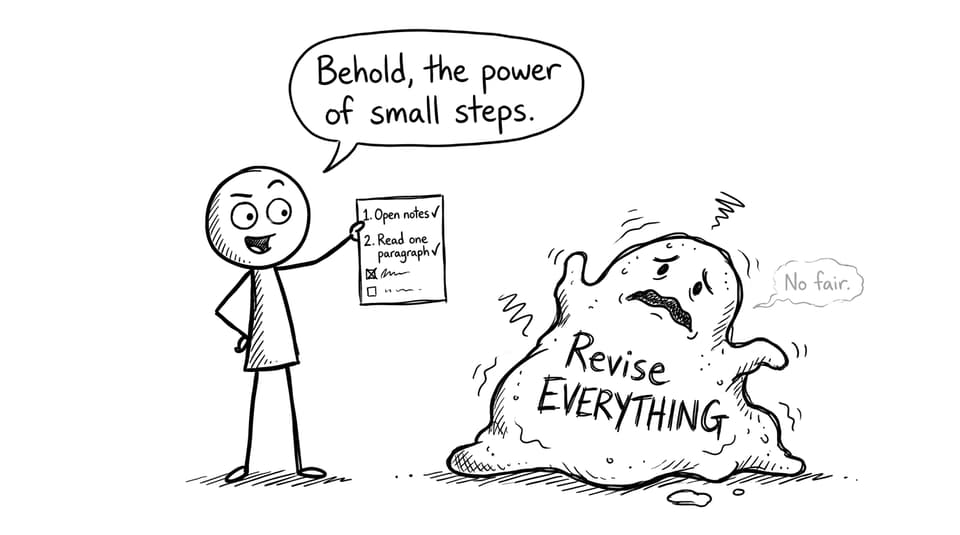
Your to-do list should sound like a timer, not a life sentence.
Instead of:
- “Revise Chemistry”
Write:
-
“Study Notes: acids vs bases (8 minutes)”
-
“Questionbank: 6 acids/bases questions (12 minutes)”
-
“Flashcards: 10 definitions (5 minutes)”
This is where RevisionDojo helps because the tools match the micro-task mindset: Study Notes for quick clarity, Flashcards for daily recall, and Questionbank for targeted practice with feedback. When you finish a small set, you get a clean win, not an endless chapter.
Build your loop with How to Study for IB Exams Without Burning Out and then keep your daily memory warm with IB Flashcards with Spaced Repetition (SRS).
Exam Tips for time-blocking that actually works
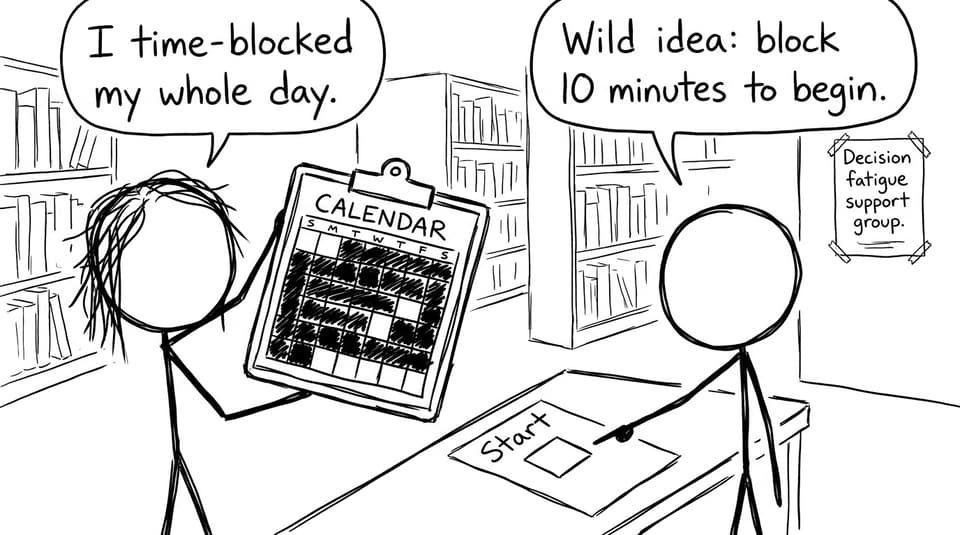
Time-blocking fails when the block is too ambitious. The goal is not to schedule your whole personality. The goal is to remove decision fatigue.
Try this simple pattern:
-
25 minutes: one topic, one outcome (e.g., one Questionbank set)
-
5 minutes: break
-
10 minutes: mark, log mistakes, create 3 flashcards
If you want a subject-specific model, see How to Revise for IB Math Using the Pomodoro Technique. For broader focus systems, use IB Revision Hacks: Quick Tips for Efficient Studying.
Make distractions inconvenient (not “forbidden”)
In exam season, willpower is a limited resource. Design beats discipline.
Practical moves:
-
Put your phone in another room for one sprint.
-
Open only what you need (one tab, one chapter, one task).
-
Keep “break activities” pre-chosen (water, stretch, short walk).
If you struggle with drifting attention, these Exam Tips pair well with How Do You Study Efficiently for IB Without Getting Distracted?.
Use the 5-minute rule (but define the first action)
“Study for five minutes” is helpful, but “start” must be concrete.
Examples of a good five-minute start:
-
Open RevisionDojo Study Notes and write three bullet points from memory.
-
Do two Questionbank questions, even if you get them wrong.
-
Review one small Flashcards deck.
Once you start, your brain often stops resisting. If you do not continue, you still win: you reinforced the identity of someone who begins.
Reward consistency, not hero days
Procrastination loves all-or-nothing thinking. So flip the incentive.
Reward ideas:
-
After two sprints: 15-minute guilt-free break.
-
After a week of daily flashcards: a planned treat.
-
After a timed set: use RevisionDojo AI Chat to review one mistake and turn it into a rule you can repeat.
If you need a realistic routine to copy, see Countdown to IB Exams: A Guide to Effective Studying and How to Stay Organized with a Full IB Timetable.
Conclusion: turn Exam Tips into a daily starting ritual
The students who beat procrastination are not magically disciplined. They just make starting small, specific, and repeatable. Pick one micro-task, time-block one sprint, remove one distraction, and let the win be enough to return tomorrow.
If you want one place to run that whole system, RevisionDojo is built for IB exam season: Questionbank, Study Notes, Flashcards, AI Chat, Grading tools, Predicted Papers, Mock Exams, Coursework Library, and Tutors. Use these Exam Tips as your foundation, then let the platform carry the routine when motivation disappears.