

The moment IB SEHS stops feeling like a textbook
There’s a specific kind of panic that shows up in IB SEHS revision: you understand the definition, you can recite the process, but when a question asks you to apply it, your brain goes quiet.
That silence usually isn’t a knowledge problem. It’s a connection problem.
IB SEHS is built to reward students who can take physiology, biomechanics, psychology, and nutrition, then attach them to what happens in training sessions, rehab clinics, school PE lessons, and public health headlines. When you learn to “bridge” theory to reality, you remember faster, write fuller answers, and pick up the marks that come from applied detail.
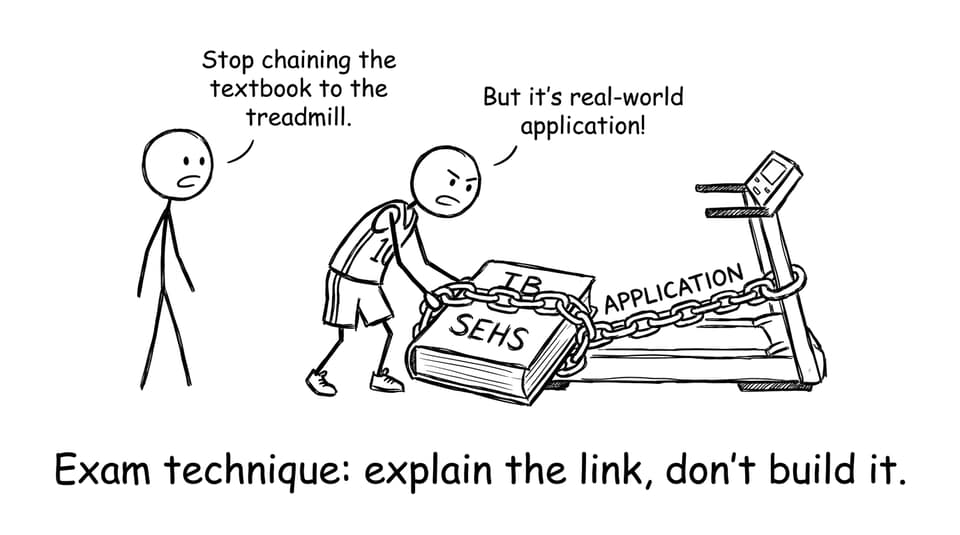
Quick checklist: the real-world application loop
Use this loop whenever you revise IB SEHS content:
-
Name the concept (precise term and definition)
-
Choose a real setting (sport, gym, rehab, classroom, daily life)
-
Add a measurement (data, test, observation, or variable)
-
Explain the mechanism (“because…” using SEHS language)
-
Finish with an outcome (performance, fatigue, injury risk, recovery, health)
If you want a central place to pull topics and build examples quickly, start at the IB SEHS (new syllabus) resource hub and move between Study Notes, Flashcards, and the Questionbank as you practise.
Apply physiology like a coach who speaks in data
Physiology becomes memorable when it stops being abstract and starts sounding like training feedback.
Try linking IB SEHS physiology to moments athletes actually experience:
-
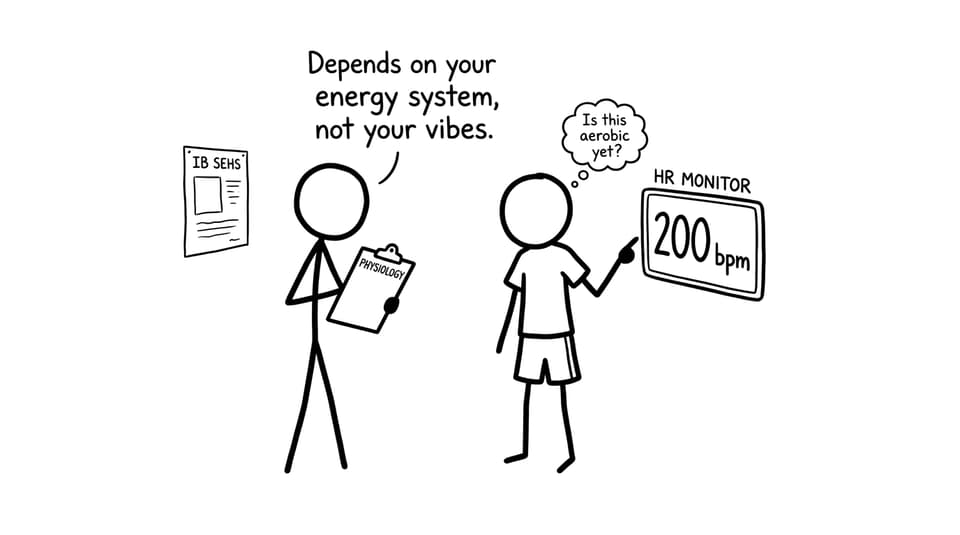
Energy systems: Explain why repeated sprints in games rely heavily on anaerobic pathways, while recovery between efforts leans on aerobic processes. Build your phrasing using the A.2.3 Energy Systems topic page.
-
VO₂ max: Tie it to endurance performance testing and training adaptation. Use one clean statistic (units, typical improvement range, or a training intervention) from the VO₂ max factors notes.
-
Lactate inflection point: Link it to pacing decisions in rowing, cycling, or middle-distance running, then explain fatigue and sustainability with the lactate inflection point notes.
The exam trick is simple: don’t just list terms. Make the marker see the situation, then explain the mechanism.
Use biomechanics to explain why technique changes performance (and injuries)
Biomechanics is where IB SEHS can feel like “physics with extra steps” until you attach it to movement that matters: jumping, lifting, sprinting, throwing, changing direction.
A fast way to create application:
-
Pick a movement in sport.
-
Identify the joint action and type of contraction.
-
Add one performance lever (force production, lever class, range of motion).
-
Add one risk lever (load, angle, repetition, fatigue).
For movement topics, the B.1 Generating movement in the body page is useful because you can jump straight into practice questions, flashcards, and worked explanations.
Want a molecular-level “real world” link? Use the sliding filament theory notes to connect ATP availability to fatigue, sprint performance, and why recovery protocols matter.
Make nutrition answers sound like real meal decisions
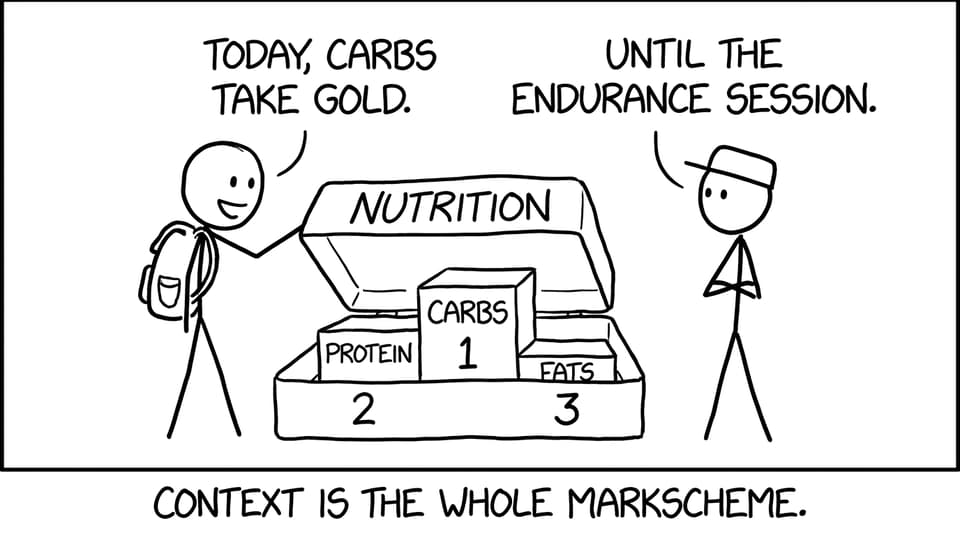
Nutrition marks often come from context. A perfect statement in the wrong scenario still feels empty.
In IB SEHS, your job is to match nutrition to the demands:
-
Endurance build: carbohydrate availability, hydration planning, recovery fueling.
-
Strength blocks: protein distribution, energy surplus/deficit, timing around sessions.
-
Tournament days: practicality (digestion, timing, travel, nerves).
A helpful habit is turning each topic into a few Flashcards that force you to apply, not just define. RevisionDojo’s IB Flashcards are built for spaced repetition, which is ideal for nutrition details you need under pressure.
Treat psychology as performance under pressure, not theory on a page
Sports psychology is already “real life,” but exam answers can still become vague. Make IB SEHS psychology concrete by anchoring it to a pressure moment: a penalty, a final sprint, a team conflict, a return-from-injury.
Use a structure:
-
Skill (goal-setting, imagery, arousal regulation)
-
Mechanism (attention, confidence, perception of control)
-
Outcome (decision-making speed, consistency, team cohesion)
For targeted practice, the Psychology of Sport topic page is a clean place to revise and then immediately apply with exam-style questions.
Turn your own lab data into exam-ready evidence
The easiest real-world application is often the one you already lived.
If you’ve done fitness testing, reaction time tasks, or recovery tracking, you can reference that experience in IB SEHS answers:
-
State the measure (heart rate, time, RPE, distance).
-
Comment on reliability/validity briefly.
-
Link to the concept and explain what the data suggests.
When you want exam-style practice that forces applied explanations, use a Questionbank section like A.3 Response Questionbank and write your own “example bank” as you go.
Bring it together with RevisionDojo
The point of IB SEHS isn’t to memorize sports science. It’s to explain humans in motion, under stress, adapting over time.
On RevisionDojo, you can run a simple cycle: learn fast with Study Notes, lock in terms with Flashcards, apply with the Questionbank, ask AI Chat to clarify what your explanation missed, and then rehearse timing with Mock Exams and Predicted Papers. If coursework pressure is in the background, the Coursework Library, Grading tools, and Tutors help you keep momentum without guessing.
If you want your next IB SEHS answer to sound like it belongs in the real world, start by practising one concept today and forcing yourself to write the link.