


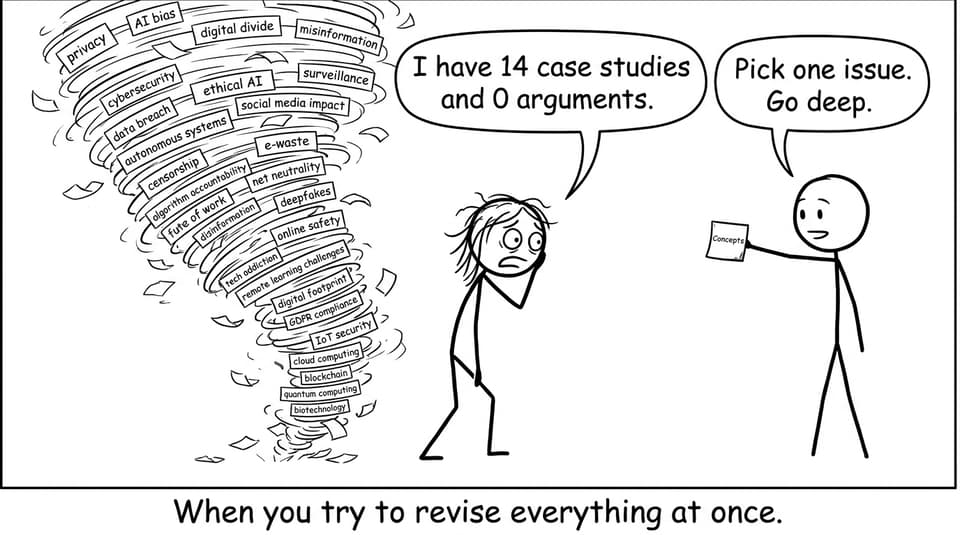
Most IB students don’t struggle because they lack opinions. They struggle because they have too many.
In IB Digital Society, the internet hands you a new controversy every hour: a data leak, an AI scandal, a platform rule change, a protest organized on an app. The course rewards the student who can slow all that noise down and turn it into analysis.
That’s the real skill: linking IB Digital Society concepts to real-world issues without turning your essay into a news recap.
Quick checklist for linking IB Digital Society to real life
-
Pick one issue and frame it with one concept (power, change, ethics, identity, systems).
-
Use a case study with a clear “before/after” so you can show impact.
-
Add two perspectives (different countries, communities, stakeholders).
-
Move from “what happened” to “so what?” in every paragraph.
-
Keep a small bank of reusable examples and update them monthly.
If you need a structured home base for this, start with IB Digital Society Resources.
Why real-world issues lift your IB Digital Society marks
Examiners reward answers that apply the course, not answers that announce it.
A real-world issue gives you evidence for claims, but more importantly it gives you something to evaluate: who benefits, who is harmed, what trade-offs are being made, and what changes over time. That’s exactly the kind of thinking built into IB Digital Society.
To make those links feel natural, it helps to know the course’s recurring lenses. If you want a fast refresher, Key Themes in IB Digital Society Explained is a useful map.
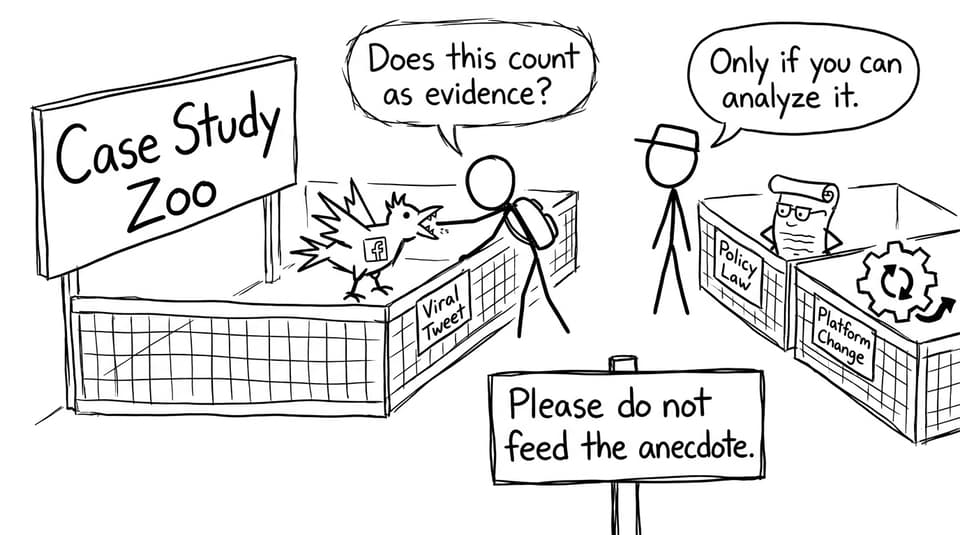
How to choose case studies that actually work
A strong IB Digital Society case study has three traits:
It matches the syllabus themes and concepts
If the concept is power, pick a case where power shifts (platform moderation, government surveillance, algorithmic ranking). If the concept is change, pick a case where a technical update reshapes behavior.
RevisionDojo’s concept breakdown on Understanding Change in Digital Society is a good example of how to turn “technology changed” into “society changed because...”.
It is recent enough to feel alive
“Recent” doesn’t mean “yesterday.” It means the impacts are still debated, so you can evaluate uncertainty, limitations, and competing interpretations.
It is global enough to compare
The same digital system lands differently across countries. That comparison is where your analysis gets sharp.
Turning a real-world issue into an exam-ready paragraph
Most students stop at description: This platform did X and people were upset.
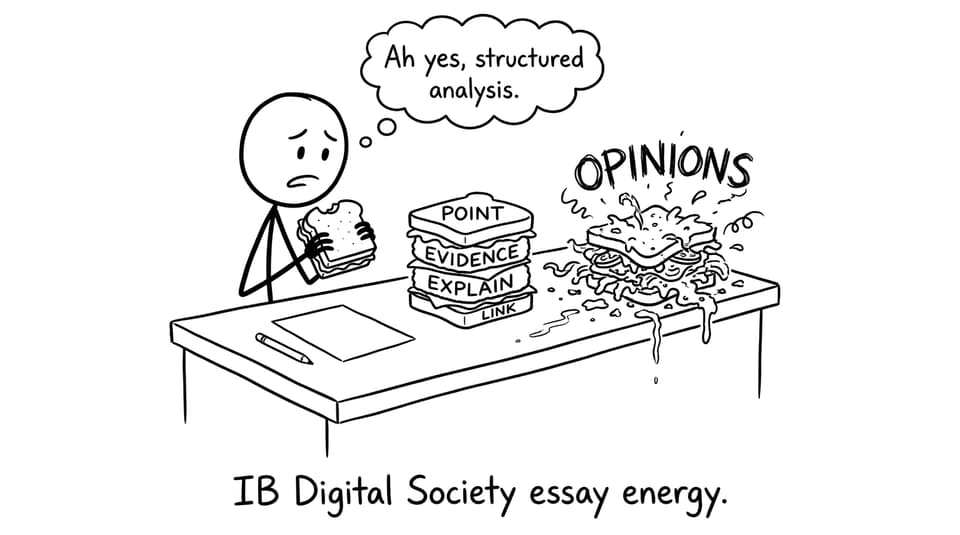
A high-scoring IB Digital Society paragraph sounds more like:
-
Point: Make a claim using the concept.
-
Evidence: Give a specific case detail (policy change, feature, law, measurable outcome).
-
Explain: Show the mechanism (how the digital system produced the impact).
-
Link: Tie back to the question and add a judgement or implication.
This gets easier when you train command terms, because the verb tells you what kind of thinking to show. Use How to Use Command Terms Effectively in IB Exams and, when you need structure under time pressure, Structure IB Answers to Maximize Marks.
Keep your links global (and your thinking ethical)
The course isn’t asking you to be cynical. It’s asking you to be precise.
When you link IB Digital Society to real-world issues, add at least one ethical angle: consent, transparency, accountability, fairness, harm, or access. Then add one global contrast: regulation differences, cultural norms, infrastructure gaps, or political context.
This habit also aligns with what the IB values across the diploma. If you want language for international-mindedness, see The IB Learner Profile Explained.
Make RevisionDojo your “case study engine”
A quiet advantage in IB Digital Society is being able to practice the same thinking repeatedly with new examples.
RevisionDojo makes that loop practical:
-
Study Notes to anchor concepts and definitions (see Digital IB Study Notes: Access Anywhere, Anytime).
-
Questionbank to practise applying concepts to unfamiliar scenarios.
-
Flashcards to keep key vocabulary and argument stems ready.
-
AI Chat to test counterarguments and stakeholder perspectives.
-
Grading tools to tighten evaluation and clarity.
-
Predicted Papers and Mock Exams to rehearse timing and structure.
-
Coursework Library and Tutors when you want feedback that’s faster than waiting for the next class.
If coursework is on your mind, How to Write a Strong IB Digital Society IA Research Question helps you turn an issue into a focused line of inquiry.
Conclusion: make the world your syllabus
IB Digital Society is one of the rare IB subjects where the real world is not a distraction -- it is the point.
Pick one issue. Anchor it in one concept. Add perspectives. Evaluate the trade-offs. Then practise the same move again and again using RevisionDojo’s Questionbank, Study Notes, Flashcards, AI Chat, and Mock Exams until “linking to real life” becomes your default exam skill.
When your arguments get sharper, the headlines get quieter. And IB Digital Society starts to feel less like chaos and more like clarity.
