If you have ever watched a rehearsal and thought, “This looks nothing like my research notes,” you are already in the real work of IB Theatre.
Because integrating world theatre traditions is not about collecting “cool techniques.” It is about borrowing a way of seeing. A different relationship to the body, to rhythm, to stillness, to the audience. When it works, your performance suddenly has a spine. When it does not, it feels like costume jewelry: shiny, unearned, and easy to spot.
In IB Theatre, examiners reward integration that is intentional, culturally aware, and clearly explained. Your job is to make your choices visible: why this tradition, why this convention, why now.
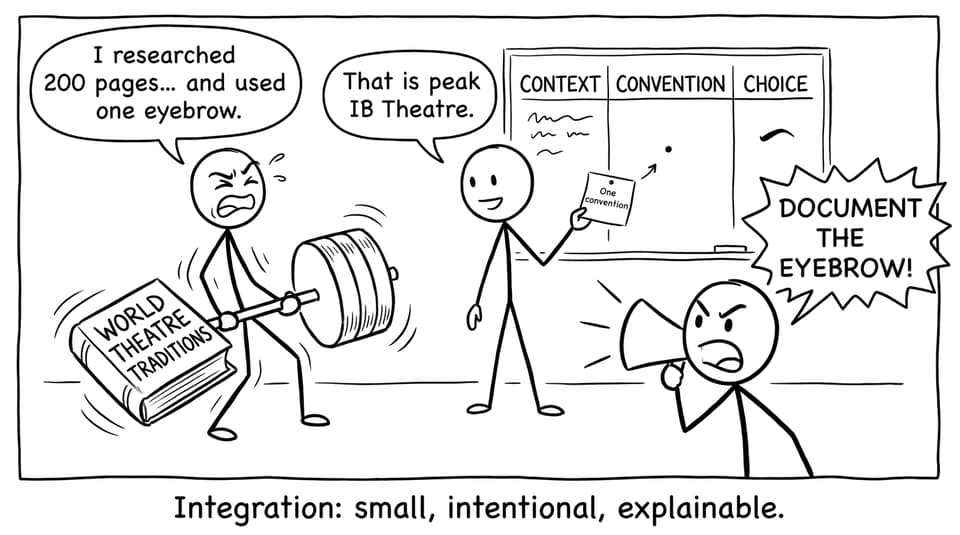
IB Theatre integration comic: the eyebrow
Quick integration checklist for IB Theatre
Use this before you rehearse, and again before you write:
Pick one world theatre tradition and define a clear focus.
Research context first (history, belief systems, audience expectations).
Select 1--2 conventions you can actually embody.
Workshop the convention physically, then adjust for your own performance intention.
Why integration matters in IB Theatre (and what examiners notice)
World theatre traditions sit at the heart of IB Theatre because the course is built on the idea that theatre is a global language with local dialects. Integration proves you can:
Move from research to practical exploration.
Show cultural awareness without flattening a tradition into stereotypes.
Make performance choices that shape meaning for an audience.
Reflect with honesty, specificity, and clear cause-and-effect.
A helpful way to think about it: examiners are not asking, “Did you use Kabuki?” They are asking, “Did Kabuki change what your audience experienced, and can you explain how?” For a deeper research mindset, borrow the workflow from Connecting Culture and Context in IB Theatre Research.
How to integrate world theatre traditions into your performance work
Start with context, not aesthetic
In IB Theatre, context is not background decoration. It is the engine.
Before you touch a mask, gesture system, chorus structure, or drumming pattern, write three short answers:
What problem did this tradition solve for its community?
What did audiences expect from performers?
What values does the performance embody (restraint, satire, ritual, hierarchy, spirituality)?
Actor--audience relationship: Direct address, shared ritual, interruption.
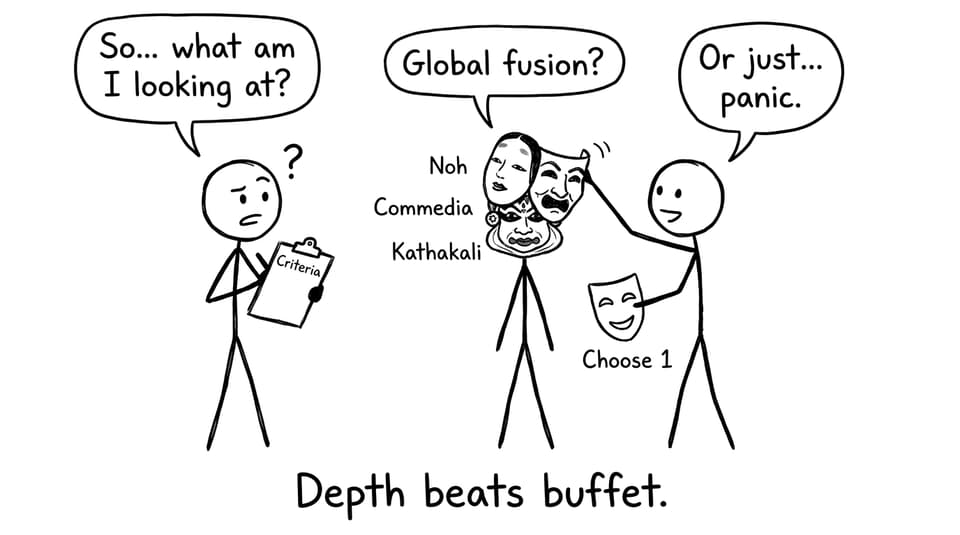
Pick 1--2 conventions and write a “because” sentence for each: I used X because it helps the audience read Y. That single sentence becomes gold later in your IB Theatre writing.
IB Theatre integration comic: too many masks
Workshop like a scientist: test, observe, revise
A common IB Theatre trap is rehearsing the convention the same way every time and calling it “exploration.” Instead, run small experiments:
Change only one variable (tempo, gaze, level, proximity).
Reflect with respect (and avoid appropriation shortcuts)
Respect is visible in details: naming origins accurately, acknowledging what you do not know, and avoiding “mix-and-match” decisions that erase meaning.
In IB Theatre, strong reflection includes:
What felt difficult to embody, and why.
What you changed to suit your own performance intention.
How your position as a learner shaped your interpretation.
What feedback revealed about audience understanding.
The hardest part of IB Theatre is not the rehearsal. It is turning rehearsal into examiner-friendly evidence.
RevisionDojo helps you do that faster:
Study Notes to lock in terminology and criteria language (Study Notes).
Flashcards for conventions, practitioners, and key vocab so you can speak precisely in reflections (IB Flashcards).
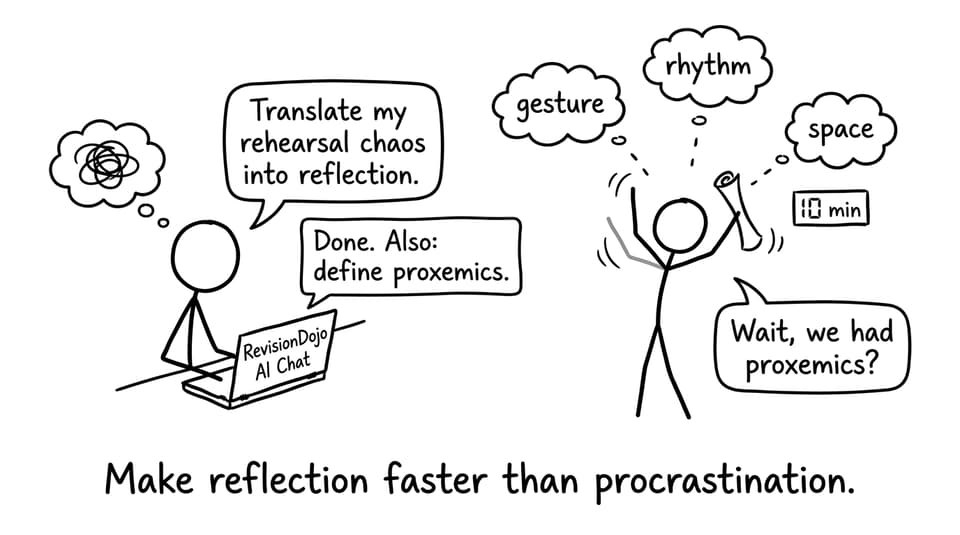
AI Chat to turn messy rehearsal notes into structured reflection drafts you can refine.
Grading tools to check whether your writing actually matches criteria.
Mock Exams and Predicted Papers to practise calm performance analysis under time pressure.
Questionbank to build consistent exam technique across the IB schedule (Questionbank).
Coursework Library and Tutors when you need examples and feedback loops that save weeks.
IB Theatre reflection comic: AI Chat vs chaos
Conclusion: make integration small, clear, and undeniable
The best integration in IB Theatre is rarely loud. It is specific. A shift in rhythm. A disciplined stillness. A coded gesture that changes how a character is read.
Do fewer things, but explain them better. Research the context, test the convention, document the change, and write reflections that connect choice to meaning. Then use RevisionDojo to tighten your language, organise your evidence, and practise with tools built for IB success.
When your world theatre tradition is not just present but purposeful, your performance stops trying to impress and starts communicating. That is where top marks live in IB Theatre.