



The night before an IB deadline, most students don’t panic because they can’t do the maths.
They panic because they can do it and still can’t explain it.
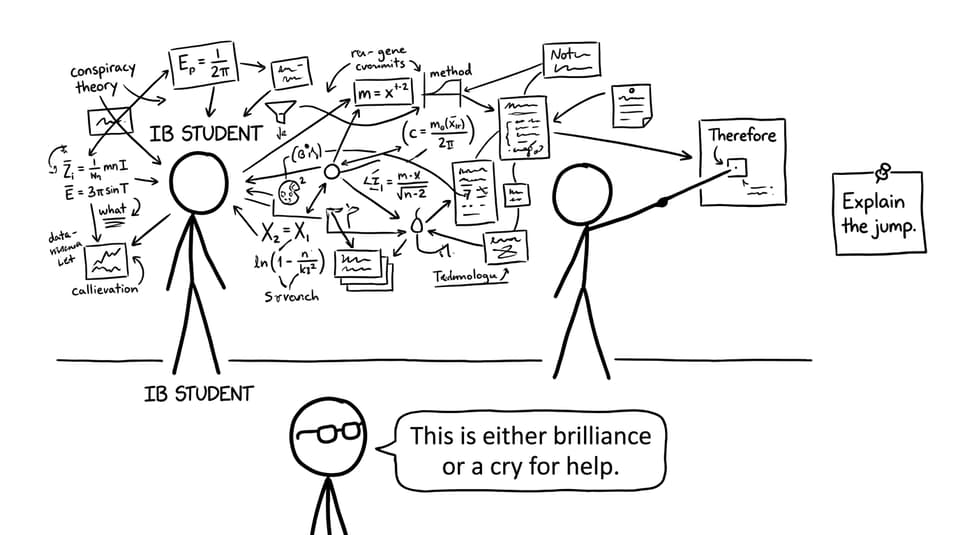
You know the feeling: your working is correct, your answer is reasonable, and yet the page reads like a private conversation between you and your calculator. An examiner doesn’t live in your head. They only see what you wrote. In the IB, that gap between “I understand it” and “I can communicate it” is where marks quietly disappear.
This guide is about closing that gap. You’ll learn how to explain calculations clearly without flattening the ideas that make them impressive. And you’ll see how RevisionDojo can turn that skill into a repeatable method: quick prompts, consistent structure, and feedback loops that sound like the IB.
A quick clarity checklist (use before any solution)
If you want a fast standard to hold yourself to in IB maths (and in sciences, economics, and any subject with quantitative reasoning), use this checklist:
-
State the goal of the calculation in one sentence.
-
Name the method (formula, model, theorem, test) and why it applies.
-
Define symbols/variables the first time they appear.
-
Show only the decision steps (the steps where reasoning happens).
-
Interpret the result in context (units, meaning, reasonableness).
-
Add one line of reflection after major results: what it implies, what it assumes, what might limit it.
When you do this consistently, your writing stops being “working” and becomes an argument. That is exactly what the IB rewards.
Why the IB cares about explanation (even when the answer is right)
The IB isn’t only assessing whether you can reach an answer. It’s assessing whether you understand why that answer follows.
That’s why so many students feel confused after getting a lower mark than expected: they assume maths is binary (right/wrong), but the markscheme often rewards reasoning, interpretation, and communication.
If you’re writing an Internal Assessment, this matters even more. Clear mathematical communication is explicitly rewarded, and reflection is not optional. If you need help aligning to what examiners look for, start with RevisionDojo’s guidance on structure and criteria:
Even if you’re studying for exams rather than writing an IA, the same principle holds: a well-explained method is easier to reproduce under time pressure. Clarity becomes a performance advantage.
The core principle: explain the “why” at the moments it changes the maths
Most students over-explain the wrong parts.
They spend lines on arithmetic anyone can follow, then skip the exact moment where a decision was made:
-
why a model was chosen,
-
why a substitution is valid,
-
why a boundary condition matters,
-
why a test is appropriate,
-
why a negative sign appears,
-
why a graph feature supports the conclusion.
If you want depth without noise, aim your explanation at the decision points. That’s where understanding lives. That’s also where IB markers decide whether you “used mathematics” or merely “did procedures.”
A structure that works for almost any IB calculation
Use this five-part template whenever you write a solution, an IA section, or a longer response. You can keep it compact, but keep the order.
Purpose (one sentence)
Say what you’re finding and why.
Example sentence stems:
-
“To estimate ___, I calculate ___ because ___.”
-
“To test whether ___ is plausible, I use ___ since ___.”
This prevents the reader from asking, “Why are we doing this?” halfway down the page.
Method (name it, then justify it)
Write the formula/model and state why it applies.
Good explanations sound like:
-
“Because the relationship appears linear, I use a linear regression model…”
-
“Since the rate of change depends on the current value, a differential equation model is appropriate…”
If you’re unsure which methods are commonly examined (or you need more practice seeing how they’re phrased), RevisionDojo’s course hubs are a clean starting point:
Substitution (define symbols, then substitute neatly)
Define variables the first time. Keep substitution readable.
A simple trick: write the general form first, then one substitution line, then a simplified line. Don’t write ten lines of calculator output.
Result (box it, units if relevant)
A reader should find your final value in three seconds.
Include units where relevant. If it’s dimensionless, say so. In IB sciences especially, unit discipline can be the difference between “looks right” and “is right.”
Interpretation + reflection (the depth line)
This is where you keep depth without drowning the page.
Add 2-4 sentences:
-
what the result means,
-
whether it is reasonable,
-
what assumption it relies on,
-
what you would check next.
That’s not fluff. That is mathematical maturity, and it reads like the IB.
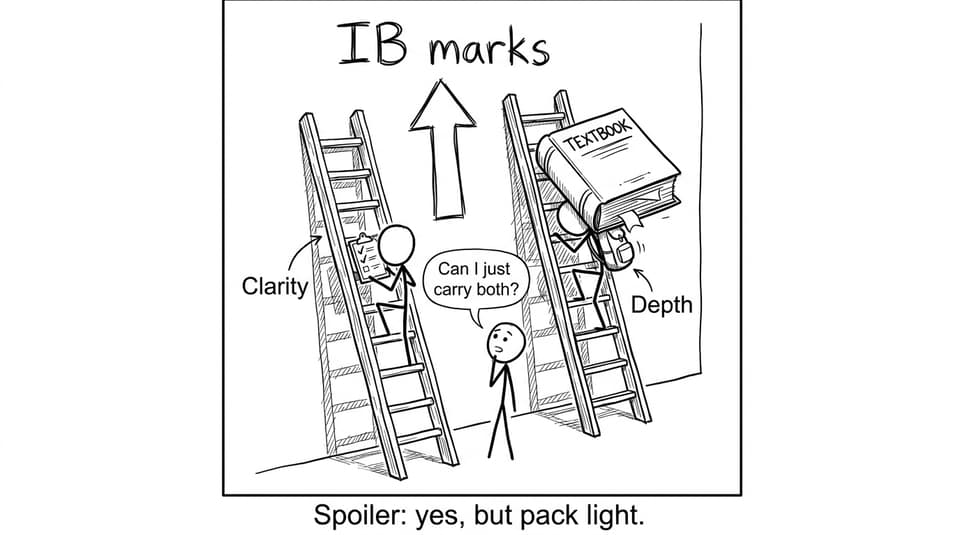
Clarity vs depth is a false trade-off (it’s really about compression)
Depth isn’t the same thing as length.
Depth is what happens when your reader sees:
-
a correct method,
-
a justified choice,
-
a coherent chain of reasoning,
-
a result that is interpreted in context.
Clarity is what happens when you compress all that into the smallest number of sentences that still preserve meaning.
The best IB students don’t write more. They write denser. Every line earns its place.
Common mistakes that make IB calculations hard to follow
Writing like a calculator log
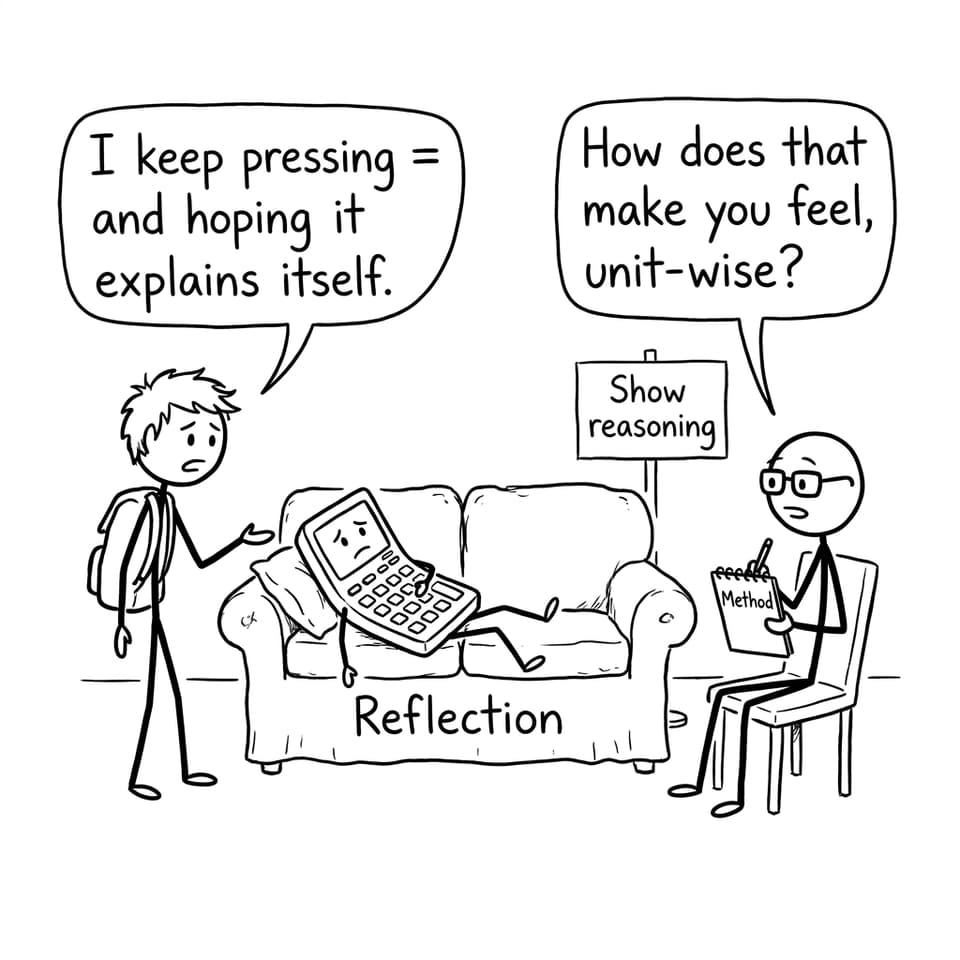
If your page is mostly equals signs, you’re asking the examiner to infer your thinking. In IB, inference is risky. Put your intention into words.
Skipping transitions
Transitions feel small, but they are the rails your reader rides.
Use phrases like:
-
“Therefore,”
-
“Hence,”
-
“Since ___, it follows that ___,”
-
“Substituting ___ into ___ gives ___.”
Not defining variables consistently
In a longer IA or extended response, inconsistent notation quietly breaks trust. If you redefine a variable, explain it clearly.
No interpretation
A final answer without meaning is just a number. The IB wants evidence that you know what you just computed.
Repeating the same explanation
If you do the same process five times, explain it well once, then summarize the repetitions.
Techniques to stay examiner-friendly under time pressure
These are small habits that scale across the IB.
Use “one sentence per decision”
Whenever you choose something (method, model, transformation), write one sentence explaining the choice. This prevents the biggest clarity gaps.
Label your equations only when they matter
Not every line needs a label. But when you will refer back later, label it. Your future self will thank you, and your examiner will too.
Replace long derivations with a roadmap
Sometimes you need advanced steps (integration methods, proof logic, regression reasoning). You can keep depth by writing a roadmap:
-
“Step 1: rewrite the expression to make substitution possible.”
-
“Step 2: apply substitution and simplify.”
-
“Step 3: evaluate bounds and interpret.”
This maintains rigor while protecting readability.
Practice explanation the same way you practice questions
Explanation is a skill, not a personality trait.
A strong IB routine is:
-
attempt a question,
-
check the markscheme,
-
rewrite the explanation in your own words,
-
reattempt a similar question.
RevisionDojo is built for that loop:
If you want a schedule that makes explanation practice automatic, use:
Using RevisionDojo to explain calculations with more confidence
Most students treat explanation as something you do at the end, when you’re tired. That’s why it reads tired.
A better approach is to build explanation into the process:
-
Study Notes help you phrase methods correctly, so you don’t invent uncertain language mid-solution. Start from Study Notes and build out.
-
Flashcards help you retain the definitions and “reasoning lines” (the short justifications that appear again and again in IB maths). If you want to systematize it, see How to Use RevisionDojo Flashcards for Formula Mastery and IB Flashcards with Spaced Repetition.
-
AI Chat is ideal for the one question students keep skipping: “What do I write between these two lines so it makes sense?” Use it to generate a single bridging sentence, not a paragraph.
-
Grading tools help you see whether your writing is aligned to criteria language. For IA work, try the IB Maths AI IA Grader.
-
Predicted Papers and Mock Exams are where you rehearse explanation under time. When you can explain clearly at speed, you’re exam-ready. Start here: IB Predicted Papers.
The point isn’t to sound fancy. It’s to sound precise, like someone who understands what they’re doing.
Closing: make your maths readable, and the IB becomes fairer
The IB can feel harsh when you know you understand something but your page doesn’t prove it. The fix is not to write more. The fix is to write with intention.
Explain the purpose, justify the method, show the key transformations, interpret the result, and add one reflection line that signals depth. Do that consistently, and your calculations stop looking like private scratch work and start reading like confident mathematical thinking.
If you want one place to build that habit, use RevisionDojo as your system: Study Notes for phrasing, Flashcards for recall, Questionbank for repetition, AI Chat for the missing sentence, Grading tools for criteria alignment, and Predicted Papers and Mock Exams for timed rehearsal. That’s how clarity becomes a score you can earn, not a personality trait you hope you have.