

Editing is the moment most IB students skip--and it’s usually the moment that would have lifted their IA into the top band.
You finish the analysis. You’ve got graphs. The conclusion feels believable. Your brain is fried. So you export a PDF and call it done.
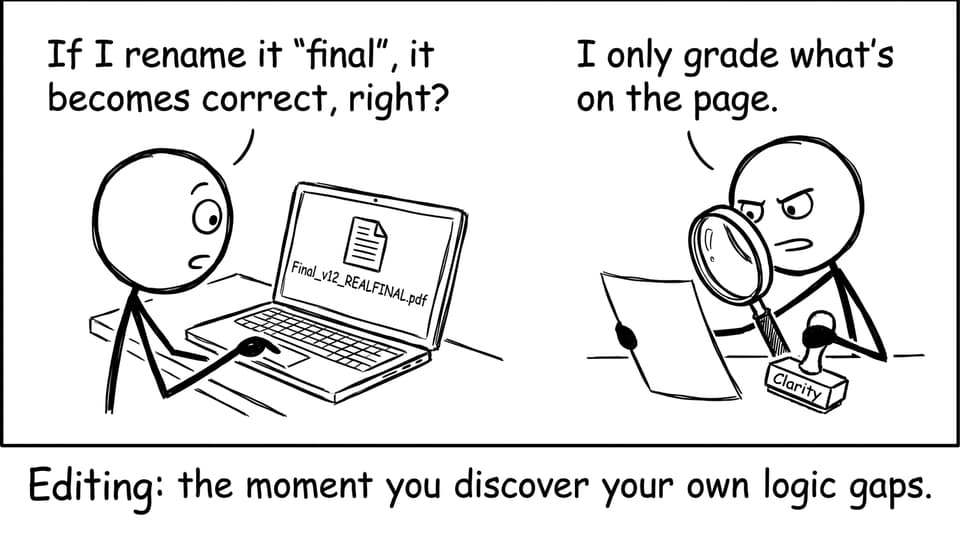
But an examiner doesn’t read your effort. They read your pages. They don’t see the late nights, the reruns of the same calculation, the panic Google searches. In the IB, marks arrive when your thinking is visible, organised, and easy to follow.
So the real question is simple: can your IA survive being read quickly by someone who has seen hundreds like it?
Quick checklist: edit your IA like an IB examiner
Before you start rewriting paragraphs, run this fast, examiner-style sweep:
-
Your full draft is complete (not half-written “placeholders”).
-
You have the subject criteria or rubric open beside your document.
-
Each section has a clear purpose and links to your research question.
-
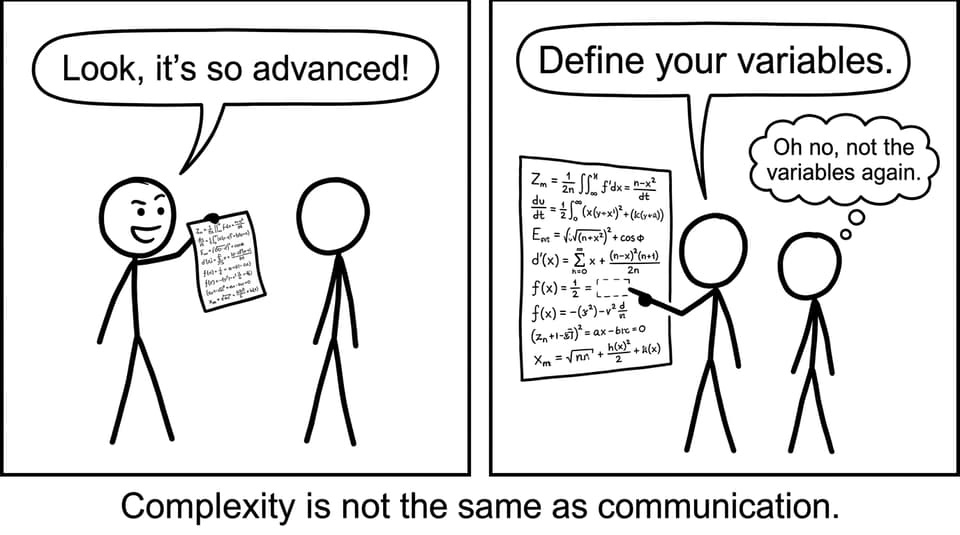
Variables, methods, and assumptions are defined the first time they appear.
-
Every table/graph has a label, unit, and a sentence explaining what it shows.
-
You’ve checked calculations, rounding, and consistency.
-
You’ve added reflection that explains impact, not just “limitations exist.”
-
You’ve proofread formatting, citations, and final PDF export.
If you want a single hub for coursework expectations across the IB, start with IB IA Guides: Internal Assessment Structure, Rubrics & Tools.
Why editing like an examiner changes your IB grade
An examiner’s job is not to admire your topic. It’s to award marks against criteria. That means they’re scanning for evidence:
-
Clear structure (they should never get lost).
-
Mathematical or subject communication that is consistent and defined.
-
Reasoning that flows from question to method to results to conclusion.
-
Reflection that shows you understand what your results mean and what they don’t.
-
Accuracy and presentation that build trust.
This is why editing is not “fixing typos.” Editing is making your work easier to award marks to.
If you haven’t already, read What IB Examiners Look for in a Strong IA to calibrate what “good” looks like in examiner language.
Do the first read like you’ve never seen your IA before
Here’s the uncomfortable trick: pretend you’re a stranger.
Open your IA and read the introduction and the first two pages only. Stop there. Ask:
-
Do I understand the aim without guessing?
-
Do I know what each variable or term means?
-
Would I be able to explain the logic of the approach to someone else?
-
Does each paragraph move forward, or does it wander?
In the IB, confusion is expensive. Examiners don’t email you for clarification. They just move on.
A useful way to force honesty is to paste a paragraph into RevisionDojo’s AI Chat and ask: “What is the purpose of this paragraph, in one sentence?” If the answer sounds vague, your writing is probably vague too.
Edit with the IB criteria in front of you (not in your memory)
Most students “feel” like their IA is aligned. Examiners check.
Your second pass should be criteria-first. Keep the rubric visible and work section by section:
Presentation: make the document effortless to navigate
An examiner should be able to skim your headings and understand the whole investigation.
-
Headings are consistent and meaningful.
-
Tables and figures are numbered and titled.
-
You introduce every visual before it appears and interpret it after.
-
The layout still works in grayscale and in PDF form.
If your IA is drifting long, trimming is often an editing win, not a content loss. Use Can an IA Be Too Long? as a practical diagnostic.
Communication: define, label, and stay consistent
This is where IB examiners quietly take marks.
-
Define variables at first use.
-
Use one symbol per quantity (don’t switch halfway).
-
Put units everywhere they belong.
-
Keep equation steps readable (one main move per line).
-
Explain what the math means in words, not just what you did.
Personal engagement: show ownership without over-sharing
Engagement is not a diary entry. It’s evidence that you made choices and understood them.
Try adding short, calm sentences like:
-
“I chose this model because it matches the behaviour seen in the scatterplot and allows interpretation of parameters.”
-
“After testing X, I rejected it because residuals suggested a non-linear relationship.”
That kind of voice signals control--which is exactly what the IB wants.
Reflection: turn “limitations” into examiner-ready evaluation
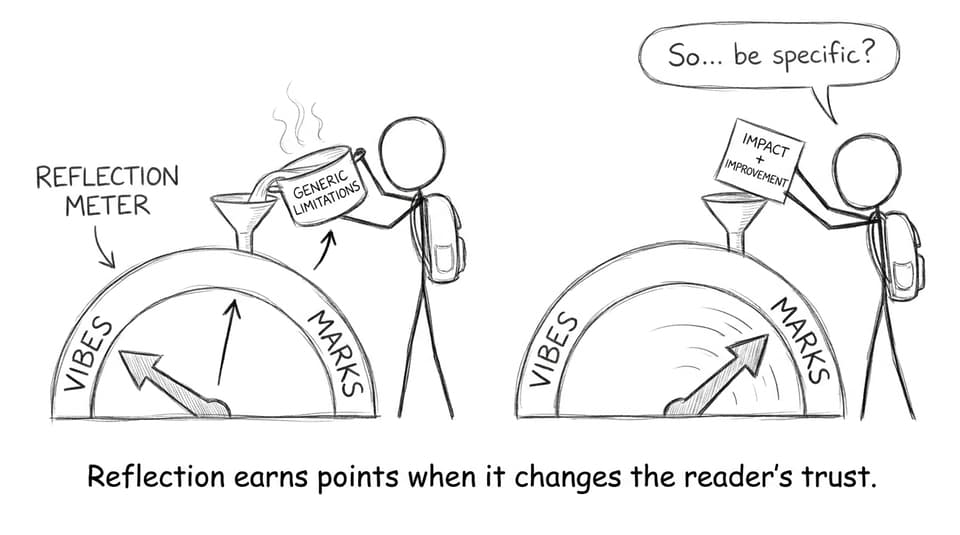
A common IB weakness is reflection that sounds like a template: “Human error may have affected results.” True, but empty.
Instead, make reflection do three jobs:
-
Identify a limitation.
-
Explain its impact on the conclusion.
-
Offer a realistic improvement or alternative method.
For a deeper model of what strong evaluation looks like, use How to Write a Compelling IA Evaluation Section.
Make your clarity “markable”: the examiner’s three questions
When an examiner is reading fast, they are unconsciously asking three questions:
What are you trying to find out?
If your research question or aim is buried in paragraph three, bring it forward. Put it in the first few lines and echo it in your conclusion.
If you’re still unsure whether your question is sharp enough, the broader coursework context at IB Internal Assessment: A Complete Guide helps you pressure-test feasibility.
Why does each step exist?
Many IAs describe steps but don’t justify them. Editing is where you add the “because.”
-
“I used this interval because it balances smoothness with sensitivity to noise.”
-
“I excluded this outlier because it was caused by a measurement fault, not the system studied.”
Those sentences are small, but they read like examiner-aware thinking.
What does this result mean?
If your results section is heavy on visuals and light on interpretation, you’re giving away marks.
A quick fix: after every major result, add 2--3 lines:
-
State the pattern.
-
Explain what it implies.
-
Link back to the research question.
If you want to train this skill, read What Real Analysis Looks Like in an IB IA.
Verify accuracy like you’re trying to disprove yourself
This is the examiner mindset that separates solid from excellent: assume something is wrong until you confirm it.
Do a dedicated “accuracy pass”:
-
Recalculate key values independently.
-
Check rounding (don’t round early and then build conclusions on it).
-
Ensure graph axes match units in the text.
-
Make sure symbols match the calculator/software output.
-
Confirm captions actually describe the correct figure.
In RevisionDojo, you can pair this with Grading tools to get rubric-aware feedback quickly, then use AI Chat to ask: “Where would an examiner doubt my reasoning?”
The final polish pass: citations, formatting, and the PDF test
Polish is not decoration. It’s trust.
-
Fonts and spacing are consistent.
-
Equations are readable and not cut off.
-
Page numbers work.
-
Your bibliography is consistent.
-
In-text citations match the reference list.
If citations are a weak point, use How to Cite Sources Correctly in Your IA and then do one last scan for missing references.
How RevisionDojo helps you edit like an IB examiner
Editing is easiest when you have a system, not just motivation.
RevisionDojo is built around the same loop high scorers use in the IB: draft, check against criteria, fix what costs marks, and repeat.
Here’s how the platform naturally supports an examiner-style edit:
-
Coursework Library to compare your structure to strong exemplars.
-
Grading tools to get criterion-aligned feedback and spot gaps quickly.
-
AI Chat to test clarity (“Is this explanation sufficient for a reader with no context?”).
-
Study Notes and Flashcards to tighten subject understanding while you edit (so your writing becomes more confident).
-
Tutors when you need human feedback on argument flow and communication.
And when coursework is done, you can switch gears into exam preparation without losing momentum: Questionbank, Mock Exams, and Predicted Papers help you keep the rest of your IB performance rising while your IA gets finalised.
If you want to build a broader performance loop after your IA is submitted, RevisionDojo App: The Smarter Way to Prep for IB Exams shows how the tools connect.
Closing: the IB reward is clarity you can prove
Most students think the IB rewards intelligence. It does, but in a specific form: intelligence that’s legible.
Editing your IA like an examiner is how you translate effort into marks. You make the logic easier to follow. You remove ambiguity. You prove accuracy. You add reflection that changes the reader’s confidence in your conclusion.
When you’re ready to do that systematically, use RevisionDojo to run the same loop examiners live by: criteria-first feedback with Grading tools, fast clarity checks with AI Chat, exemplar comparisons in the Coursework Library, and ongoing support from Tutors. Then take the same discipline into exams with Study Notes, Flashcards, the Questionbank, Mock Exams, and Predicted Papers.
The final draft isn’t the one you finish. It’s the one an examiner can’t misunderstand.