



Stress in IB Sciences rarely arrives with drama. It usually shows up quietly: a lab report tab you stop opening, a formula sheet you keep meaning to rewrite, a growing sense that Biology, Chemistry, and Physics are all asking for 110% at the same time.
Then one day you sit down to revise, and your brain does that unhelpful thing where it remembers everything you haven’t done instead of what you can do next.
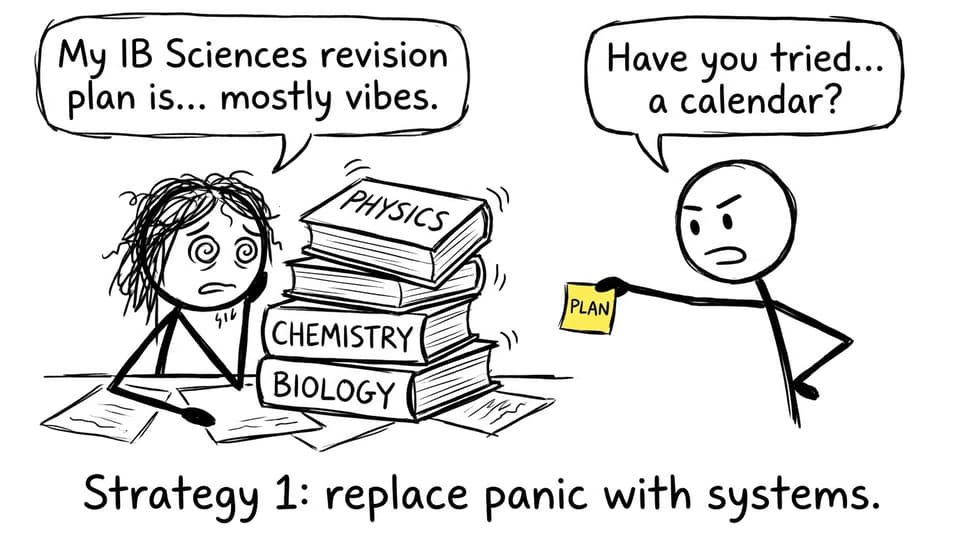
This is the trap with IB Sciences: the workload is real, but the stress often comes from feeling like you need a perfect plan before you start. You don’t. You need a small system that makes progress inevitable.
A quick checklist to calm IB Sciences stress
Use this as a simple reset when IB Sciences start to feel heavy:
-
Pick one topic (not the whole subject)
-
Do 10-15 minutes of recall (Flashcards or self-quizzing)
-
Do 10 exam-style questions (timed if possible)
-
Review mistakes and write one rule for next time
-
Plan the next session in 60 seconds
If you want everything in one place, RevisionDojo makes this loop easy with Study Notes, Flashcards, Questionbank, AI Chat, Grading tools, Predicted Papers, Mock Exams, a Coursework Library, and Tutors.
Why IB Sciences feel uniquely stressful
IB Sciences combine three pressures that stack on top of each other:
-
Concept load (big ideas with tricky definitions)
-
Application (data, calculations, unfamiliar contexts)
-
Deadlines (labs, write-ups, internal assessments)
The stress isn’t a sign you’re “bad at science.” It’s often a sign that your revision style is too passive or too vague for the kind of performance IB Sciences demand.
When you shift to shorter, more specific practice loops, your brain gets evidence. And evidence is calming.
9 practical strategies to deal with stress in IB Sciences
Strategy 1: Replace “study science” with a one-line next action
Most IB Sciences stress comes from tasks that are too large to start.
Try this instead: write a next action you can complete in 10 minutes.
Examples:
-
“Do 8 multiple-choice questions on periodicity.”
-
“Rewrite the definition of natural selection and test it without looking.”
-
“Solve 3 kinematics questions and check units.”
When you need a topic hub to make that next step obvious, start from RevisionDojo’s subject pages for IB Biology resources, IB Chemistry resources, and IB Physics resources.
Strategy 2: Time-box revision with the Pomodoro rhythm
If your brain doesn’t trust there’s an end, it resists beginning.
Use 25 minutes focused + 5 minutes break. Or 40 + 10 if you prefer. The exact numbers matter less than the promise: you can stop soon.
Pair the timer with one concrete task: a question set, a flashcard session, a single subtopic.

Strategy 3: Keep one “science inbox” to stop mental clutter
Stress multiplies when your notes are everywhere: photos, random docs, half-finished summaries.
Make one place for each subject:
-
One folder for notes
-
One folder for IA/lab data
-
One running “error log” document
Then keep your learning tight: clarify with notes, lock memory with Flashcards, and apply with questions.
For structured learning pages that reduce overwhelm, explore the IB Notes hub.
Strategy 4: Study by mistake pattern, not by chapter
In IB Sciences, it’s rarely “I don’t know anything.” It’s usually one of these:
-
You misread command terms (state vs explain vs evaluate)
-
You miss units or significant figures
-
You can recall facts but can’t apply them to data
After every practice set, write one sentence:
“Next time I will…”
That single sentence turns stress into a plan.
Strategy 5: Use active recall daily (even when you’re tired)
Active recall is the closest thing to honest feedback.
The trick is making it small enough to do consistently:
-
8-12 minutes of Flashcards
-
5 definitions
-
2 diagrams from memory
If you need help building the habit, use RevisionDojo’s Flashcards feature alongside the guide on how to use flashcards for IB Biology revision. The principle works across IB Sciences.
Strategy 6: Turn IA and lab stress into a template
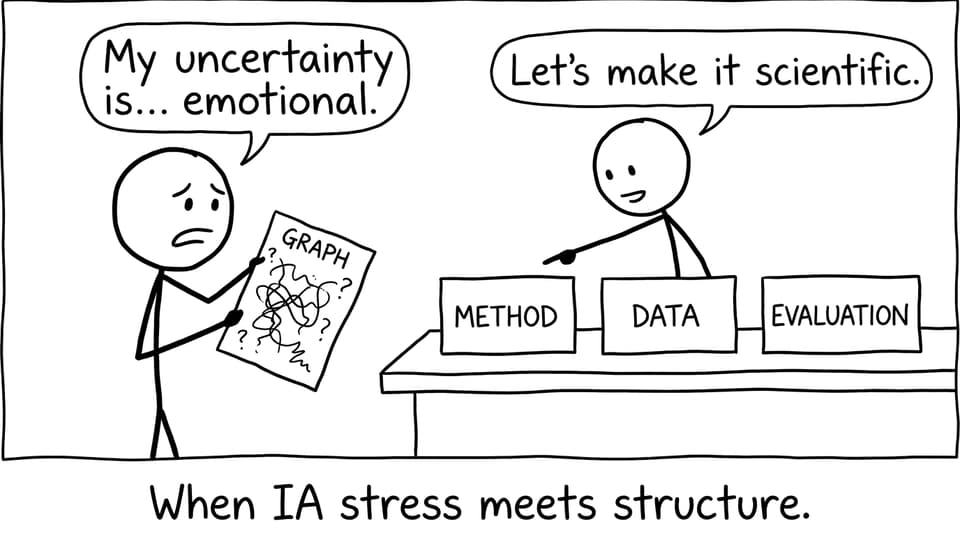
IA stress often feels emotional because the task is open-ended. Structure removes that fog.
When you’re stuck, force the work into three boxes:
-
Method (what you did, clearly)
-
Data processing (what you calculated, with uncertainty)
-
Evaluation (limitations, improvements, validity)
You’re not trying to write something “beautiful.” You’re trying to write something that scores.
RevisionDojo’s Coursework Library and Grading tools are built for this kind of structured feedback loop: you draft, you get criterion-aware guidance, you improve.
Strategy 7: Practice exam-style questions early (not at the end)
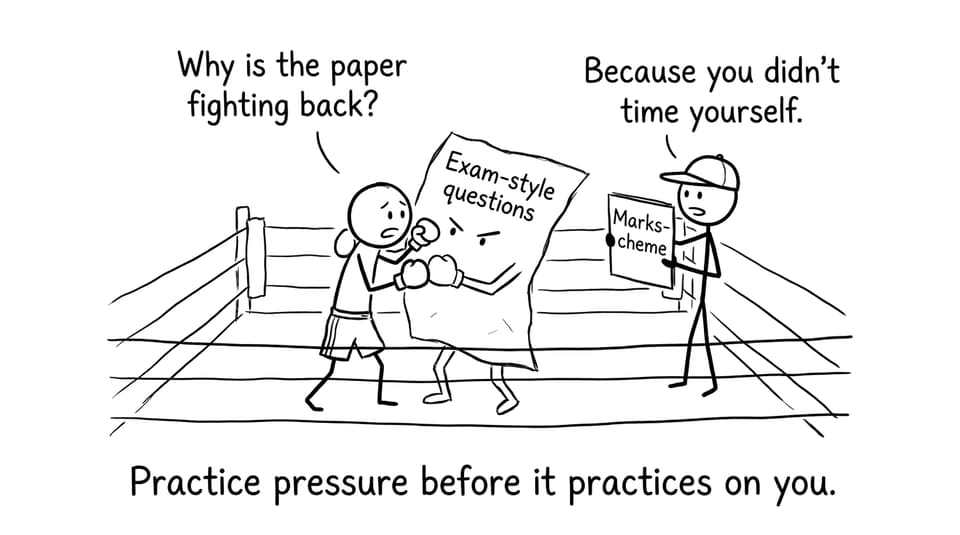
Confidence in IB Sciences comes from exposure to the style of questions you’ll face.
That means:
-
Do small timed sets
-
Mark carefully
-
Redo the same question type 48 hours later
For Chemistry, you can drill focused sets like IB Chemistry Periodicity Questionbank. For Physics foundations, a reliable anchor is IB Physics A.1 Kinematics Notes.
Strategy 8: Build understanding, not just memory
Memorization helps, but IB Sciences punish memorization without meaning.
Try this “why ladder”:
-
What is the definition?
-
Why does it happen?
-
What data would show it?
-
How could IB ask it in a new context?
When you want a clear, syllabus-aligned overview that keeps concepts connected, use RevisionDojo’s guide: Complete guide to IB Biology.
Strategy 9: Ask for help earlier than feels necessary
Waiting to ask for help is a stress strategy that fails slowly.
Two better options:
-
Use AI Chat to get unstuck in the moment (one precise question, not “explain everything”)
-
Use Tutors when you need deeper correction on your thinking patterns
If you want a full workflow that ties support tools together, read How to study for IB exams without burning out.
Mini routine: a 45-minute stress-proof IB Sciences session
Use this when IB Sciences feel loud and you need a calmer plan.
-
10 min: Study Notes on one micro-topic
-
20 min: Questionbank set (timed)
-
10 min: review mistakes + write 2 flashcards
-
5 min: plan tomorrow’s micro-topic
This is exactly the loop RevisionDojo is designed to support across IB Sciences: Study Notes, Flashcards, Questionbank, AI Chat, Grading tools, Predicted Papers, Mock Exams, Coursework Library, and Tutors.
Closing: make IB Sciences calmer by making them smaller
The most effective way to deal with stress in IB Sciences isn’t motivation. It’s precision.
Make tasks smaller. Make practice more frequent. Make feedback immediate. When you do that, anxiety stops being a fog and becomes information you can use.
If you want one platform that turns that approach into a routine, use RevisionDojo’s Questionbank, Study Notes, Flashcards, AI Chat, Grading tools, Predicted Papers, Mock Exams, Coursework Library, and Tutors to build calm progress in IB Sciences, one focused session at a time.