


If you have ever stared at a clean equation and thought, “This is beautiful… but what does it do out there in the messy world?”, you are already standing at the edge of a strong IB Math IA.
Examiners do not reward an IA because it uses advanced-looking symbols. They reward it because the mathematics explains something real, and you can show that bridge clearly: context (\rightarrow) model (\rightarrow) testing (\rightarrow) interpretation (\rightarrow) reflection. That is the heart of a high-scoring IB exploration, and it is also the mindset that makes exam revision feel less like memorising and more like understanding.
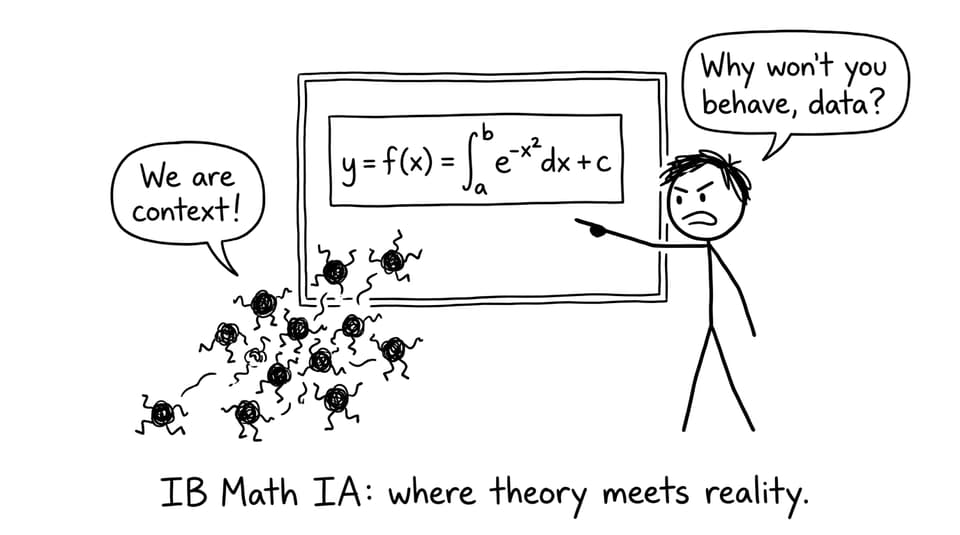
A quick IB-ready checklist for connecting theory and reality
Use this as your pre-flight check before you commit to pages of algebra:
-
Choose a real-world situation you can describe in plain language.
-
Pick a mathematical theory that genuinely fits that situation (not just one you like).
-
State assumptions early, and keep them consistent.
-
Define variables with units and meaning in context.
-
Use real or simulated data to test your model.
-
Translate every key result back into the real-world story.
-
Evaluate fit, limitations, and how the model could be improved.
If you want a structure that examiners can follow without effort, borrow the flow from How to Structure Your IB Math IA Logically and keep it beside your draft.
Start from the world, then invite the IB math in
A common IB trap is starting with a formula and then hunting for something, anything, it could apply to. That usually creates an IA that feels “math-first” and context-second.
Flip it.
Write three sentences about a real behaviour you can observe:
-
a ball’s path changes predictably after it leaves a hand,
-
a population grows quickly and then slows,
-
demand rises until price pushes buyers away,
-
noise levels spike at certain times of day.
Then ask: what feature of this behaviour should my mathematics explain? Peak? Rate of change? Long-term limit? Best-fit relationship? Once you know the feature, the theory becomes an honest tool rather than decoration.
For step-by-step guidance on getting your IA moving (especially for AI), use IB Math AI Internal Assessment: Step-by-Step Guide alongside the examiner-facing guidance in IB IA Guides.
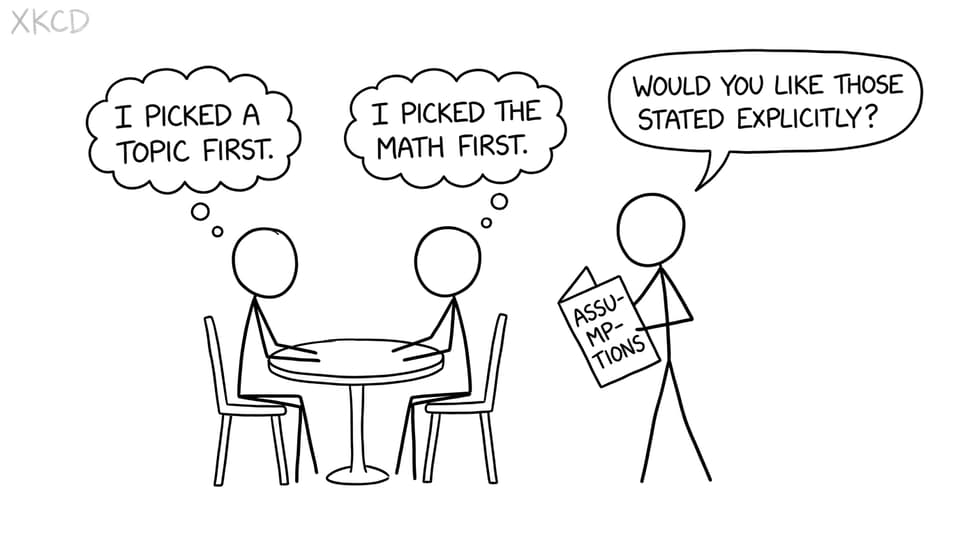
Choose mathematical theory that can carry real weight
In an IB Math IA, “theory” does not mean a long textbook proof. It means: you understand where the model comes from, what each parameter represents, and why it makes sense for your context.
A few reliable pairings:
-
Quadratic / trig modelling for projectile motion or arcs.
-
Exponential vs logistic models for growth with constraints.
-
Derivatives and optimisation for “best” decisions (profit, distance, time).
-
Logarithms for scales like sound intensity or earthquake magnitude.
-
Statistics and regression when the real world is noisy and you need evidence, not certainty.
If you are unsure how examiners judge “appropriate mathematics,” read the AA criteria breakdown: Unpacking the IB Math IA Assessment Criteria. That page helps you aim for the right depth without overcomplicating.
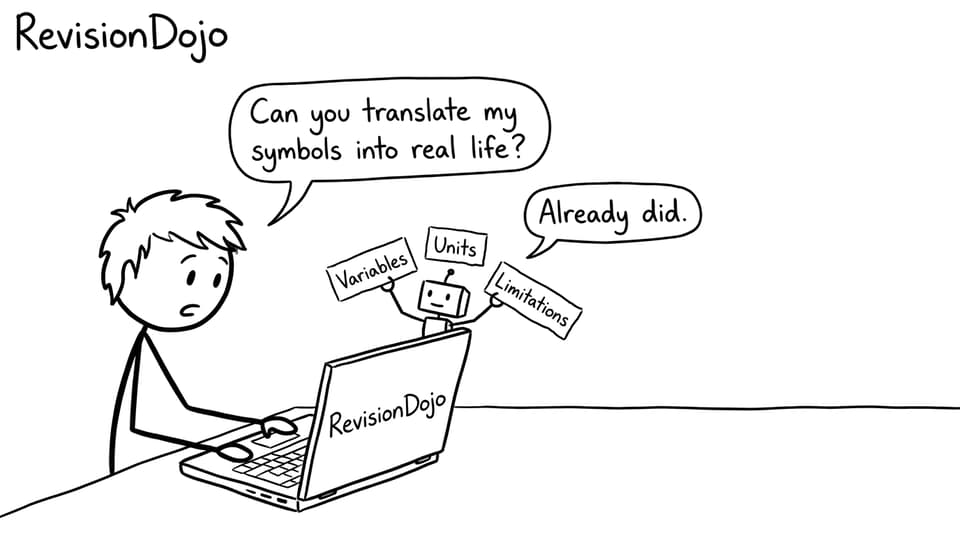
Map variables to reality like you are translating languages
This is where many IB IAs quietly lose marks: symbols appear, but the reader is not told what they mean.
A strong variable map looks like this:
-
(t) = time in seconds (measured from the moment the object is released)
-
(h(t)) = height in metres (measured from ground level)
-
(r) = growth rate per day (estimated from early data)
-
(K) = carrying capacity (interpreted as maximum sustainable population)
Then do one more thing that feels small but is powerful: explain which variables are measured, which are estimated, and which are assumed. That one sentence signals maturity to an IB examiner.
When you get stuck on phrasing or units, RevisionDojo’s AI Chat is ideal for quick clarity checks (for example: “Is this parameter interpretation consistent?”). And if you are training your general math precision for exams at the same time, pair your IA work with the targeted drills in the Questionbank on your strand: IB Mathematics Analysis and Approaches Resources.
Use data to test the theory, not to decorate it
You do not need a perfect dataset. You need a dataset that lets you evaluate your model.
Three practical IB options:
-
Primary data: you collect it (great for personal engagement, but time-consuming).
-
Secondary data: sourced from reputable datasets (efficient, but cite carefully).
-
Simulated data: acceptable when real collection is unrealistic, as long as assumptions are explicit.
The key is what you do next: show the mismatch as well as the match. Real-world modelling is rarely exact. A graph with residuals or an error measure (percentage error, RMSE, etc.) gives you something to discuss in reflection.
For a deeper workflow on this part, use How to Use RevisionDojo to Prepare for IB Math IA Data Analysis. It pairs well with RevisionDojo’s Study Notes and Flashcards because you can learn a method, memorise the key interpretation lines, and apply them immediately.
Interpret results in real terms (the examiner is waiting for this)
A clean derivative or regression output is not the finish line. In an IB Math IA, it is the moment you must translate back.
Examples of strong interpretation sentences:
-
“The maximum of (h(t)) occurs at (t=1.24) s, meaning the object reaches peak height about 1.24 seconds after release.”
-
“The logistic model suggests growth slows significantly once the population reaches about 80% of (K), which matches the flattening in the observed data.”
-
“The optimal price from the derivative test is $7.50, but this assumes demand remains linear outside the observed range, which may not hold.”
Notice what these do: they give the maths meaning and open a door for evaluation.
If you want to see what that tone looks like in real submissions, use Using IA/EE Exemplars to Improve Your IB Math IA and browse course-specific examples like IB Maths AI IA Examples.
Reflection: where IB theory meets honesty
Reflection is not apologising for imperfections. Reflection is showing that you understand why imperfections appear.
Useful prompts:
-
Which assumption most affected the result?
-
What variable did I treat as constant that is not constant in real life?
-
Where does the model fit well, and where does it systematically fail?
-
What extension would improve realism without exploding complexity?
This is also where RevisionDojo’s Grading tools help: you can check your draft against criterion language early, not at the end, and fix the missing reflection before it becomes structural.
Closing: make IB math feel like it belongs in the world
The best IB Math IAs do something quietly powerful: they take an idea that looks abstract on paper and show how it behaves when it meets friction, noise, and real constraints. That is the same skill you need for exams too, not just knowing methods, but knowing when and why they apply.
If you want the fastest path from “I have an idea” to “this reads like a top-scoring exploration,” build your workflow around RevisionDojo: use the Coursework Library and IA Guides for structure, Exemplars for standards, AI Chat for clarity, Grading tools for rubric alignment, and the Questionbank, Mock Exams, and Predicted Papers to keep exam prep moving in parallel.
Your IA is not a separate project from exam success. Done well, it is your most personal proof that you can make IB mathematics explain the world.