


Molarity is the kind of simple idea that becomes stressful only when the clock starts. You sit down with an IB Chemistry question, read “250 cm³,” and your brain immediately hears: trap. Not because the chemistry is hard, but because the exam rewards calm unit handling more than heroic memorization.
In IB Chemistry, molarity is the quiet bridge between what you can measure (mass, volume, burette readings) and what you must calculate (moles, ratios, concentrations). Once you can calculate molarity reliably, titrations, equilibria, kinetics, and acids and bases stop feeling like separate topics and start feeling like the same story told with different characters.
What molarity means in IB Chemistry
Molarity (also called concentration, symbol c) is:
moles of solute per volume of solution in dm³
The core relationship you use again and again in IB Chemistry is:
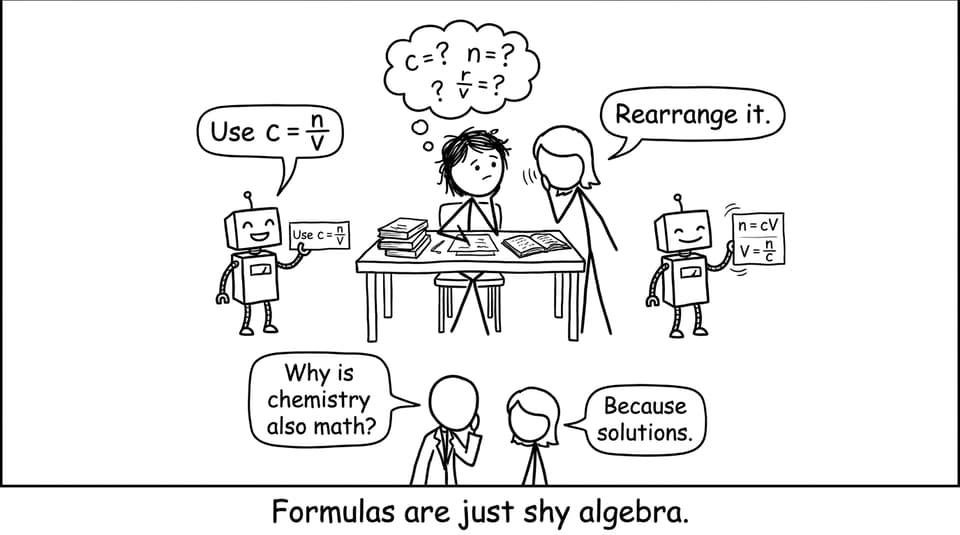
c = n / V
Where:
-
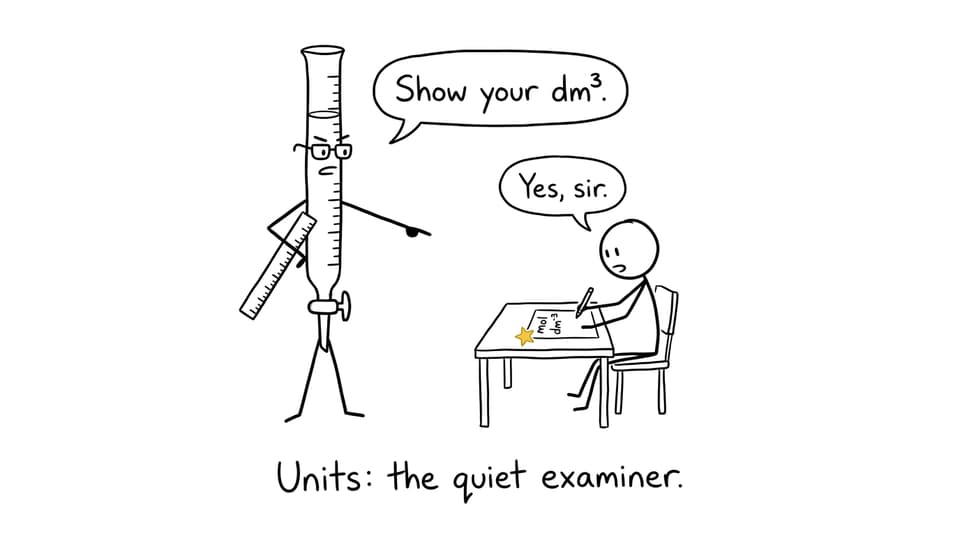
c = concentration in mol dm⁻³
-
n = amount in mol
-
V = volume in dm³
If you want a quick refresher on the IB unit expectations, this breakdown helps: What Is the Unit for Concentration in Chemistry? IB Chemistry Explained.
A quick molarity checklist (the exam-proof version)
Before you touch your calculator, run this checklist:
-
Do I have moles (n)? If not, can I get them from mass or another concentration?
-
Is the volume in dm³ (not cm³)?
-
Am I using c = n/V (or a rearrangement) with consistent units?
-
Have I left rounding until the end?
When you practice these steps with exam-style prompts, it becomes automatic. RevisionDojo’s IB Chemistry Questionbank is built for exactly that kind of repetition.
How to calculate molarity step by step (IB Chemistry method)
Find moles of solute (n)
In IB Chemistry, moles usually come from one of three routes:
From mass
-
n = m / M
-
mass in g, molar mass in g mol⁻¹
If you’re shaky on mole conversions, pair this with RevisionDojo notes on the mole concept: Counting Particles by Mass: The Mole (Notes).
From another solution
- n = c × V
From particles
- n = particles / Nₐ
Convert volume into dm³
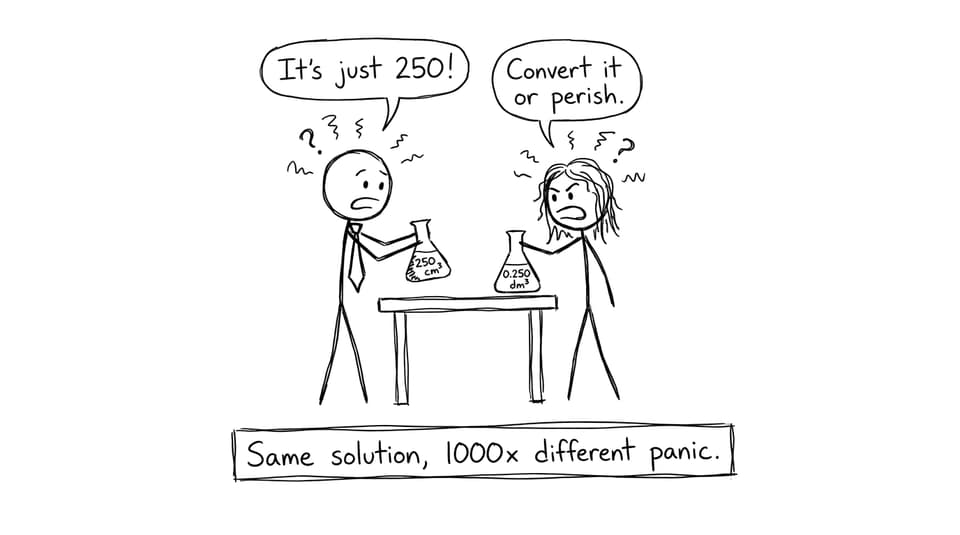
This is the most common IB Chemistry concentration error.
Remember:
-
1 dm³ = 1 L
-
1000 cm³ = 1 dm³
So:
-
250 cm³ = 0.250 dm³
-
25.0 cm³ = 0.0250 dm³
Apply c = n/V
Once n is in mol and V is in dm³:
- c = n / V gives molarity in mol dm⁻³
Worked IB Chemistry example (the one you’ll actually see)
Question: What is the molarity of a solution made by dissolving 4.00 g NaOH and making up to 250 cm³?
Step 1: moles
-
M(NaOH) = 40.0 g mol⁻¹
-
n = 4.00 / 40.0 = 0.100 mol
Step 2: volume in dm³
- 250 cm³ = 0.250 dm³
Step 3: molarity
- c = 0.100 / 0.250 = 0.400 mol dm⁻³
This is classic IB Chemistry: clean numbers, clean marks, and a big penalty if you skip the cm³ to dm³ conversion.
Rearranging molarity (because IB Chemistry loves it)
You’re not always asked to calculate c. Sometimes the question hides it in reverse.
Rearrangements:
-
n = cV
-
V = n/c
The best way to make these feel natural is to practice mixed-format problems. RevisionDojo’s IB Chemistry hub pairs Study Notes, Flashcards, and Grading tools so you can spot which rearrangement you needed after the fact and fix it fast.
Molarity in dilution questions
Dilution in IB Chemistry is mostly a conservation story: moles stay the same, but volume changes.
Use:
- c₁V₁ = c₂V₂
Example: 5.00 cm³ of 2.0 mol dm⁻³ diluted to 100 cm³
-
Convert volumes consistently (cm³ works if both are cm³)
-
c₂ = (2.0 × 5.00) / 100 = 0.10 mol dm⁻³
This dilution logic shows up again in acids and bases and pH work, where concentration drives hydrogen ion values. Related reading: pH and the hydrogen ion concentration (Notes).
Where molarity appears most in IB Chemistry
If you want to revise strategically, molarity links directly into:
-
Titration calculations and equivalence logic: Titration Explained Step-by-Step and Equivalence Point Explained for IB Titrations
-
Indicators and endpoints: How Acid-Base Indicators Work
-
Stoichiometry in solutions (moles from cV, then mole ratios)
Common molarity mistakes (and how to stop making them)
-
Forgetting cm³ to dm³ conversion (the 1000x disaster)
-
Using mass directly in c = n/V (you must convert to moles first)
-
Wrong species in stoichiometry (calculate moles from the balanced equation, not vibes)
-
Rounding early and drifting away from the markscheme value
In RevisionDojo, students often fix these fastest by doing timed sets in the Questionbank, then checking mistakes with AI Chat and the Grading tools to see exactly where units or ratios slipped.
Conclusion: make molarity your calm advantage in IB Chemistry
In IB Chemistry, molarity is less about memorizing a formula and more about building a habit: get moles, get dm³, then use c = n/V with clean units. Once that habit is solid, dilution, titration, and stoichiometry questions stop feeling like separate battles.
If you want to turn this into marks quickly, use RevisionDojo as your system: hit the IB Chemistry Questionbank, reinforce with Study Notes and Flashcards, then pressure-test yourself with Mock Exams and Predicted Papers. When you get stuck, AI Chat and the Coursework Library help you close gaps without wasting revision time. IB Chemistry rewards consistency, and molarity is where consistency starts.