

In the lab, the most dramatic chemistry often happens without a sound.
One moment your conical flask looks completely ordinary. The next, it flips to pink, orange, or green as if it just received a secret message. That tiny color change is one of the most testable ideas in IB Chemistry: acid--base indicators. They look like magic, but they behave like a well-trained equilibrium.
This post explains how acid--base indicators work, why they change color over a range (not one exact pH), and how to pick the right one for a titration question.
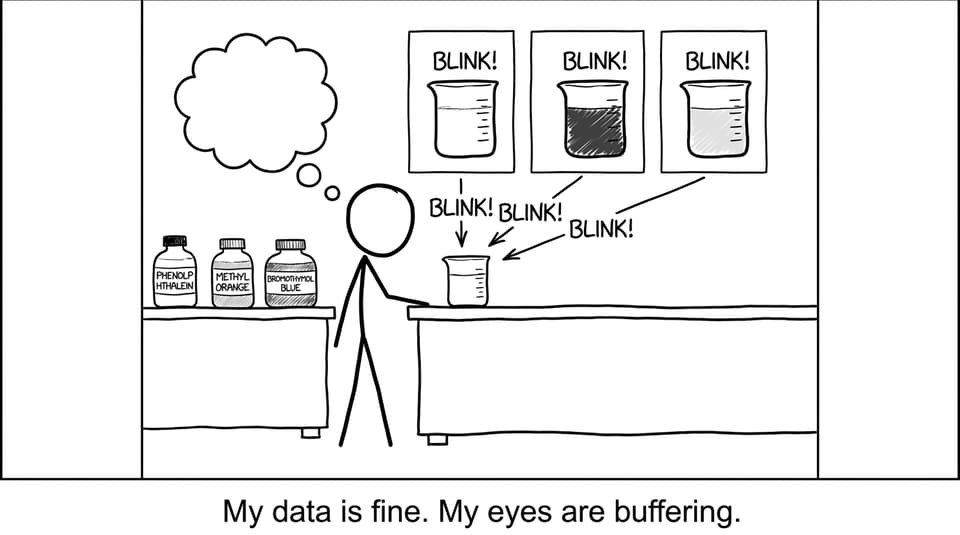
Acid--base indicators in IB Chemistry: a quick checklist
If you remember nothing else, remember this:
-
An acid--base indicator is a weak acid or weak base.
-
It exists as two main forms with different colors.
-
Those forms are linked by an equilibrium.
-
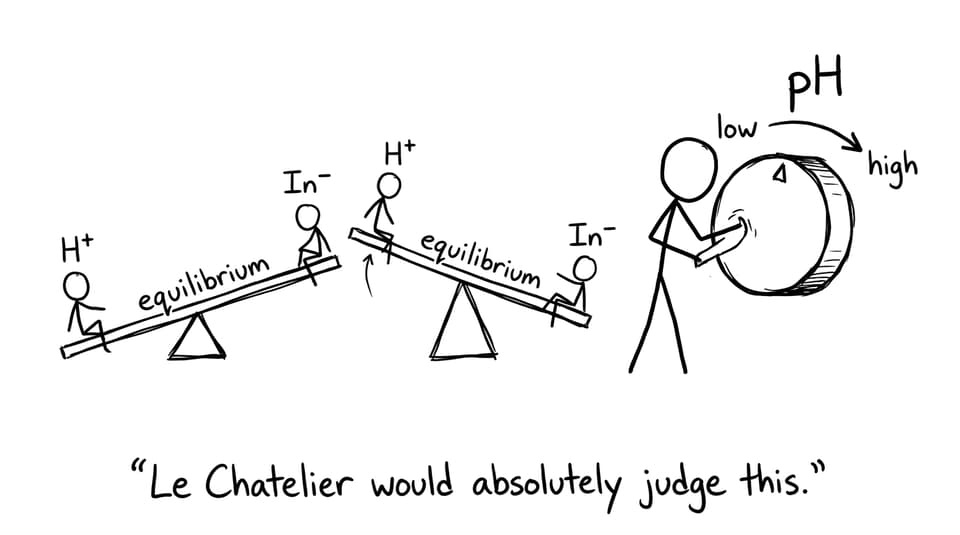
pH shifts the equilibrium position (Le Châtelier), changing the dominant color.
-
The color change happens across a transition range (typically about 2 pH units) centered near the indicator’s pKa.
-
In titrations, you choose an indicator whose transition range overlaps the steep part of the pH curve near the equivalence point.
For syllabus-aligned practice, the Acids and Bases Questionbank is a fast way to turn this into marks.
What an acid--base indicator actually is
In IB Chemistry, an acid--base indicator is usually introduced with a simple definition:
An acid--base indicator is a weak acid (or weak base) that has one color in its protonated form and another color in its deprotonated form.
A common way to write a weak-acid indicator is:
-
HIn (protonated, “acid form”)
-
In⁻ (deprotonated, “base form”)
And yes, the colors depend on the specific molecule. Classic examples you’ll see in IB Chemistry discussions include phenolphthalein, methyl orange, bromothymol blue, and litmus.
If you want the broader acid--base foundations that sit underneath this, review 8.2 Properties of acids and bases Notes alongside your class notes.
The equilibrium behind the color shift (the core IB Chemistry idea)
Indicators work because they establish an equilibrium in water:
[\text{HIn} \rightleftharpoons \text{H}^+ + \text{In}^-]
That single reversible arrow is the whole story.
-
In acidic solution, ([H^+]) is high, so equilibrium shifts left. More HIn forms, so you see the acid-form color.
-
In basic solution, ([H^+]) is low (equivalently, ([OH^-]) is higher), so equilibrium shifts right. More In⁻ forms, so you see the base-form color.
This is why indicators are an equilibrium topic disguised as a “colors” topic. If you’re brushing up on equilibrium constants and acid strength, pair this with Ka and Kb Explained for IB Chemistry.
Why the two forms have different colors
Students sometimes try to memorize indicator colors like a vocabulary list. But IB Chemistry exam questions often reward the “why.”
The protonated and deprotonated forms have different molecular structures and electron distributions. In many indicators, deprotonation increases electron delocalization across the molecule. That changes the energy gap between electronic states, which changes what wavelengths of visible light are absorbed, and therefore what color your eye perceives.
So the color change is not “because pH is low.” It’s because pH changes the relative amounts of two species that absorb light differently.
Transition range: why indicators change over a range (not a point)
Each indicator has a transition (working) range, usually around 2 pH units wide, centered near its pKa.
Using the indicator equilibrium:
[\text{HIn} \rightleftharpoons \text{H}^+ + \text{In}^-]
-
When pH (\approx) pKa, you have comparable amounts of HIn and In⁻, so you often see a blended or intermediate color.
-
When pH < pKa - 1, HIn dominates (acid color).
-
When pH > pKa + 1, In⁻ dominates (base color).
This also explains a common IB Chemistry misconception: indicators don’t “flip” at one exact pH. Your eyes notice a relatively sudden change because the ratio shifts quickly near pKa, but chemically it’s still a range.
For proton-transfer basics (and better language for Paper 2 explanations), see R3.1 Proton transfer reactions Notes and Conjugate acid-base pairs Notes.
Choosing the right indicator for a titration (where IB Chemistry marks hide)
In titration questions, the indicator should change color where the pH curve is steepest, close to the equivalence point.
Matchups you should be able to justify:
-
Strong acid + strong base: equivalence pH around 7. Indicators like bromothymol blue often work.
-
Strong acid + weak base: equivalence pH is below 7. Indicators like methyl orange are typically suitable.
-
Weak acid + strong base: equivalence pH is above 7. Phenolphthalein is commonly suitable.
-
Weak acid + weak base: pH change near equivalence is not steep. Indicators are unreliable; a pH probe is better.
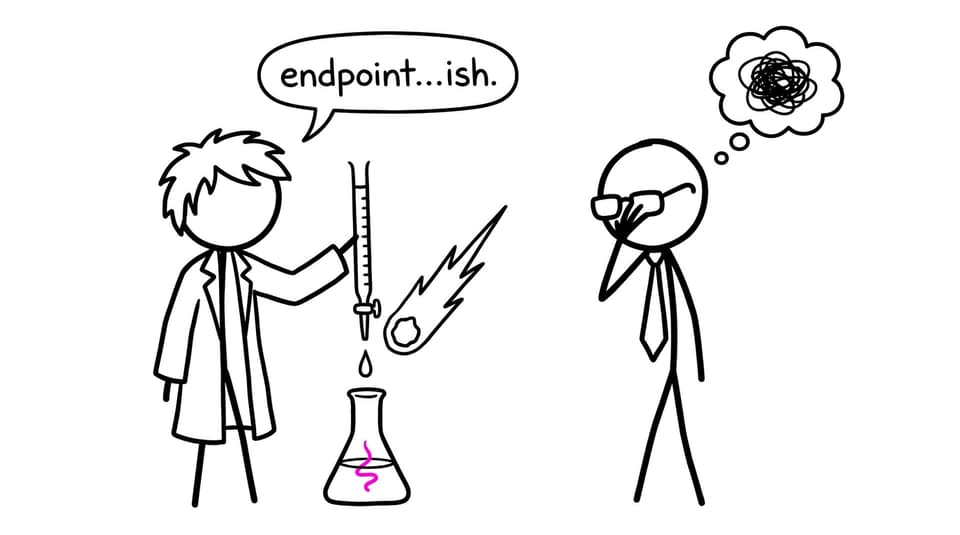
If you want the lab method and the “endpoint vs equivalence point” wording that examiners like, use Titration Explained Step-by-Step and Equivalence Point Explained for IB Titrations.
Two high-yield indicator examples to know
Phenolphthalein
-
Acid form: colorless
-
Base form: pink
-
Transition range: pH 8.2 to 10.0
This is why phenolphthalein pairs well with titrations that have a basic equivalence point (often weak acid + strong base).
Methyl orange
-
Acid form: red
-
Base form: yellow
-
Transition range: pH 3.1 to 4.4
This is why methyl orange is often chosen when the equivalence point is acidic (often strong acid + weak base).
If your understanding of “strong vs weak” feels shaky (it’s a frequent trap in IB Chemistry), revisit Strong and weak acids and bases Notes.
A calm way to revise this for IB Chemistry exams
Acid--base indicators reward a particular style of thinking: zoom in close enough to see molecules and equilibria, then zoom out to see a titration curve and an exam question.
If you want to train that skill, RevisionDojo is built for it: use the Study Notes to lock down the definitions, the Flashcards to keep transition ranges and key ideas active, and the Questionbank to practice indicator-selection questions until the reasoning feels automatic. When you get stuck, AI Chat helps you rewrite your explanation in examiner-friendly language, and Grading tools can highlight what your answer is missing. When exam season tightens, Mock Exams, Predicted Papers, the Coursework Library, and Tutors help you stay honest about timing and depth.
Indicators may look like a color trick. In IB Chemistry, they’re really a quiet lesson in equilibrium--and once you see that, titration questions start to feel a lot less mysterious.