

In IB Chemistry, the most painful titration mistakes rarely come from “bad maths.” They come from a tiny misunderstanding that quietly ruins everything else: you think you’ve found the moment the reaction is complete, but you’ve actually found a color change that happens nearby.
That gap between what’s true in theory and what you see in the flask is where marks go missing.
What the equivalence point actually means in IB Chemistry
The equivalence point is the moment in a titration when the moles of titrant added have reacted exactly with the moles of analyte present, according to the balanced equation.
In other words, the reactants have met in the correct stoichiometric ratio. No “almost.” No “it looks right.” Just chemistry.
A simple example (1:1 neutralization):
At the equivalence point:
- moles of HCl initially in the flask = moles of NaOH added from the burette
This idea shows up everywhere: strong acid/strong base, weak acid/strong base, strong acid/weak base, and (at HL) even when you move beyond acid-base into other titration types.
If you want a broader walkthrough of technique and reading burettes, keep Titration Explained Step-by-Step open beside your notes.
Quick checklist: how to spot equivalence point questions
Use this mini-checklist when an IB Chemistry question mentions titration curves or indicators:
-
Do I have a balanced equation (and mole ratio)?
-
Is the question asking for equivalence point (stoichiometry) or endpoint (indicator)?
-
Is it a strong/weak acid/base combination (so the pH at equivalence changes)?
-
Am I being asked to choose an indicator based on a pH range?
For definition clarity, RevisionDojo’s IB Chemistry Key Definitions is a fast reference.
Equivalence point vs endpoint (the exam trap)
These two words sound like twins. In practice, they behave like cousins who only meet at weddings.
Equivalence point
-
A theoretical point defined by stoichiometry
-
Found via calculation or by analyzing the curve
-
Occurs at a specific pH depending on acid/base strengths
Endpoint
-
The observed point where the indicator changes colour
-
An experimental approximation of the equivalence point
-
Can be slightly before or after the true equivalence point
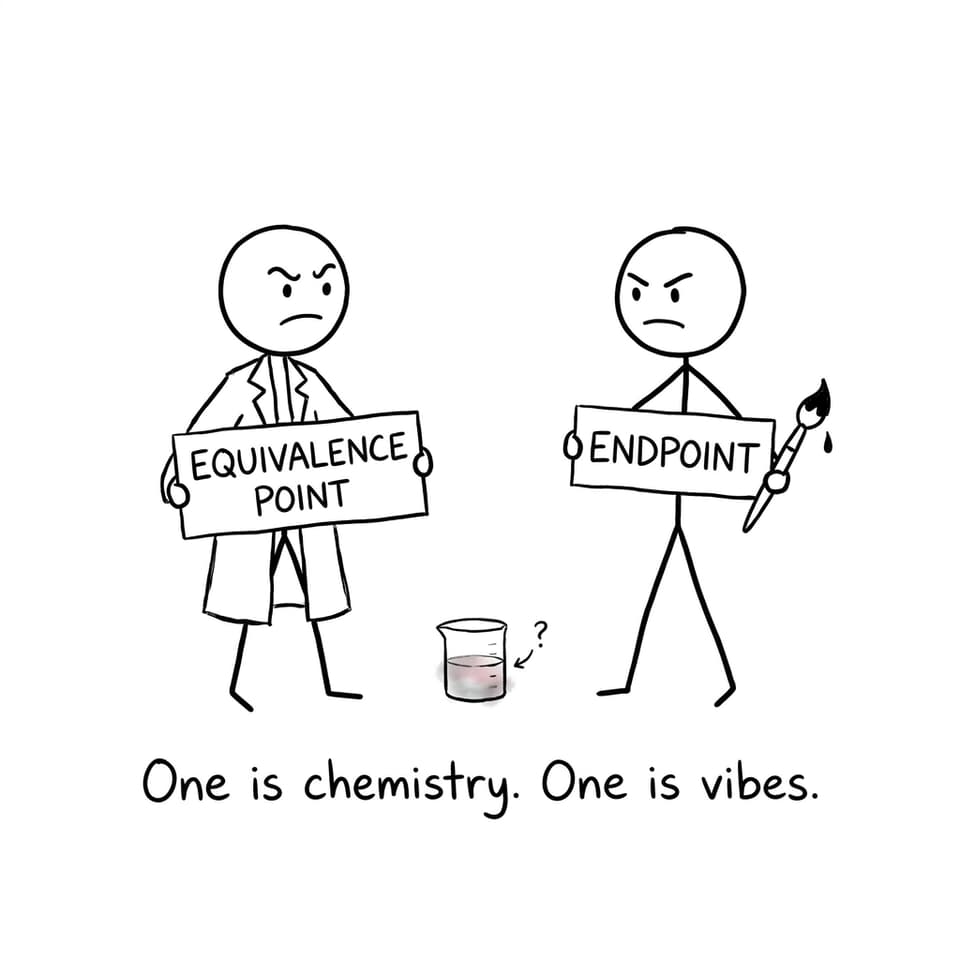
A good titration is basically you trying to make the endpoint land as close as possible to the equivalence point.
Why the pH at equivalence is not always 7 in IB Chemistry
A lot of students carry “equivalence point = pH 7” like a superstition. It’s only reliably true for strong acid + strong base.
Strong acid + strong base
-
Salt does not hydrolyze meaningfully
-
Equivalence point is ~pH 7
Weak acid + strong base
-
You form a basic conjugate base
-
Equivalence point is greater than 7
Strong acid + weak base
-
You form an acidic conjugate acid
-
Equivalence point is less than 7
Weak acid + weak base
-
No dramatic vertical jump
-
pH depends on (K_a) and (K_b)
-
Indicators often become unreliable; a pH probe is better
To deepen curve interpretation for different combinations, see pH Curves of Acid-Base Combinations (HL Notes).
How to find the equivalence point on a titration curve
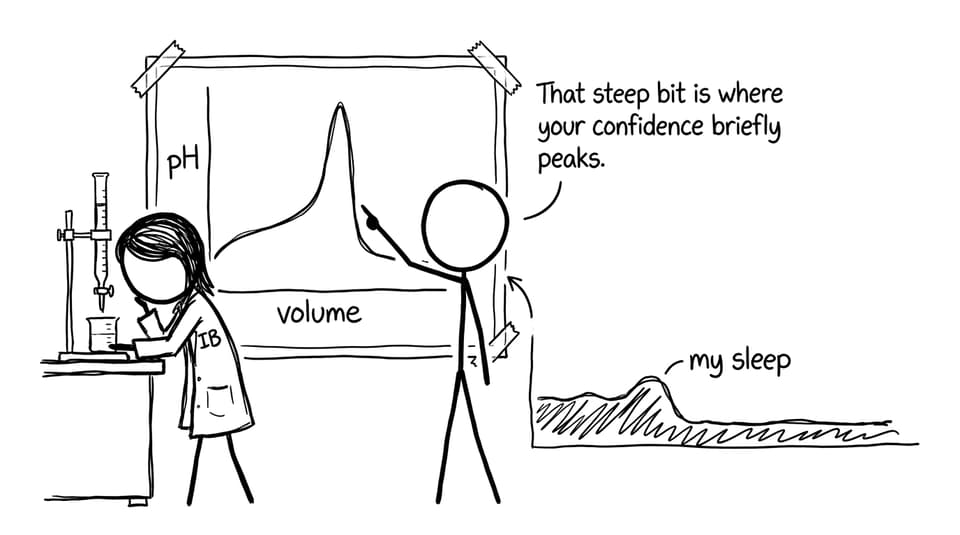
On a pH vs volume curve, the equivalence point sits at the midpoint of the steep vertical region (the sharp rise or drop).
A practical way to do it in exams:
-
Find the section where pH changes most rapidly
-
Identify the “middle” of that near-vertical leap
-
Read the corresponding volume (and sometimes pH)
This is exactly why many data-based questions ask you to explain “why the pH changes sharply near the equivalence point”: it’s the moment when small extra amounts of titrant finally stop being buffered by excess analyte.
For targeted curve practice, the Acids and Bases Questionbank (SL/HL) is built for this style of prompt.
Indicators: matching transition range to equivalence point
Indicators change colour over a range, not at a single pH. So the rule is:
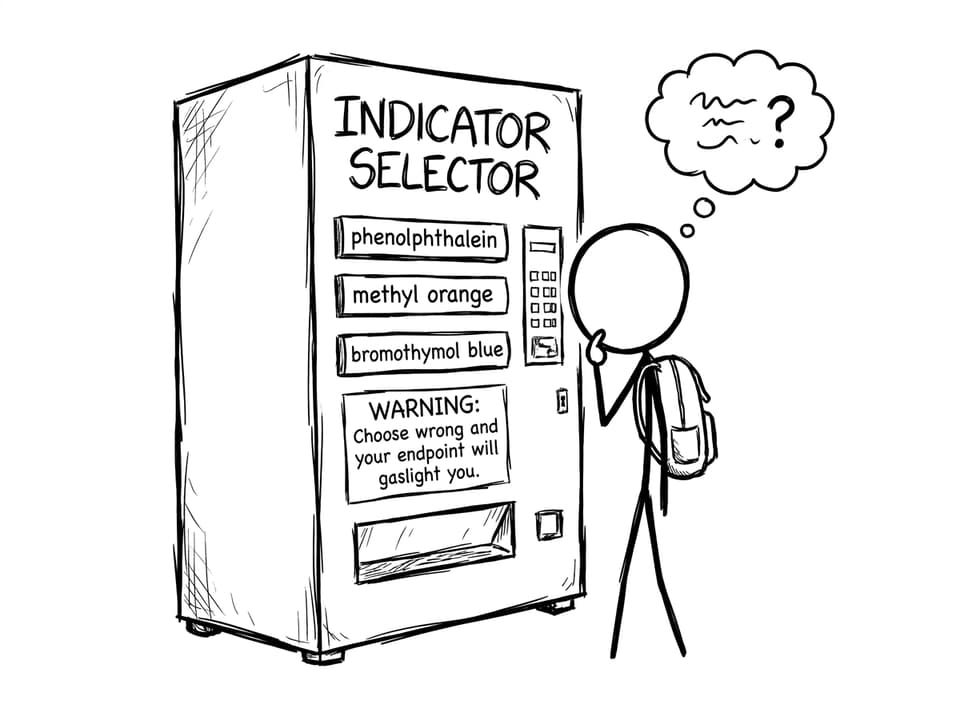
Choose an indicator whose transition range overlaps the steep region around the equivalence point.
Common matches you should know in IB Chemistry:
-
Phenolphthalein (pH ~8.2-10): good for weak acid + strong base
-
Methyl orange (pH ~3-4.4): good for strong acid + weak base
-
Bromothymol blue (pH ~6-7.6): good for strong acid + strong base
For the “why” behind those choices (and how indicators work chemically), read How Acid-Base Indicators Work and, for HL detail, Acid-Base Indicators and pH Changes (HL).
When indicators aren’t enough: pH probes and conductometry
Some titrations don’t reward “eyeballing.” If the curve doesn’t have a sharp vertical region, an indicator endpoint can drift.
In those cases, IB questions may mention:
-
pH-meter detection: gives a full curve so you can identify equivalence point more precisely
-
Conductometric approaches (HL contexts): uses conductivity changes rather than colour
If you want exam-style prompts that combine curves, equivalence point volume, and explanation, use R3.1 Proton Transfer Reactions Questionbank.
Closing thoughts: make the equivalence point your anchor
The equivalence point is the quiet anchor of IB Chemistry titrations: once you understand it as a stoichiometric truth (not a colour moment), indicator choice, curve interpretation, and calculation questions start to feel like variations of the same story.
If you want to turn that story into marks, RevisionDojo helps you train it from multiple angles: Study Notes for concepts, Flashcards for quick recall, the Questionbank for exam-style repetition, AI Chat for “why is this pH not 7?” moments, Grading tools for feedback, and Mock Exams and Predicted Papers to test timing and accuracy.
For more topic support, browse IB Chemistry posts and keep IB Chemistry titrations as one of your highest-return revision targets.