


A week before exams, a lot of IB Math revision starts to sound the same.
“Today I’ll do calculus.”
“Tomorrow I’ll do statistics.”
“On Friday I’ll review vectors.”
It feels organised. It also quietly creates the exact problem that makes IB Math hard: you train your brain to think in chapters, while the exam tests your ability to think in connections.
The students who consistently score well don’t have bigger brains or secret formulas. They have a mental web. When they see an unfamiliar question, they don’t panic. They look for what it connects to.
This guide shows you how to build concept connections for IB Math success (AA or AI) using a simple mapping habit, targeted practice, and RevisionDojo tools that turn isolated revision into an integrated system.
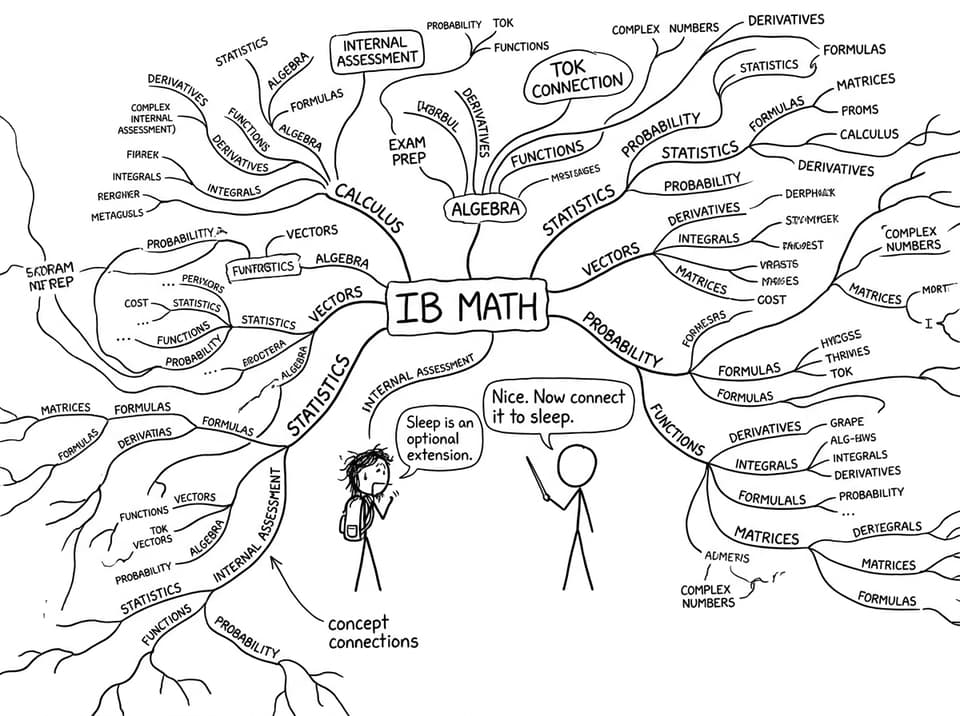
Concept connections: a quick checklist for IB Math
If you want concept connections to actually show up under time pressure, keep this checklist simple:
-
Choose your course focus: IB Math AA or IB Math AI.
-
Identify 4-6 “anchor ideas” that appear everywhere.
-
For each topic you revise, write two links to other topics.
-
Practice mixed-topic questions weekly, not just at the end.
-
Use active tools (Questionbank, Flashcards, AI Chat) instead of rereading.
-
Review mistakes by asking: “What connection did I miss?”
If you do this consistently, the IB exam starts to feel less like surprise and more like recognition.
Why concept connections matter in IB Math
IB Math is not a set of independent tricks. It’s the same few ideas wearing different clothes.
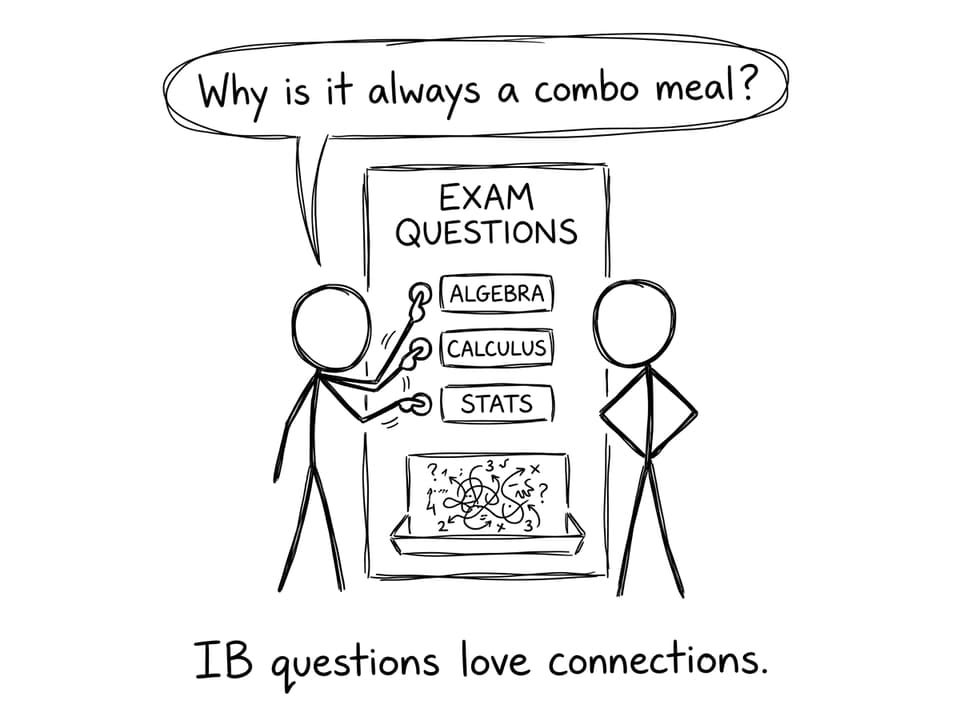
Examiners love questions that reward transfer: you take a method from one unit and apply it inside another. That’s why students who study in isolation often say, “I understood the chapter, but I didn’t recognise the question.”
Concept connections help you:
-
Spot familiar structure fast (even when the context is new)
-
Solve multi-step problems more efficiently
-
Remember methods longer because they’re stored with meaning
-
Reduce errors from “topic confusion” (using the right tool in the wrong place)
A useful mindset: the IB isn’t asking, “Do you know calculus?” It’s asking, “Do you know when calculus is the right language?”
The five anchor ideas that connect most IB Math topics
When you feel lost, come back to anchors. Anchors are ideas that show up across the syllabus again and again.
Functions as the central hub
Nearly everything in IB Math can be framed as a function: inputs, outputs, behaviour, and interpretation. Even statistics becomes easier when you see regression as “choosing a function that fits data.”
If you’re revising AA, start with the core structure of functions using the IB Mathematics Analysis and Approaches Resources. If you’re in AI, the broader applied overview in Mathematics Applications & Interpretation (AI) makes the same hub visible through modelling.
Change (rates) connects algebra to calculus to modelling
Derivatives are not a unit. They’re a way of talking about change. Once you store that meaning, you’ll connect:
-
turning points (algebra/graphs)
-
optimisation (calculus)
-
real-world rate problems (modelling)
Space and representation (geometry, vectors, graphs)
Geometry becomes much less memory-heavy when you treat it as representation: coordinates, vectors, transformations, and diagrams describing the same reality.
A focused bridge is in How to Connect Vectors and Geometry in IB Math AA.
Uncertainty links probability, statistics, and calculus (yes, calculus)
In AI especially, probability and statistics are everywhere. But even in AA, ideas like area-under-curve thinking and distributions connect to integration and function behaviour.
Patterns and structure (sequences, algebraic manipulation, symmetry)
Patterns are the quiet engine behind algebraic fluency. When you see structure, you simplify faster, spot factorisations, and avoid unnecessary calculator dependence.
How to build IB concept connections (a practical method)
You don’t need an artistic mind map. You need a repeatable process.
Start with a “two-link rule”
Each time you revise a topic, force two connections:
-
One connection to a topic you already feel confident in
-
One connection to a topic that still feels shaky
Example:
-
Quadratics connect to graph features (turning points, intercepts)
-
Quadratics connect to optimisation in calculus (max/min)
This is how IB revision becomes cumulative instead of repetitive.
Use mixed practice early, not late
Most students wait until the final weeks to do mixed questions. That’s backwards. Mixed practice is what creates connections.
RevisionDojo’s Comprehensive IB Question Bank is built for exactly this: you can filter by topic when you’re learning, then deliberately mix topics when you’re connecting.
A concrete way to do it:
-
20 minutes: one weak subtopic
-
20 minutes: one related subtopic
-
20 minutes: mixed set that forces a choice between them
If you’re in AA and want a clean entry point into calculus practice, use IB Mathematics Analysis and Approaches Topic Calculus Questionbank.
Turn your mistakes into connection prompts
The fastest way to build concept connections is to study your own errors like data.
After any practice set, ask:
-
What did I think the question was testing?
-
What was it actually testing?
-
Which connection would have made the correct method obvious?
This is where RevisionDojo’s AI Chat and Grading tools shine: you can paste your attempt, get feedback aligned to IB expectations, and then ask follow-ups like, “What other topics connect to this method?”
Use Notes and Flashcards to store meaning, not just formulas
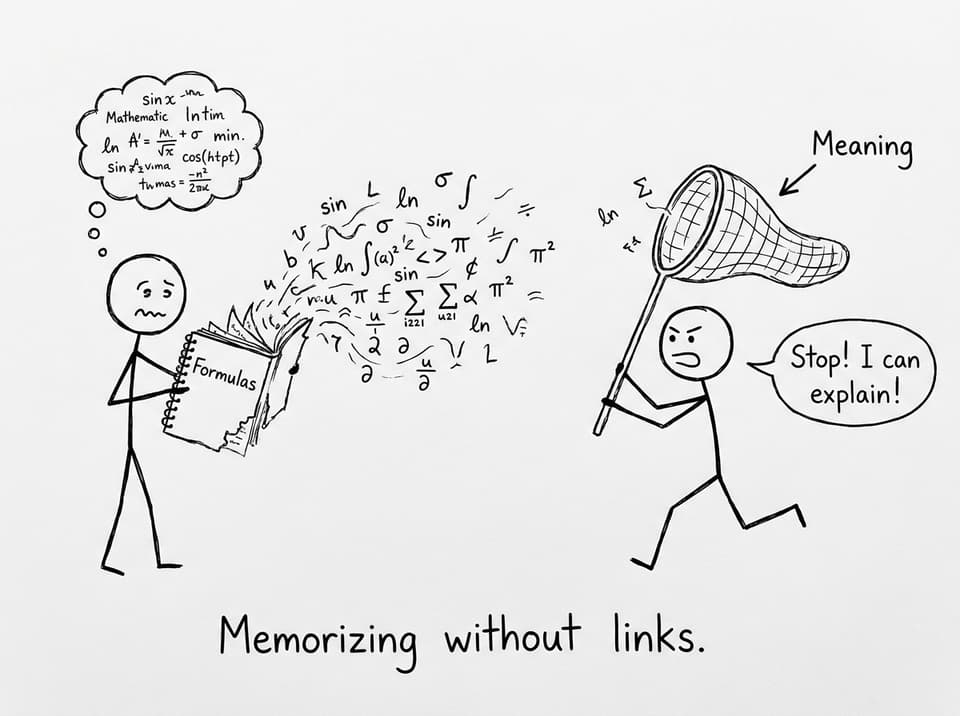
Formulas are cheap in the calculator era. Meaning is expensive.
A strong connection habit is:
-
read a short explanation
-
do one worked example
-
convert it into a “why” flashcard
If you’re in AI, the approach in How to Use RevisionDojo Notes to Simplify IB Math AI Concepts pairs well with Flashcards because it keeps definitions tied to interpretation.
And if you need a bigger picture of how IB maths is organised, keep IB Maths Syllabus: Student-Friendly Breakdown open while you map links.
A simple weekly routine to make connections stick
You can do all of this without adding more hours. You just change the order.
Connection-building weekly plan
-
Day 1: Learn and summarise one topic using Study Notes (keep it concise).
-
Day 2: Drill that topic in the Questionbank (accuracy first).
-
Day 3: Add one connected topic and do a mixed set.
-
Day 4: Create or review Flashcards (definitions, interpretations, triggers).
-
Day 5: Timed mini-mock using Mock Exams or Exam-style sets.
-
Day 6: Error review + rebuild your concept links.
-
Day 7: Light recap, then rest.
If you want guidance on building depth (not just speed), pair this with How to Build Conceptual Understanding in IB Math AA and How to Use RevisionDojo Lessons for Deep Understanding.
RevisionDojo also supports the “full-stack” IB workflow: Predicted Papers and Mock Exams for realism, Coursework Library for strong IA direction, and Tutors when you need a human to diagnose what you can’t yet see.
Conclusion: think like the IB exam writes questions
The turning point in IB Math usually isn’t a new resource or a longer study day. It’s the moment you stop treating topics as separate rooms and start treating them as one building with hallways.
Build the hallways: functions to calculus, algebra to probability, graphs to interpretation, geometry to vectors. Then practise in a way that forces you to walk those paths.
When you’re ready to make that shift, RevisionDojo is the cleanest place to do it: Study Notes for clarity, Flashcards for recall, Questionbank for high-quality practice, AI Chat and Grading tools for feedback, and Mock Exams plus Predicted Papers to rehearse the real exam feeling.
Your goal isn’t to “cover everything.” Your goal is to connect everything. That’s how IB Math starts to feel solvable.